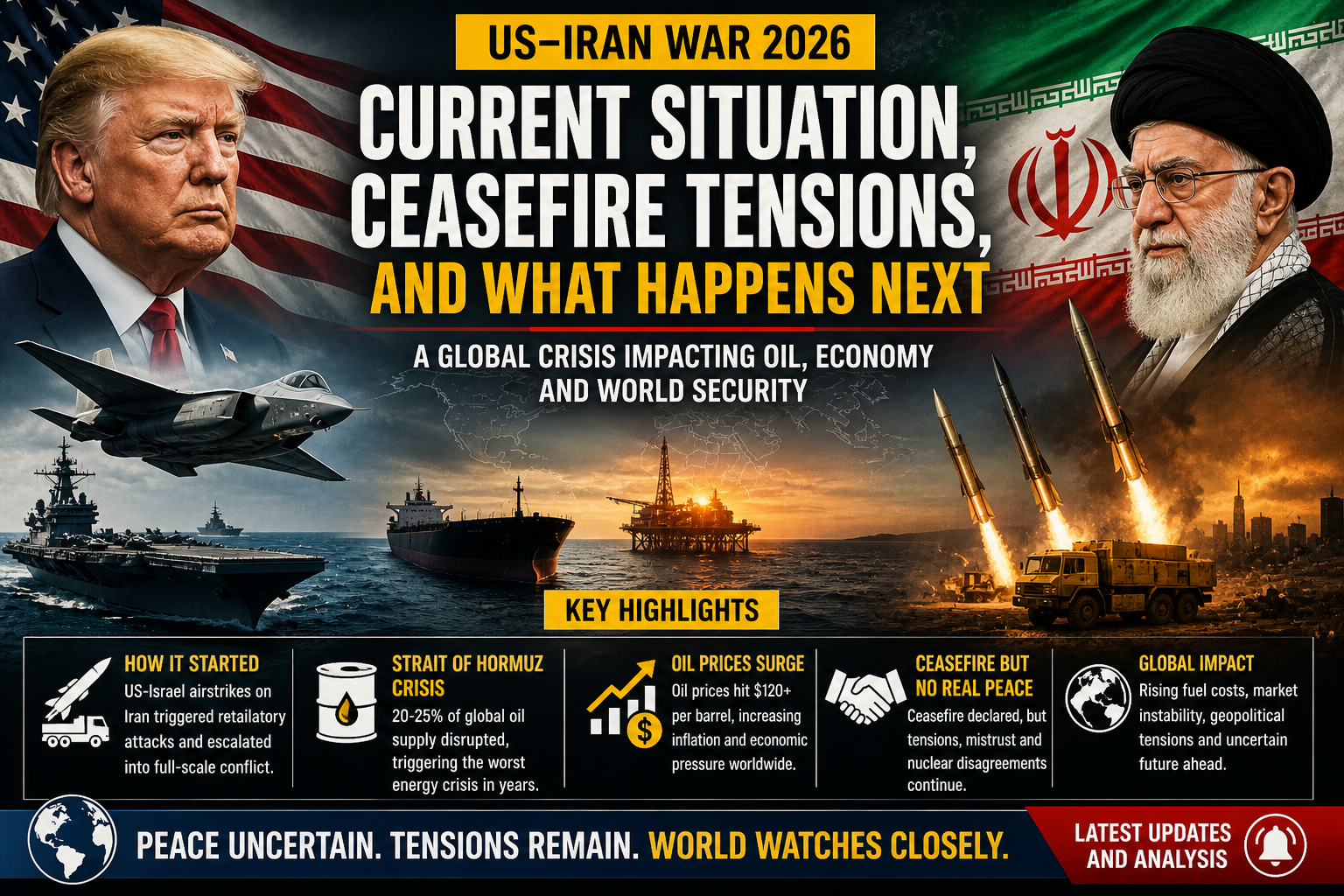
The ongoing conflict between the United States and Iran in 2026 has become one of the most critical geopolitical crises in recent years.
While a temporary ceasefire has been announced, the situation remains unstable, with tensions continuing to affect global markets, energy supply, and international diplomacy.
How the US–Iran War Started in 2026
The war began on February 28, 2026, when the United States, along with Israel, launched airstrikes on Iranian military and government targets.
Iran responded with:
- missile attacks
- drone strikes
- attacks on US bases and allies
- closure of the Strait of Hormuz
This escalation quickly turned into a full-scale regional conflict.
As of May 2026:
- A ceasefire was declared in early April
- The US claims hostilities have been “terminated”
- However, political disagreement continues within the US government
- Tensions remain high, with no final peace agreement
According to reports, thousands have died and millions have been displaced due to the conflict.
Even with the ceasefire, both sides remain in a strategic standoff, especially over trade routes and nuclear concerns.
The Strait of Hormuz Crisis: Why It Matters
The biggest global impact of this war revolves around the Strait of Hormuz.
- Around 20–25% of global oil supply passes through this route
- Iran restricted and controlled passage
- The US attempted to reopen and secure the route
This disruption triggered what experts called:
“the largest global energy supply disruption in history”
Oil Prices and Global Economic Impact
The war has had a massive effect on global markets:
- Oil prices surged to $120+ per barrel
- Inflation fears increased worldwide
- Shipping routes disrupted
- Energy costs surged globally
Countries like:
- India
- China
- Japan
are heavily affected due to reliance on Middle Eastern oil.
Military Standoff: Why the War Has Not Ended
Despite the ceasefire, the war has not fully ended.
Key reasons:
1. Nuclear Disagreement
The US demands Iran stop uranium enrichment
Iran refuses without guarantees
2. Strategic Control
Iran wants control over regional routes
The US wants free navigation
3. Political Divide in the US
Congress remains divided over continuing the war
4. No Trust Between Both Sides
Negotiations have failed multiple times
Global Consequences of the Conflict
This war is not just about two countries.
It has triggered:
- global inflation pressure
- fuel shortages
- geopolitical instability
- increased military presence in the Middle East
- rising tensions involving multiple countries
The conflict has also affected international trade and supply chains significantly.
Is the War Really Over?
The official claim suggests hostilities have stopped.
But reality shows:
- ceasefire ≠ peace
- tensions remain active
- negotiations have failed
- military readiness continues
This makes the current situation:
“a paused conflict, not a resolved one”
What Happens Next? (Future Outlook)
Experts believe three possible scenarios:
1. Prolonged Standoff (Most Likely)
- no major war
- no full peace
- continued tension
2. Full Escalation
- if ceasefire breaks
- could lead to wider Middle East war
3. Diplomatic Resolution
- unlikely in short term
- requires major concessions
Conclusion
The 2026 US–Iran war has reshaped global geopolitics, energy markets, and international relations.
While a ceasefire has reduced active fighting, the conflict is far from over.
The world now faces a fragile situation where:
- peace is uncertain
- tensions remain
- economic impact continues
The coming months will determine whether this becomes a long-term geopolitical standoff or a larger global crisis.
FAQs
Is the US–Iran war over in 2026?
No, a ceasefire exists but tensions and conflict risks remain.
Why is the Strait of Hormuz important?
It carries about 20–25% of global oil supply, making it critical for energy security.
How has the war affected oil prices?
Oil prices have surged above $120 per barrel due to supply disruptions.
What caused the US–Iran war?
It began with US-Israel airstrikes on Iran and escalated through retaliatory attacks.