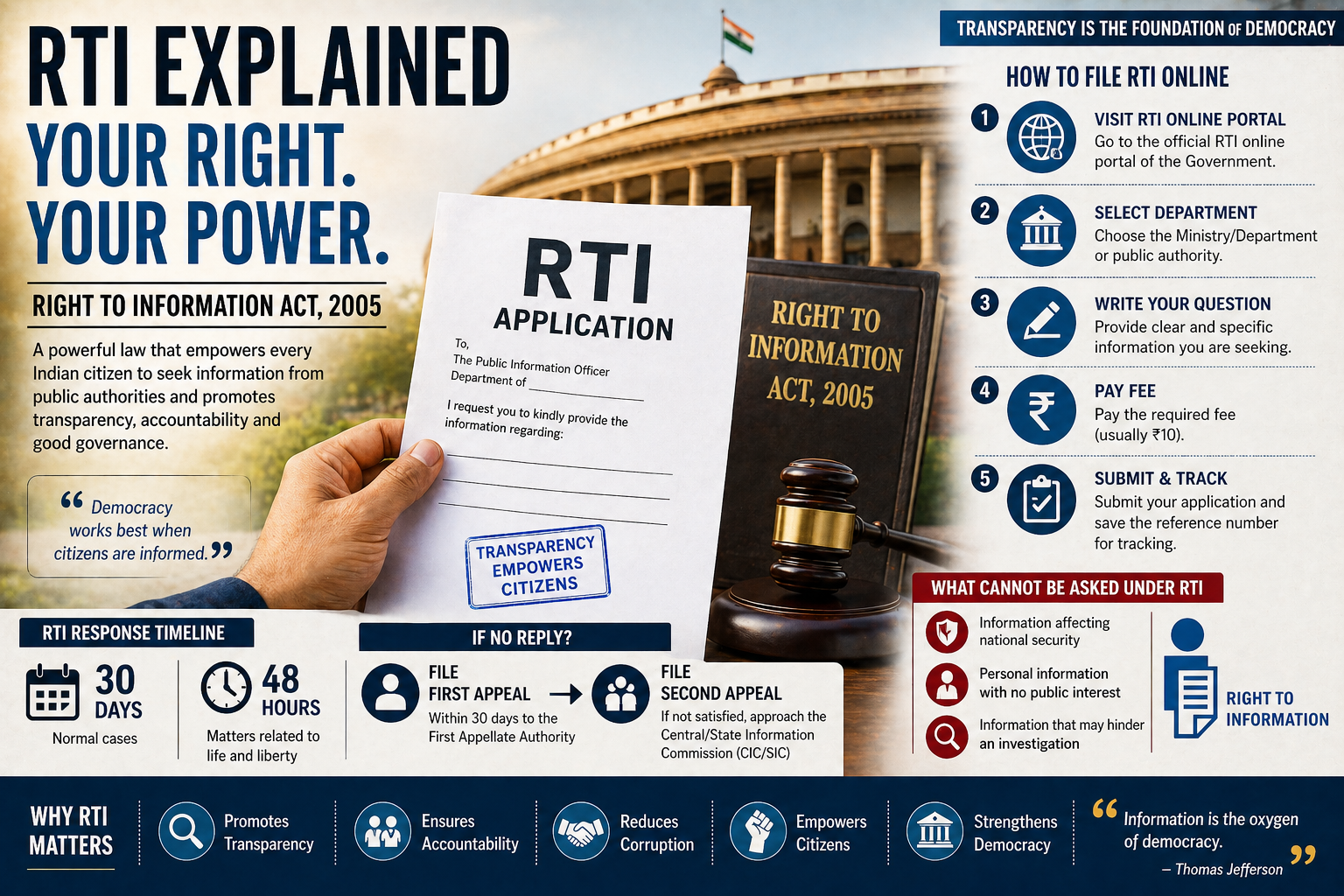
The Right to Information (RTI) Act, 2005 is one of the most important laws in India that empowers citizens to seek information from public authorities.
In simple words, RTI gives every Indian citizen the legal right to ask:
- what decision was taken
- why it was taken
- who approved it
- how public money was spent
- status of pending files
- copies of official documents
This law is widely regarded as a cornerstone of democracy because it promotes transparency, accountability, and citizen empowerment.
What Is RTI?
RTI stands for:
Right to Information
It is a law that allows citizens to request information from any public authority, including:
- government departments
- ministries
- PSUs
- municipalities
- police departments
- public universities
- सरकारी offices
Under the RTI Act, these bodies are legally required to respond within a prescribed timeline.
Why RTI Is Important
RTI plays a crucial role in strengthening democracy.
It helps citizens ask questions like:
- Where was the budget spent?
- Why is my passport application delayed?
- Why is road construction incomplete?
- What is the status of a government file?
- Why was a recruitment result delayed?
Because of RTI, many major public interest issues and corruption cases have come to light over the years.
This is why RTI is often called:
the citizen’s strongest legal tool
Who Can File an RTI?
Any Indian citizen can file an RTI application.
You do not need to be a lawyer.
You do not need any special legal knowledge.
A simple written application is enough.
How to File RTI Online in India (2026 Guide)
This is one of the most searched queries.
Step 1: Visit RTI Online Portal
For central government departments, use the official RTI online portal.
Step 2: Select Ministry / Department
Choose the concerned public authority.
Step 3: Write Your Question Clearly
Example:
“Please provide the status of my passport application filed on 10 March 2026.”
Step 4: Pay Fee
Usually the fee is ₹10.
Step 5: Submit and Save Reference Number
Track it for follow-up.
Several states also provide online RTI filing systems, though implementation varies.
How Long Does RTI Take?
The standard response time is:
30 days
If the matter concerns life or liberty, the information must be provided within:
48 hours
This timeline is one of the key strengths of the Act.
What If No Reply Is Received?
If no response is received within 30 days, you can file:
First Appeal
This must usually be filed within 30 days from the expiry of the response period.
If the first appeal also fails, you can move to:
Second Appeal
before the:
- Central Information Commission (CIC)
- State Information Commission (SIC)
What Information Cannot Be Asked Under RTI
RTI is powerful, but it has limitations.
Certain information may be exempt, such as:
- national security matters
- military deployment secrets
- personal private information
- ongoing investigation-sensitive records
Recent legal and statutory changes have especially affected access to “personal information” under Section 8(1)(j).
This is one of the most important RTI developments in recent years.
RTI in 2026: Important Legal Updates
The RTI framework has seen important developments due to the Digital Personal Data Protection Act (DPDP).
Some categories of personal information now face stricter disclosure rules.
This means RTI applications involving:
- personal data
- income details
- private records
may now be more carefully scrutinized.
For example, courts have clarified that RTI is not meant for private litigation disputes such as spouse tax return requests
Why RTI Still Matters in 2026
Despite changes, RTI remains one of the most powerful tools for citizens.
It helps in:
- exposing corruption
- speeding up public services
- ensuring file movement
- demanding transparency
- tracking public spending
Even today, thousands of applications are filed every day across India
Best RTI Questions to Ask
Examples:
- Status of government application
- Reason for service delay
- sanctioned budget copies
- tender award details
- road construction timeline
- recruitment result file status
This section targets long-tail search keywords.
Conclusion
The Right to Information Act remains one of the strongest democratic tools available to Indian citizens.
Whether you want to know the status of an application, understand government spending, or demand accountability, RTI gives you that legal right.
In 2026, understanding RTI is more important than ever because transparency and privacy laws are evolving rapidly.
FAQs
What is RTI in simple words?
RTI is the legal right of citizens to seek information from government authorities.
How much is RTI filing fee?
Usually ₹10.
How many days for RTI reply?
30 days, and 48 hours for life-and-liberty matters.
Can RTI be filed online?
Yes, for many departments and states.