Turkey, Saudi Arabia and Pakistan Sign a New Defence Pact
The geopolitical landscape of the Middle East may be entering another significant phase.
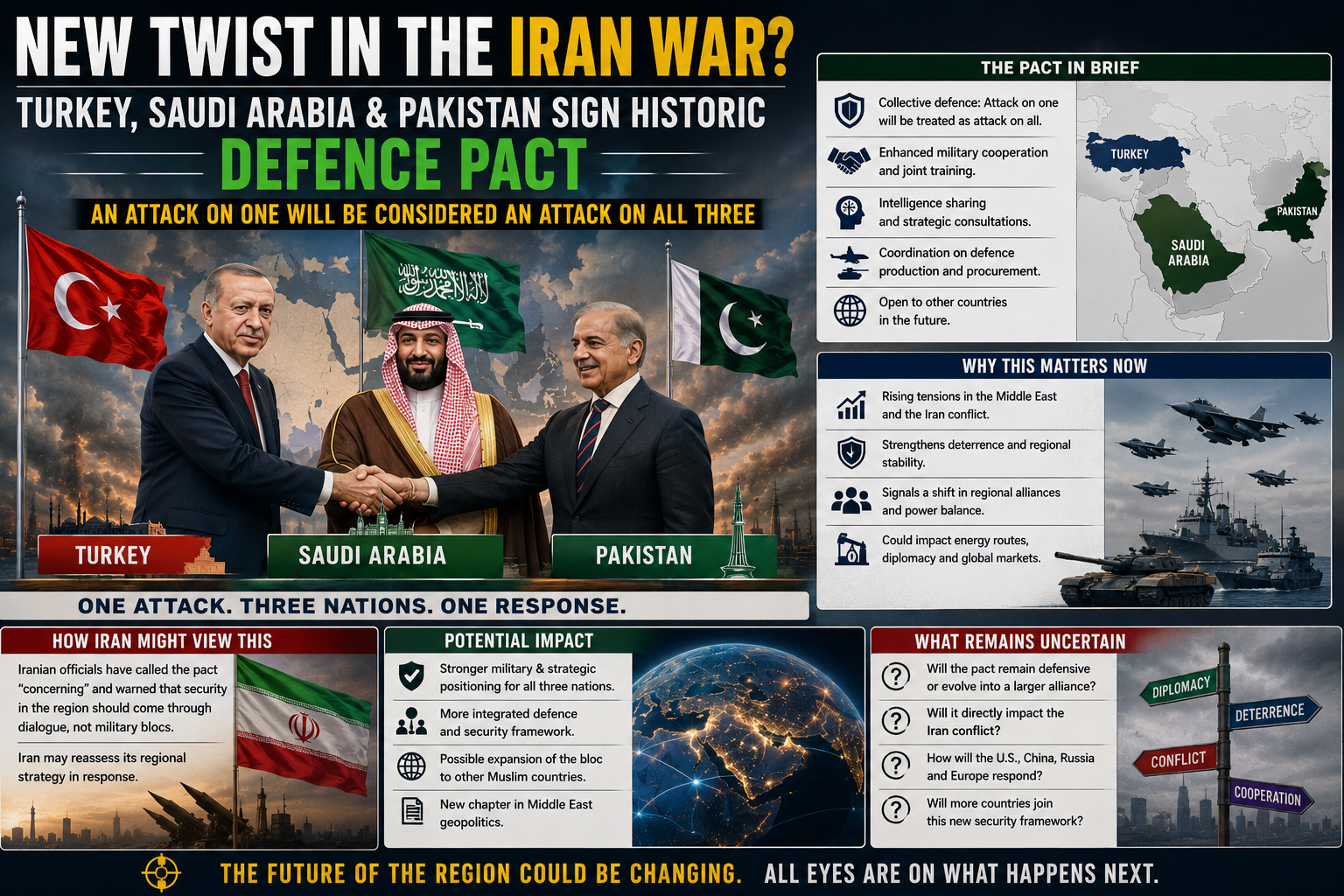
Turkey, Saudi Arabia, and Pakistan have signed the Mecca Joint Defence Agreement, a trilateral security pact under which an armed attack on one member would be treated as an attack on all three. Turkish officials have described the arrangement as broadly comparable to the collective-defence principle found in NATO’s Article 5, while emphasizing that it is intended as a defensive agreement rather than one directed at a specific country.
The agreement comes after months of heightened regional tensions, making it one of the most closely watched diplomatic developments in West Asia.
What Does the Defence Pact Say?
According to public statements, the agreement includes:
- Collective defence commitments.
- Greater military cooperation.
- Joint strategic consultations.
- Coordination on regional security.
- A framework for future institutional cooperation.
Officials have also indicated that the partnership could expand over time to include additional countries.
Why Is This Agreement Significant?
The timing of the agreement has drawn attention because it follows a period of instability involving Iran, maritime security concerns, and broader regional competition.
Whether the pact changes the strategic balance will depend on how it is implemented and how other regional powers respond.
Possible Geopolitical Implications
A New Security Bloc
If the agreement develops into deeper military cooperation, it could become an influential regional security arrangement.
Stronger Defence Coordination
Joint military planning, intelligence cooperation, and defence procurement could become more integrated over time.
A Broader Diplomatic Signal
The agreement may also signal an effort by its members to strengthen regional security cooperation while diversifying strategic partnerships.
How Could Iran View the Development?
Iranian officials and lawmakers have criticized the agreement, arguing that security in the region should be achieved through dialogue rather than new military alignments.
How Tehran ultimately responds will depend on diplomatic developments and the implementation of the pact.
Impact on Regional Security
Several questions are likely to shape future developments:
Will the pact remain primarily defensive?
Will additional countries seek to join?
How will existing regional organizations respond?
Could it encourage greater deterrence, or increase strategic competition?
These questions remain open, and analysts are closely watching how the agreement evolves.
Economic Implications
Any significant shift in Middle East security can have wider economic effects, including on:
- Energy markets.
- Shipping routes.
- Investment confidence.
- Defence spending.
- Regional trade.
The extent of these impacts will depend on future events.
Frequently Asked Questions
What is the new defence agreement?
It is a reported trilateral defence arrangement between Turkey, Saudi Arabia, and Pakistan under which an armed attack on one member would be treated as an attack on all three.
Is the pact officially directed against Iran?
Public statements from Turkish officials describe the agreement as defensive and state that it is not specifically directed at Iran or any other country.
Could more countries join?
Officials have indicated that the framework could expand in the future, though no definitive timeline has been announced.
Conclusion
The new defence agreement between Turkey, Saudi Arabia, and Pakistan represents an important diplomatic development in a region where security dynamics continue to evolve.
Whether it becomes a lasting strategic alliance or remains a limited defence framework will depend on future political decisions, regional diplomacy, and the broader security environment. As events unfold, this agreement is likely to remain a significant topic in discussions about the future of Middle Eastern geopolitics.