Few leaders in modern Indian history have left as deep and lasting an impact as Manmohan Singh.
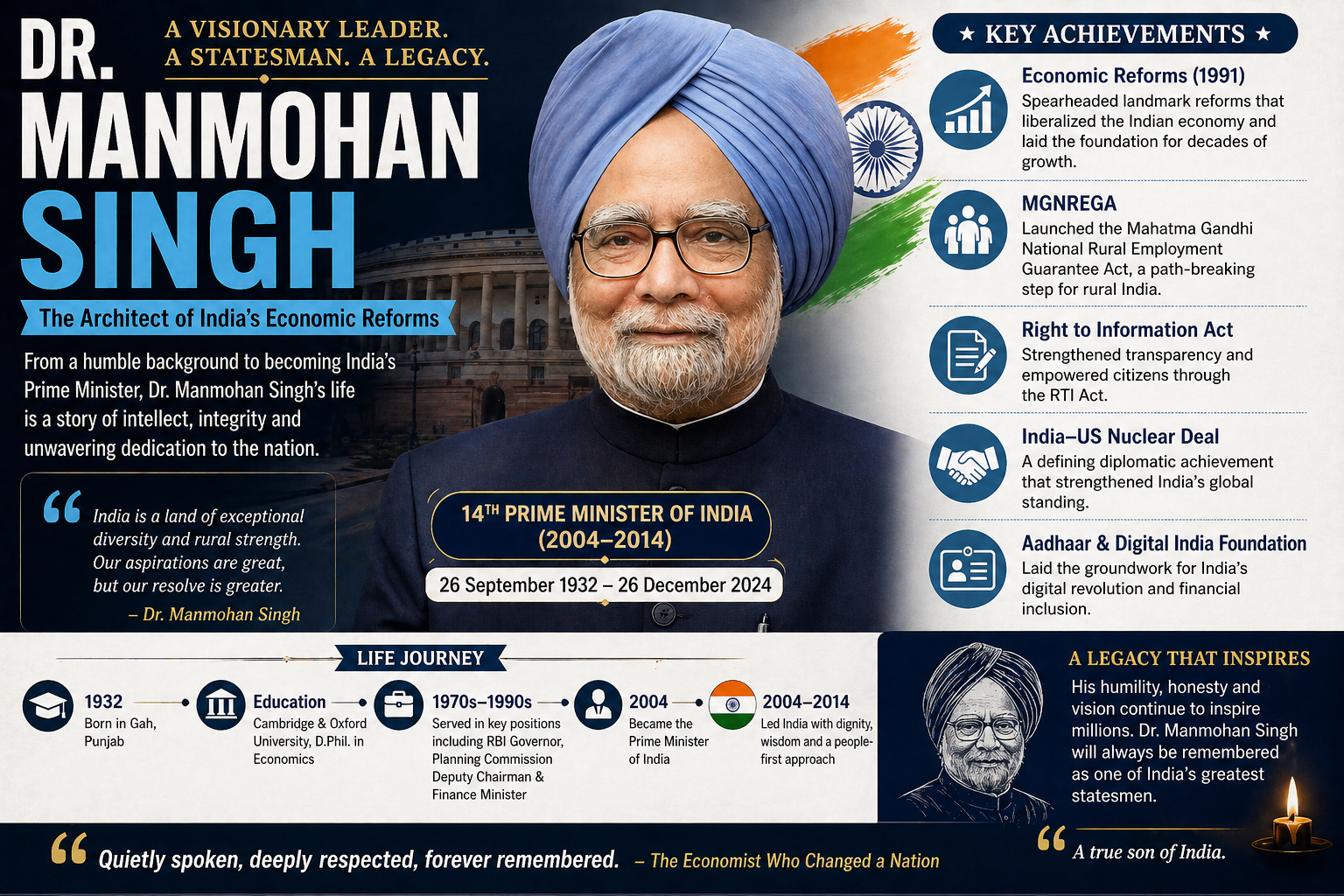
Known for his intellect, humility, and economic vision, Dr. Singh served as India’s 14th Prime Minister from 2004 to 2014 and is widely regarded as the architect of India’s 1991 economic reforms.
His contribution to India’s rise as a global economic power remains one of the most important chapters in the country’s history.
Early Life and Education
Manmohan Singh was born on 26 September 1932 in Gah, in undivided Punjab (now in Pakistan).
After Partition, his family moved to Amritsar.
His academic journey was extraordinary.
He studied economics at:
- Panjab University
- University of Cambridge
- University of Oxford
He earned a D.Phil. in Economics from Oxford, making him one of India’s most academically accomplished prime ministers
The Man Who Changed India’s Economy in 1991
The defining moment of Dr. Singh’s career came in 1991, when India was facing a severe balance-of-payments crisis.
As Finance Minister under P. V. Narasimha Rao, he introduced the landmark reforms that transformed India’s economy.
These reforms included:
- ending the License Raj
- opening India to foreign investment
- reducing import restrictions
- encouraging privatization
- promoting globalization
These changes laid the foundation for modern India’s growth story.
This is why Dr. Singh is often called:
the architect of modern India’s economy
Prime Minister of India (2004–2014)
In 2004, Manmohan Singh became India’s Prime Minister.
He served two consecutive terms, making him one of the longest-serving PMs in Indian history.
His tenure saw:
- strong GDP growth
- welfare reforms
- infrastructure expansion
- global diplomacy
India’s economy grew at 8–9% during several years of his term.
Major Achievements of Dr. Manmohan Singh
1. Economic Liberalization
The 1991 reforms remain his biggest legacy.
2. MGNREGA
His government introduced Mahatma Gandhi National Rural Employment Guarantee Act, one of India’s largest employment guarantee schemes.
3. Right to Information
The RTI Act strengthened transparency and citizen rights.
4. India-US Nuclear Deal
One of his most significant foreign policy achievements was the 2008 India–US Civil Nuclear Agreement.
5. Aadhaar Foundation
The groundwork for India’s digital identity revolution was laid during his tenure.
Leadership Style: Quiet Yet Powerful
Dr. Singh was known for his calm and understated leadership.
Unlike many politicians, he was not known for fiery speeches.
Instead, he was respected for:
- intellect
- honesty
- policy focus
- humility
This earned him immense respect globally.
Former U.S. President Barack Obama described him as a key architect of India’s transformation.
Legacy and Final Years
Dr. Singh passed away on 26 December 2024 at the age of 92 in New Delhi.
His passing marked the end of an era.
Across political lines, leaders paid tribute to him as one of India’s greatest statesmen.
His legacy continues through:
- economic reforms
- welfare legislation
- institutional integrity
- democratic values
Why Dr. Manmohan Singh Will Always Be Remembered
History remembers him for transforming India during one of its toughest economic crises.
He was a leader who proved that:
quiet leadership can change a nation
His life remains an inspiration for students, economists, civil servants, and future leaders.
Conclusion
Manmohan Singh was more than a Prime Minister.
He was a scholar, economist, reformer, and statesman.
From rescuing India’s economy in 1991 to leading the nation for a decade, his contribution to India’s rise remains unmatched.
His legacy will continue to shape India for generations.
FAQs
Why is Dr. Manmohan Singh famous?
He is famous for leading India’s 1991 economic reforms and serving as Prime Minister from 2004 to 2014.
What were Manmohan Singh’s major achievements?
Economic liberalization, MGNREGA, RTI, and the India-US nuclear deal.
When did Dr. Manmohan Singh pass away?
He passed away on 26 December 2024.