Scroll through any government announcement, welfare scheme poster, or public campaign—and a pattern often stands out.
Across many programs and official events, a prominent photo of a political leader is frequently visible.
This observation raises an important and widely discussed question:
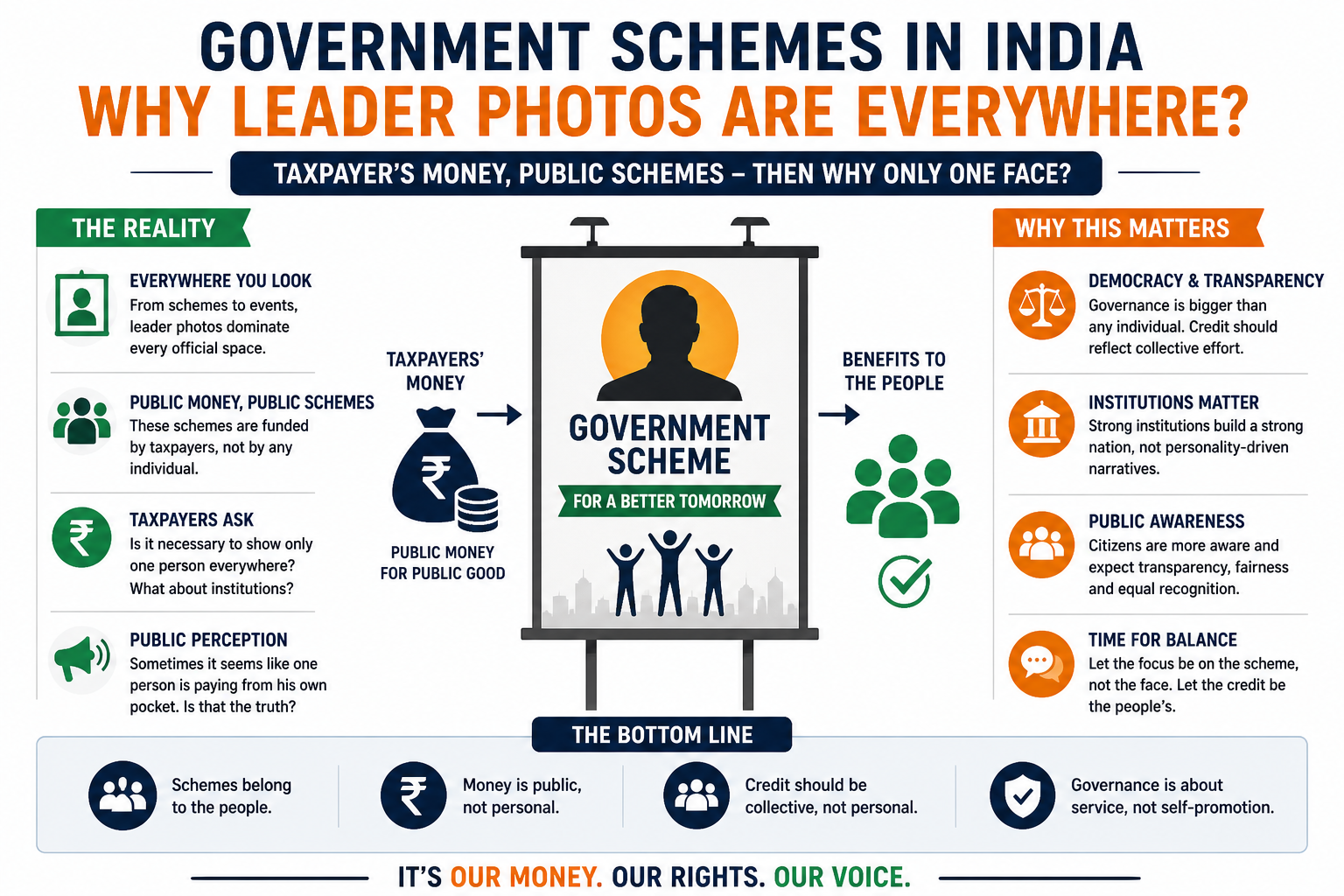
Why do government schemes often highlight a leader’s image, especially when these initiatives are funded by taxpayers?
This blog explores the issue from multiple perspectives—policy, communication strategy, and public perception.
Understanding Government Schemes and Public Funding
Government schemes in India are funded through:
- taxes collected from citizens
- public revenue sources
- national and state budgets
This means:
These programs are essentially funded by the people
They are designed to benefit:
- economically weaker sections
- rural communities
- public infrastructure
- social welfare
The Visible Pattern: Leader-Centric Branding
Many citizens have observed that:
- official posters often feature a single prominent face
- schemes are visually associated with specific leaders
- public messaging emphasizes individual leadership
This has led to growing discussions around branding vs governance.
Possible Reasons Behind Leader Photos in Schemes
There are several explanations for this practice.
1. Political Communication Strategy
Modern governance often uses branding techniques similar to corporate marketing.
- A recognizable face builds trust
- Leadership visibility creates recall
- Messaging becomes more direct and personal
From a communication standpoint, it helps connect policies with leadership.
2. Accountability and Ownership
Supporters argue that:
- showcasing leadership creates accountability
- it signals responsibility for policy implementation
- it helps citizens identify who is leading the initiative
3. Public Recognition and Awareness
In a diverse country, visual communication plays a strong role.
- Images help increase awareness
- familiar faces attract attention
- campaigns become easier to recognize
The Other Side: Public Concerns and Questions
Despite these reasons, many people raise valid concerns.
1. Use of Taxpayer Money
A common question is:
If schemes are funded by public money, why is the focus often on one individual?
Citizens feel that:
- public funds belong to the nation
- credit should reflect collective governance
- institutions matter as much as individuals
2. Perception of Personalization
Some observers feel that:
- repeated imagery creates a perception of personalization
- it may appear as if schemes are individually driven
- the role of institutions may seem less visible
3. Changing Public Expectations
Today’s citizens are more aware and informed.
They often expect:
- transparency
- institutional recognition
- balanced representation
Has This Always Been the Case?
Public communication has evolved significantly over time.
Earlier:
- government messaging was more institutional
- focus was on departments and policies
Today:
- branding plays a larger role
- visual identity is stronger
- communication is more centralized
This shift reflects broader changes in media, technology, and governance styles.
Is This Unique to India?
Not entirely.
Globally, many governments use leadership visibility in communication.
However, the extent and style vary across countries.
Some systems focus more on:
- institutions
- departments
- collective governance
Others emphasize:
- leadership-driven narratives
Balancing Branding and Governance
The key issue is not just about photos—it is about balance.
A balanced approach could include:
- highlighting institutions alongside leadership
- emphasizing collective effort
- ensuring transparency in communication
What Does This Mean for Citizens?
This discussion reflects a broader democratic principle:
Public awareness and questioning are essential for healthy governance
Citizens engaging in such discussions show:
- increasing political awareness
- interest in governance processes
- concern for transparency
Conclusion
The presence of leader photos in government schemes is a complex issue.
It lies at the intersection of:
- communication strategy
- political branding
- public perception
- democratic accountability
Rather than a simple right or wrong, it reflects how governance is presented in the modern era.
Ultimately, the conversation is not just about images.
It is about:
how citizens view ownership, accountability, and transparency in public systems
FAQs
Why do government schemes show leader photos?
Mainly for communication, branding, and public recognition purposes.
Are government schemes funded by taxpayers?
Yes, they are funded through public revenue and taxes.
Is this practice common globally?
Yes, but the extent and style vary across countries.
Why do people question this practice?
Due to concerns about transparency, accountability, and use of public funds.