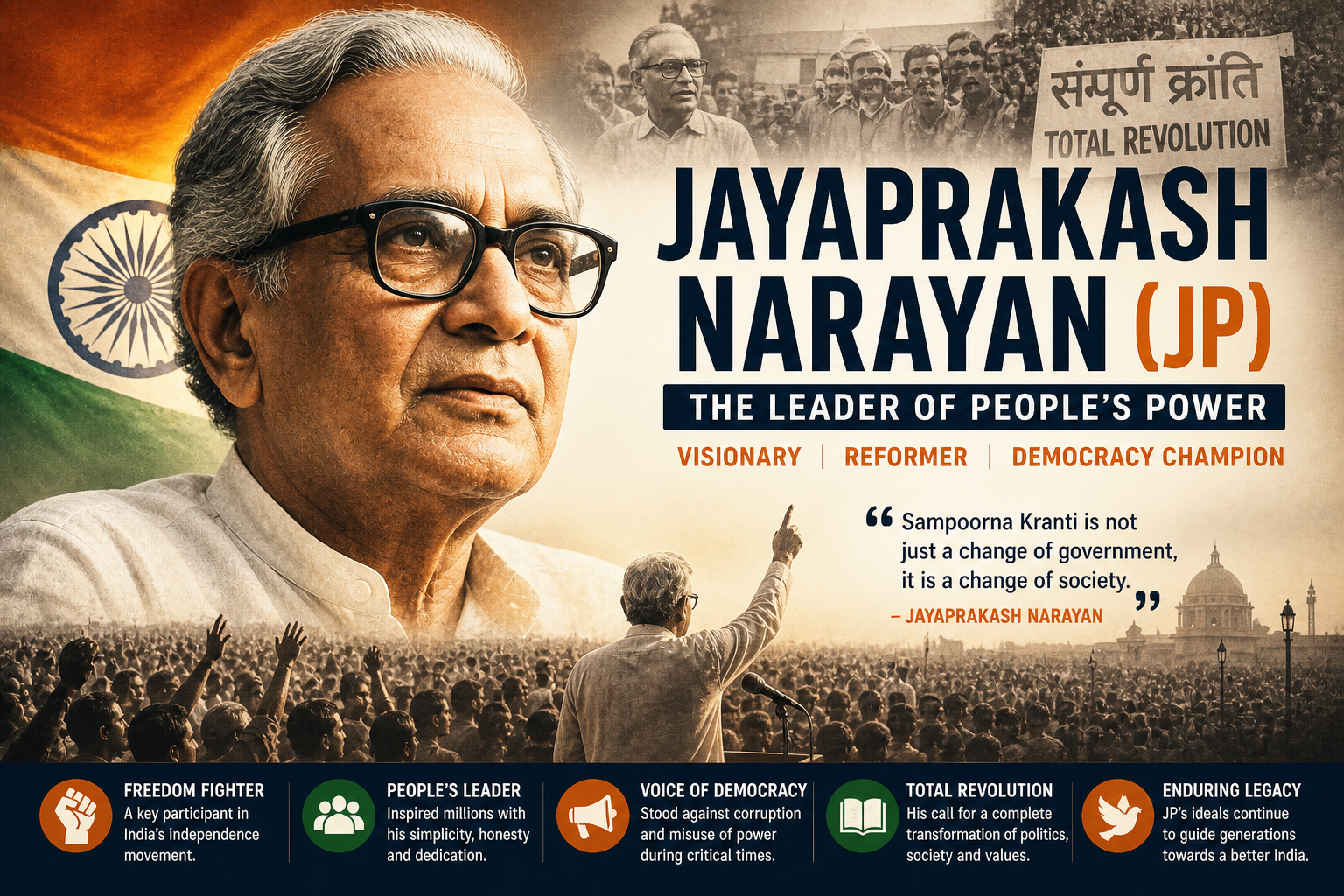
In the history of India, few leaders have had as profound an impact on democratic values as Jayaprakash Narayan, widely known as JP.
He was not just a political leader—he was a symbol of moral authority, people’s power, and democratic resistance.
His call for “Total Revolution” transformed Indian politics and continues to inspire generations.
Who Was Jayaprakash Narayan?
Jayaprakash Narayan (1902–1979) was:
- a freedom fighter
- a socialist thinker
- a mass leader
- a champion of democracy
He played a crucial role in India’s independence movement and later became one of the strongest voices for political reform and accountability.
Early Life and Education
JP was born in Bihar and showed early signs of intellectual curiosity and social awareness.
He studied in the United States, where he was exposed to:
- socialism
- political theory
- global democratic ideas
These experiences shaped his vision for a just and equal society.
Role in India’s Freedom Movement
JP joined the independence struggle alongside leaders like Mahatma Gandhi.
He became part of the socialist movement within the freedom struggle and worked to:
- mobilize youth
- organize resistance
- promote equality
His commitment to freedom was unwavering.
The Concept of “Total Revolution”
One of JP’s most powerful contributions was the idea of:
Total Revolution (Sampoorna Kranti)
This was not just political change.
It included transformation in:
- politics
- society
- economy
- education
- values
JP believed that real change must come from within society, not just through governments.
The JP Movement: A Turning Point
In the 1970s, JP led a mass movement against:
- corruption
- misuse of power
- lack of accountability
The JP Movement became one of the largest public movements in India.
Students, workers, and common citizens joined in large numbers.
Role During the Emergency
During the period of The Emergency in India, JP emerged as a key voice of resistance.
He stood firmly for:
- democratic rights
- freedom of expression
- constitutional values
His leadership helped unify opposition forces and restore democratic processes.
Why Jayaprakash Narayan Is Called a “Lok Nayak”
JP is often referred to as:
Lok Nayak (People’s Leader)
This title reflects:
- his deep connection with citizens
- his moral leadership
- his commitment to public welfare
He chose people over power.
JP’s Ideology: Beyond Politics
JP believed in:
- decentralization of power
- transparency in governance
- ethical leadership
He rejected traditional power politics and focused on people-centric governance.
Legacy of Jayaprakash Narayan
Even today, JP’s influence is visible in:
- democratic movements
- civil society activism
- anti-corruption campaigns
His ideas continue to shape discussions on governance and accountability.
Lessons from JP’s Life
JP’s journey teaches us:
- power should serve people
- democracy requires active participation
- moral leadership matters
- change begins with citizens
Conclusion
Jayaprakash Narayan was more than a leader—he was a movement.
His vision of Total Revolution and his commitment to democracy continue to inspire India.
In a world where power often dominates, JP reminds us that:
true strength lies in the voice of the people
FAQs
Who was Jayaprakash Narayan?
He was a freedom fighter, socialist leader, and key figure in India’s democratic movements.
What is Total Revolution?
A concept introduced by JP for complete transformation of society and governance.
What was the JP Movement?
A mass movement in the 1970s against corruption and misuse of power.
Why is JP important in Indian history?
He played a major role in protecting democracy during critical times.