India and Iran share a long-standing relationship rooted in history, trade, and strategic cooperation.
Over the years, this relationship has evolved through multiple challenges, including international sanctions, shifting global alliances, and changing geopolitical priorities.
But today, a question is being increasingly discussed:
If Iran has supported India in many ways, why does India maintain a cautious or limited public stance?
To understand this, we need to look deeper into the history, economics, and strategic realities behind India–Iran relations.
Historical and Strategic Relationship Between India and Iran
India and Iran have traditionally maintained:
- strong cultural connections
- energy partnerships
- regional cooperation
Iran has been one of India’s key partners in:
- energy security
- connectivity projects
- regional stability discussions
This relationship has often continued even during global tensions.
How Iran Has Supported India Economically
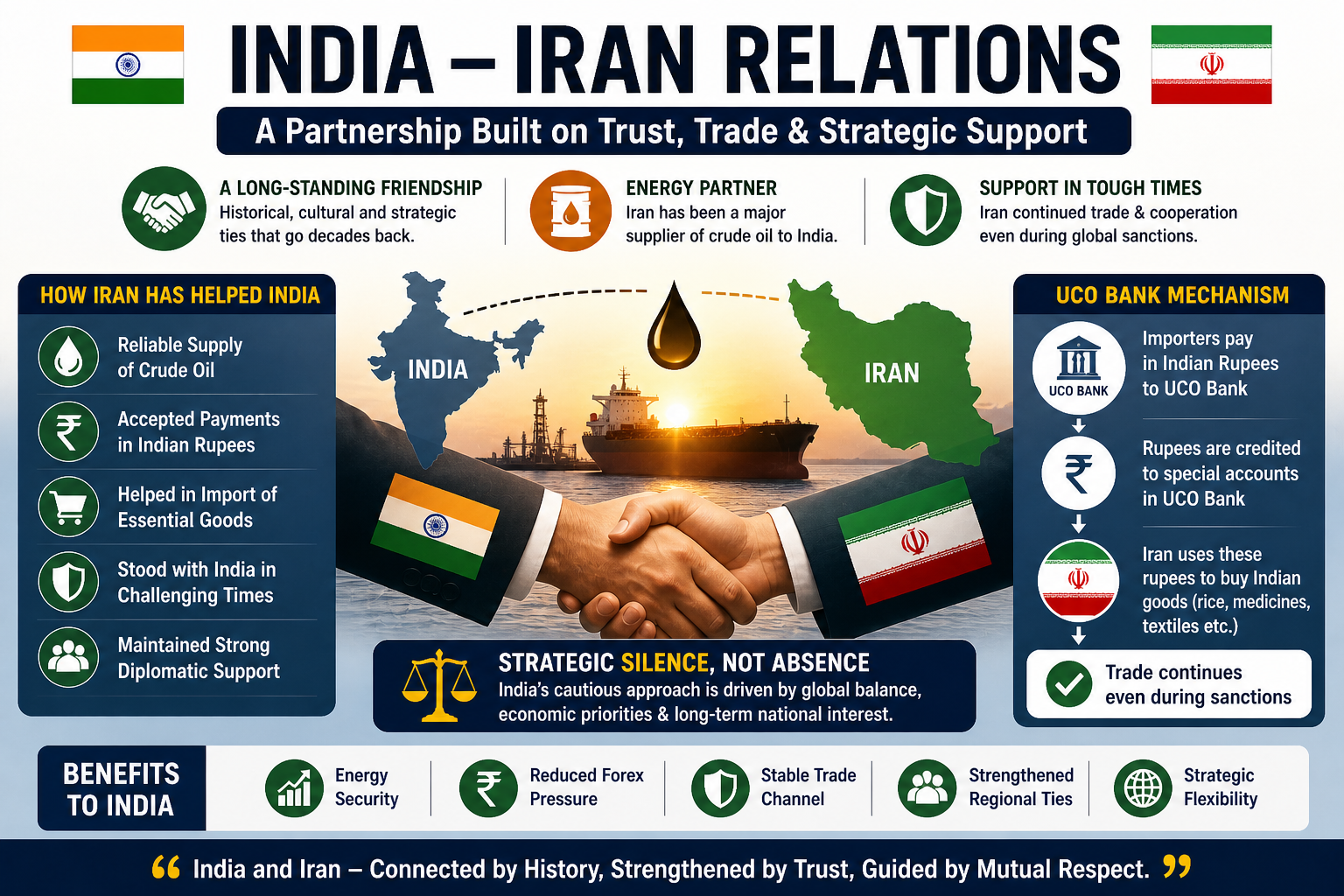
One of the most important aspects of the relationship has been oil trade.
Iran has been a major supplier of crude oil to India.
Flexible Payment Support
During periods of international sanctions, when global payment systems were restricted, Iran allowed India to:
- continue importing oil
- pay in Indian rupees instead of US dollars
This was a major relief for India’s economy.
In fact, Iran agreed to accept oil payments in rupees when traditional channels were blocked.
The UCO Bank Mechanism: A Unique Financial Model
One of the most important and less discussed aspects of India–Iran relations is the UCO Bank payment mechanism.
How It Worked
- Indian importers paid for Iranian oil in rupees
- The money was deposited in special accounts in UCO Bank
- Iran used these funds to buy Indian goods like:
- rice
- medicines
- textiles
This system allowed trade to continue even when global financial systems like SWIFT were restricted.
The rupee-based trade mechanism was actively used to facilitate oil imports and bilateral trade.
Even in recent developments, India is believed to still use rupee-based settlements for Iranian oil through indirect mechanisms.
Did This Help India? Absolutely.
This arrangement helped India:
- avoid dollar shortages
- reduce foreign exchange pressure
- maintain energy security
- continue trade despite sanctions
It was a strategic financial workaround that benefited both countries.
Iran’s Stand in Difficult Times
While not always publicly highlighted, Iran has often:
- continued trade despite sanctions
- accepted non-dollar payments
- maintained diplomatic engagement
This consistency has been seen as a form of support during challenging global conditions.
Then Why Does India Appear Silent Today?
This is where the discussion becomes more complex.
India’s current approach is shaped by multiple factors.
1. Geopolitical Balancing
India maintains relationships with:
- Western countries
- Middle Eastern nations
- global financial systems
Taking strong public positions can affect these relationships.
So India often follows a balanced and cautious diplomatic approach.
2. Global Sanctions and Pressure
Iran has faced international sanctions, especially related to:
- oil exports
- financial systems
India, being integrated into the global economy, must consider:
- trade restrictions
- financial risks
- diplomatic consequences
3. Energy Diversification Strategy
India has diversified its oil imports from:
- multiple countries
- different regions
This reduces dependency on any single nation, including Iran.
4. Strategic Silence vs Strategic Thinking
India’s approach is often described as:
“strategic silence”
This does not necessarily mean lack of support.
Instead, it reflects:
- careful decision-making
- long-term planning
- avoiding unnecessary geopolitical conflict
Is India Ignoring Iran? Or Acting Strategically?
This is an important distinction.
From one perspective:
- it may appear that India is not openly supporting Iran
From another perspective:
- India is protecting its global interests
- balancing multiple international relationships
- ensuring economic stability
Recent developments show that tensions involving Iran have directly impacted India’s economy:
- Rising oil prices are weakening the Indian rupee
- Import bills are increasing significantly
- Economic pressure is growing due to energy dependence
This highlights how deeply connected India’s economy is with Iran-related geopolitics.
The Bigger Picture: Realism in International Relations
In global politics, relationships are rarely based on emotion.
They are driven by:
- national interest
- economic priorities
- strategic positioning
India’s stance reflects:
realism, not rejection
Conclusion
India and Iran share a deep and complex relationship built over decades.
Iran has supported India through:
- flexible oil trade
- rupee-based payment systems
- continued engagement during sanctions
At the same time, India’s current approach reflects:
- strategic caution
- global balancing
- economic priorities
So the real takeaway is:
India is not silent — it is strategic.
FAQs
What is the UCO Bank Iran mechanism?
It is a rupee-based payment system used for India–Iran trade during sanctions.
Did Iran accept rupee payments from India?
Yes, Iran agreed to accept oil payments in Indian rupees.
Why is India not openly supporting Iran?
Due to geopolitical balance, sanctions, and global trade considerations.
Does India still trade with Iran?
Yes, though limited and often through alternative mechanisms.