When Thousands of EVMs Burn, Citizens Have Every Right to Ask Questions
In any democracy, trust is everything.
Trust in elections.
Trust in institutions.
Trust in the systems that count and protect votes.
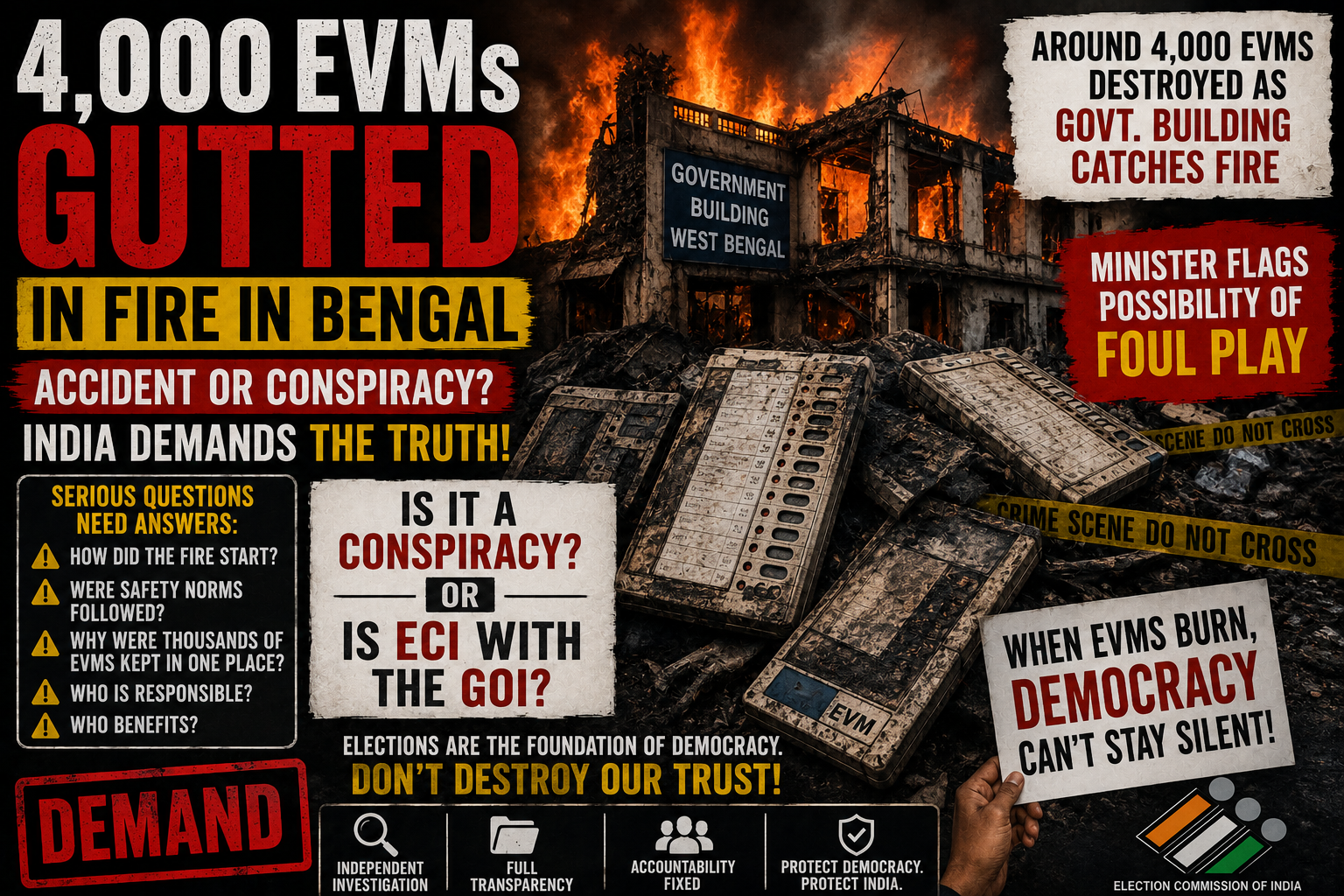
That is why reports that around 4,000 Electronic Voting Machines (EVMs) were allegedly destroyed in a fire at a government building in West Bengal have immediately triggered public concern and political controversy.
The biggest question now being asked across social media and political circles is simple:
Was this merely an unfortunate fire, or does the incident expose deeper problems in how critical election-related equipment is stored and protected?
Why This Incident Is So Serious
This is not a case involving ordinary office furniture.
These are EVMs—machines that sit at the center of India’s electoral process.
Every election season, political parties, voters, activists, and institutions spend enormous amounts of time debating election transparency, voting integrity, and public confidence.
When thousands of EVMs are reportedly destroyed in a single incident, citizens naturally want answers.
Not political speeches.
Not party talking points.
Answers.
The First Question: How Could This Happen?
Modern government facilities are expected to have:
- Fire safety systems
- Security monitoring
- Storage protocols
- Inventory controls
- Emergency response procedures
So when thousands of machines are reportedly lost in one incident, the public has every right to ask:
- How did the fire start?
- Were safety procedures followed?
- Were the machines active or retired?
- Who was responsible for storage?
- Why were so many units located in one place?
These are basic accountability questions.
The Problem Is Trust
The issue extends far beyond the physical loss of machines.
India’s election system depends heavily on public trust.
Even if there is no evidence of wrongdoing, large incidents involving election infrastructure inevitably create suspicion.
That is the reality of modern politics.
People already polarized by political debates will naturally ask difficult questions.
The solution is not to dismiss those concerns.
The solution is transparency.
Is It a Conspiracy?
At the time of writing, there is no verified evidence proving a conspiracy.
There is no publicly established evidence proving deliberate sabotage.
There is no publicly established evidence linking the incident to election manipulation.
However, citizens are still entitled to ask:
- Could negligence have played a role?
- Were security standards adequate?
- Could foul play be ruled out immediately?
- Will an independent investigation take place?
Asking questions is not conspiracy thinking.
Refusing to answer them creates even more suspicion.
Why Public Skepticism Is Growing
Across India, public confidence in institutions often depends on transparency.
Whenever major incidents occur involving:
- Elections
- Government records
- Public resources
- Financial irregularities
citizens increasingly demand independent verification rather than official assurances alone.
This is not unique to India.
It happens in democracies across the world.
Trust must be earned through openness.
The Election Commission Must Be Transparent
The Election Commission of India plays a crucial role in protecting democratic legitimacy.
That responsibility means every major incident involving election-related infrastructure should be addressed with maximum transparency.
Citizens deserve to know:
- The exact number of affected machines
- Their operational status
- Storage records
- Investigation findings
- Accountability measures
The faster facts are released, the faster speculation can be addressed.
Why Political Parties Will Use This Incident
Predictably, political parties across the spectrum are already using the controversy to advance competing narratives.
One side may portray it as evidence of institutional failure.
Another may dismiss concerns as political opportunism.
But ordinary citizens should focus on something simpler:
Facts.
The public interest is not served by blind trust or automatic suspicion.
The public interest is served by evidence.
The Bigger Issue: Accountability Culture
Whether the cause turns out to be an accident, negligence, or something else entirely, the larger issue remains the same.
Too often in India, major controversies generate headlines, investigations begin, and then public attention moves elsewhere.
Citizens are left waiting for answers that never fully arrive.
That cycle damages trust more than any individual incident.
Conclusion
The destruction of approximately 4,000 EVMs in a government building fire is not a routine administrative event.
It is a significant incident that demands transparency, accountability, and public clarity.
At this stage, there is no verified evidence proving a conspiracy.
But there is also nothing wrong with citizens demanding answers.
In a democracy, difficult questions are not a threat.
They are a requirement.
And until a full, credible, and transparent investigation is completed, one question will continue to dominate public discussion:
How did thousands of EVMs end up destroyed, and who will ultimately be held accountable?