The world today is often described through a simple but powerful lens:
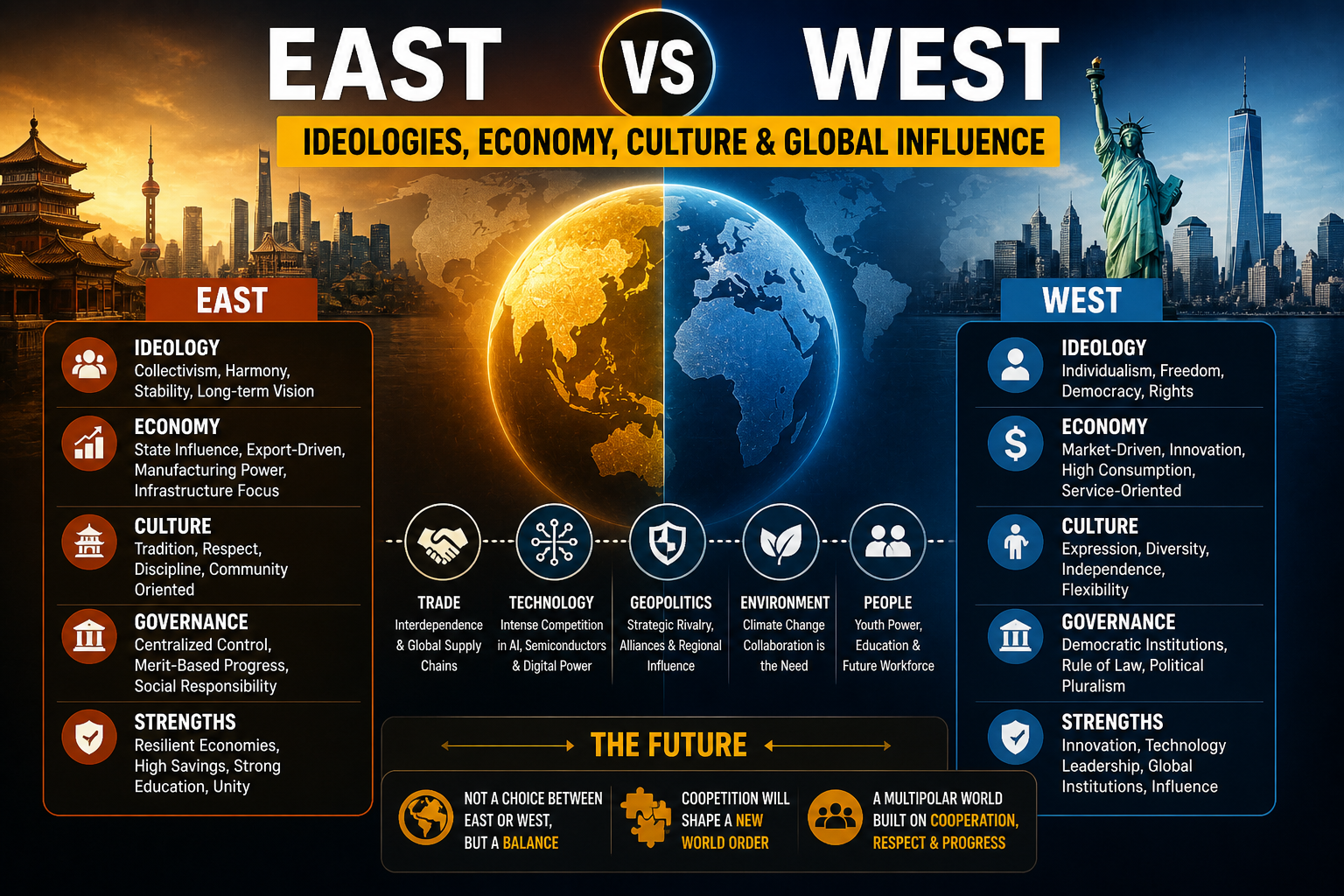
East vs West
This comparison goes far beyond geography.
It represents differences in:
- ideology
- economic models
- governance systems
- cultural values
- global ambitions
As global power dynamics evolve, understanding the contrast between Eastern and Western countries has become more important than ever.
What Do We Mean by East and West?
The “West” Typically Includes:
- North America
- Western Europe
- allied developed economies
The “East” Generally Refers To:
- Asia
- parts of the Middle East
- emerging global economies
This division is not absolute—but it helps explain global trends and conflicts.
Ideological Differences: Individualism vs Collective Thinking
One of the most fundamental differences lies in ideology.
Western Ideology
- strong focus on individual freedom
- emphasis on democracy and personal rights
- open criticism and expression encouraged
Eastern Ideology
- focus on collective well-being
- emphasis on stability and long-term planning
- social harmony often prioritized
This ideological gap shapes how societies function and respond to challenges.
Economic Models: Capitalism vs Controlled Growth
Western Economic Approach
- market-driven capitalism
- private sector dominance
- innovation-led growth
- high consumer spending
Eastern Economic Approach
- mixed or state-influenced economies
- long-term infrastructure investment
- export-driven growth
- strong government involvement
In recent years, Eastern economies have grown rapidly, challenging traditional Western dominance.
The Economic Power Shift
For decades, Western countries dominated global economic systems.
However, the balance is shifting.
Key Trends
- rapid growth in Asian economies
- increased global trade influence from the East
- rising middle class in developing regions
- diversification of global supply chains
This shift is one of the most important developments of the 21st century.
Cultural Differences: Expression vs Discipline
Western Culture
- expressive
- individual identity focused
- flexible social structures
Eastern Culture
- disciplined
- community-oriented
- respect for hierarchy and tradition
These cultural differences influence everything from:
- workplace behavior
- education systems
- leadership styles
Technology and Innovation: Competition Intensifies
Both East and West are global leaders in technology—but their approaches differ.
West
- startup-driven innovation
- private tech giants
- open ecosystems
East
- large-scale implementation
- government-supported tech growth
- rapid infrastructure deployment
The competition in areas like AI, manufacturing, and digital systems is becoming increasingly intense.
Geopolitical Tensions and Global Influence
The East vs West debate is not just academic—it has real-world implications.
Areas of Tension
- trade policies
- military alliances
- technology control
- global governance
These tensions shape international relations and global stability.
Are East and West Really in Conflict?
While differences exist, the situation is more complex than a simple clash.
In reality:
- economies are interconnected
- trade flows across regions
- cooperation continues alongside competition
The relationship is better described as:
“competitive coexistence”
The Future: Cooperation or Competition?
Looking ahead, three possibilities emerge:
1. Continued Competition
- economic rivalry
- technological race
- geopolitical tensions
2. Strategic Cooperation
- trade partnerships
- climate collaboration
- shared global goals
3. Hybrid Global System
- blending of Eastern and Western models
- multipolar world order
Conclusion
The comparison between East and West is not about choosing sides.
It is about understanding how different systems:
- think
- operate
- grow
- influence the world
As the global landscape continues to evolve, the future will likely not belong to one side alone.
Instead, it will be shaped by:
how both East and West adapt, compete, and collaborate in a rapidly changing world
FAQs
What is the main difference between East and West countries?
The main difference lies in ideology, economy, and cultural values.
Which is more powerful: East or West?
Both have strengths; global power is becoming more balanced.
Is there a conflict between East and West?
There are tensions, but also strong cooperation and interdependence.
What is the future of East vs West?
A mix of competition and cooperation in a multipolar world