Privatization has long been one of the most debated economic and political topics in modern governance.
A recurring concern raised by economists, policy analysts, and citizens is this:
Are public sector institutions first made weak so that private entities can later acquire public assets more easily?
This question has sparked intense debate across policy circles, especially whenever governments move toward:
- disinvestment
- strategic sale of PSUs
- outsourcing public services
- asset monetization
The larger concern is whether institutional weakening creates a pathway for privatization.
This blog examines that perspective in detail.
What Does This Argument Mean?
The core idea behind this argument is simple.
Some critics believe that when public sector units (PSUs) or state-owned institutions are gradually weakened through:
- underfunding
- lack of modernization
- leadership gaps
- reduced investment
- policy neglect
their performance declines.
Once the institution appears inefficient or loss-making, privatization is then presented as the only solution.
This creates an opportunity for private entities to acquire valuable public assets.
This argument is often discussed in sectors such as:
- railways
- aviation
- telecom
- banking
- energy
- healthcare
- education
How Public Sector Weakening May Create Privatization Opportunities
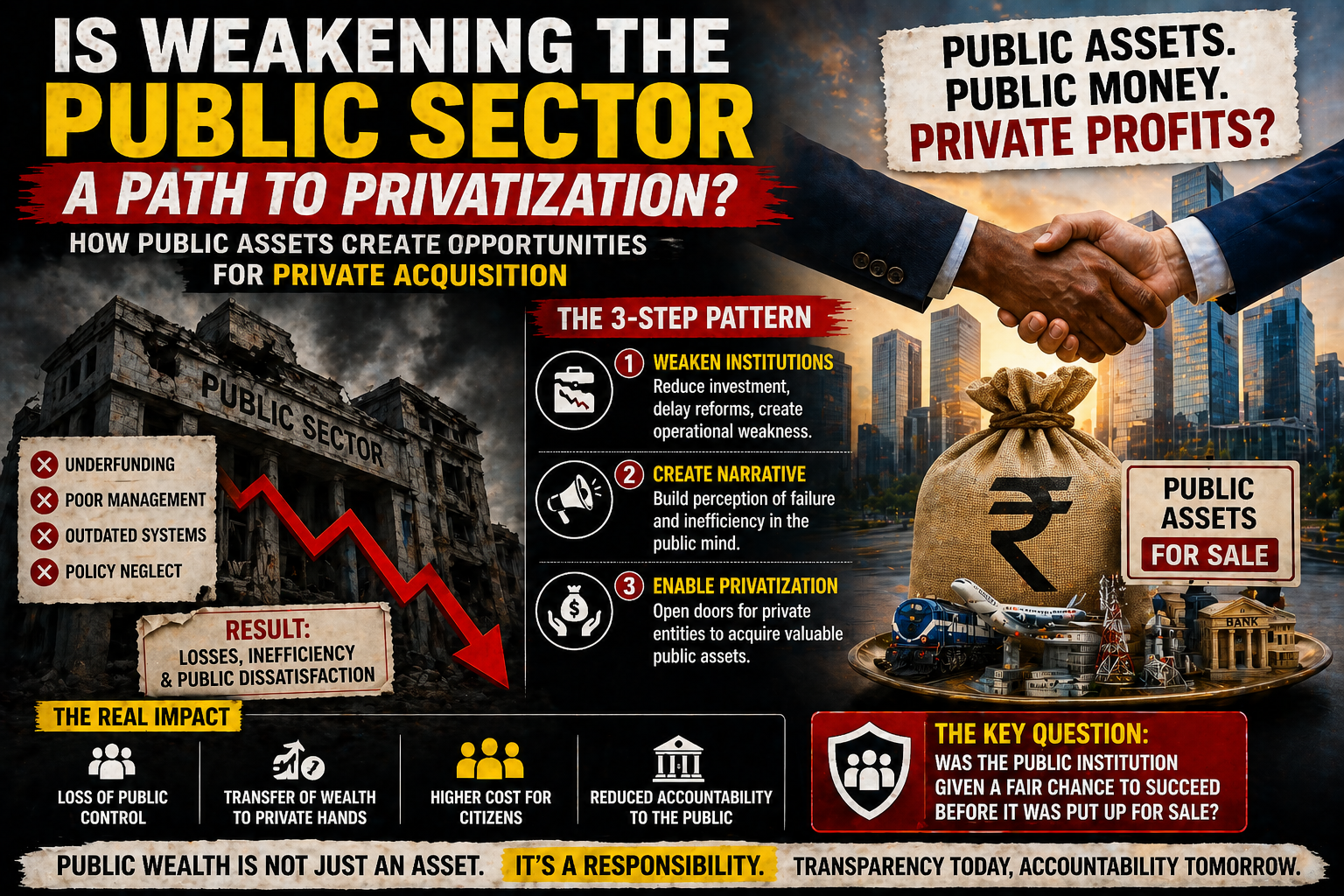
The theory often follows a three-step pattern.
1. Reduce Institutional Strength
This may happen through:
- delayed capital infusion
- technology stagnation
- workforce shortages
- poor governance reforms
When this happens, the public institution begins to underperform.
Search terms often associated with this include:
- failing PSU
- loss-making government company
- weak public institution
2. Create a Narrative of Inefficiency
Once performance weakens, the public narrative often shifts toward:
“The government cannot run businesses efficiently.”
This narrative increases support for privatization.
At this stage, public opinion may begin to favor private management.
3. Strategic Acquisition by Private Entities
After the institution is viewed as financially weak, private players may get the opportunity to acquire:
- land assets
- infrastructure
- brand value
- licenses
- customer base
- distribution networks
This is where critics argue that public assets built over decades can shift into private hands.
Why This Debate Matters
This is not merely an economic debate.
It is also a governance and social policy issue.
Public sector institutions are often built using:
- taxpayer money
- national resources
- long-term state investment
Therefore, any transfer to private ownership raises questions about:
- public accountability
- asset valuation
- long-term public interest
- access and affordability
The Other Side: Why Governments Privatize
For balanced analysis, it is important to understand the other perspective.
Governments often argue that privatization helps:
- improve efficiency
- reduce fiscal burden
- attract capital
- modernize services
- improve competition
Supporters of privatization believe private entities can bring:
- faster decision-making
- better customer experience
- profit accountability
- technology adoption
So the issue is not black and white.
Public Assets Are More Than Just Business Units
One of the biggest concerns in privatization debates is that public institutions are not just commercial entities.
They also serve social goals such as:
- employment generation
- rural connectivity
- public welfare
- affordable access
For example:
A public transport system may not be highly profitable but may still be socially essential.
This is why weakening such institutions becomes a sensitive issue.
Is Privatization Always Negative?
Not necessarily.
The real issue is how and why it is done.
Important questions include:
- Was the institution deliberately neglected?
- Was fair valuation done?
- Was there transparent bidding?
- Does the public still retain access?
These questions determine whether privatization is seen as reform or asset transfer.
The Concern Around Public Asset Ownership
A major concern raised in policy discussions is that valuable public assets may include:
- prime urban land
- natural resources
- strategic infrastructure
- monopoly licenses
If such assets are transferred after institutional weakening, critics may view it as a loss of national public wealth.
This is why the topic generates strong search interest.
Conclusion
The debate around privatization and public sector weakening remains one of the most important economic discussions today.
The central concern is whether weakening public institutions creates opportunities for private acquisition of assets built with public money.
At the same time, privatization supporters argue that efficiency and modernization require private participation.
The real question is not privatization alone.
The real question is:
Was the public institution given a fair chance to succeed before being opened for private acquisition?
That is where the national debate truly lies.
FAQs
What is privatization?
Privatization is the transfer of ownership or management of public sector assets or services to private entities.
Why do people say public sector is weakened before privatization?
Critics argue that underfunding and neglect may make public institutions appear inefficient before sale.
Is privatization always bad?
Not always. Its impact depends on transparency, public benefit, and fair valuation.