A recent report published by India Today has triggered serious concern across environmental, policy, and public circles.
The headline is alarming:
More than 10,000 litres of water may be required to produce just 1 litre of ethanol
At a time when India is already facing severe groundwater depletion, this raises a difficult but urgent question:
Is India solving one problem while creating another?
The country’s push toward ethanol-blended fuel is being promoted as a cleaner alternative to petrol.
But according to the report, the water cost may be far too high.
India Today’s Report: The 10,000-Litre Warning
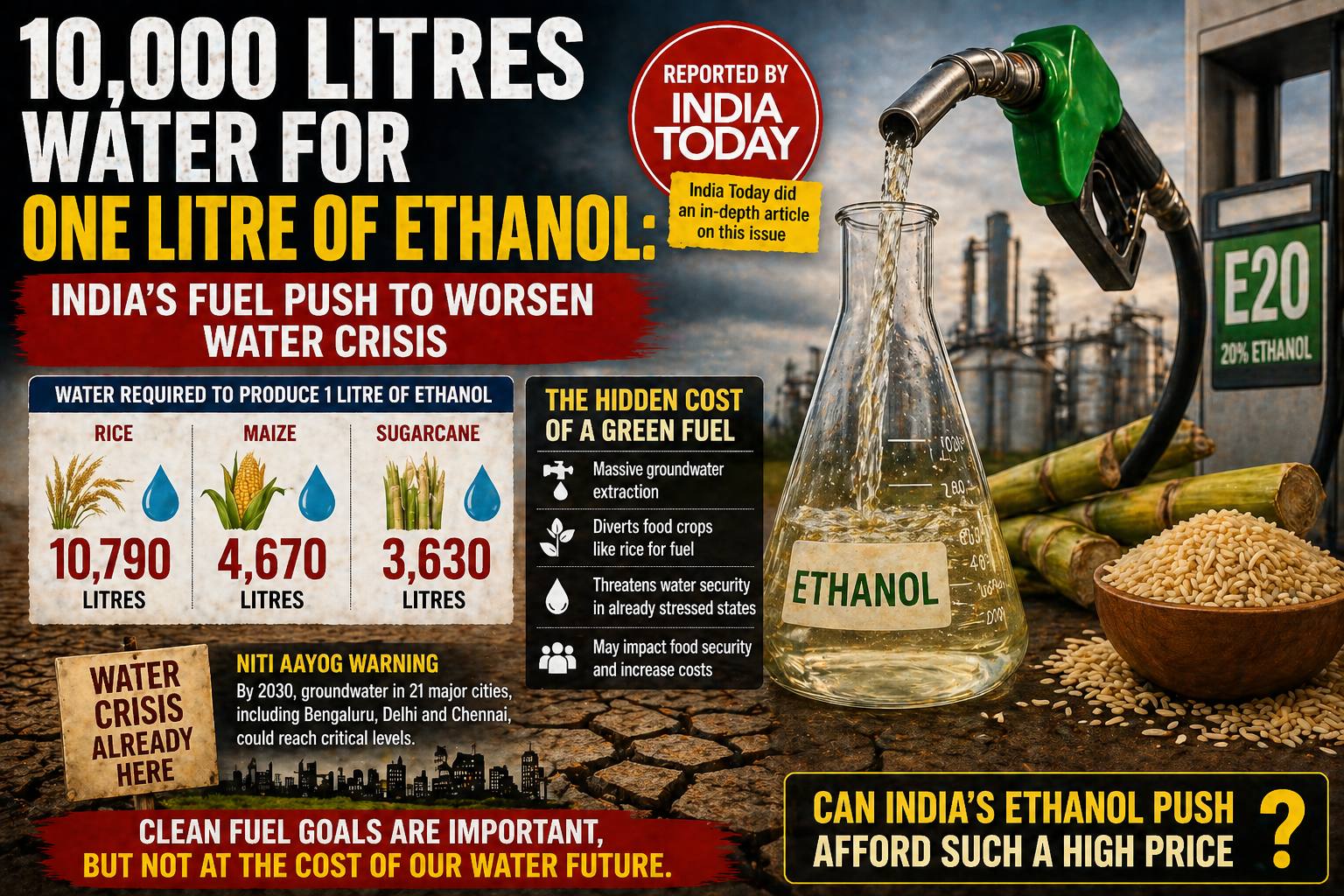
According to India Today, producing 1 litre of ethanol from rice requires approximately 10,790 litres of water.
That includes:
- irrigation water
- crop cultivation water
- processing water
- industrial wastewater treatment load
This number has shocked many readers because it directly connects fuel policy with water scarcity.
For comparison:
- Rice: ~10,790 litres
- Maize: ~4,670 litres
- Sugarcane: ~3,630 litres
What Is Ethanol Blending?
Ethanol blending means mixing plant-based ethanol with petrol.
India has aggressively moved toward:
- E20 fuel (20% ethanol blend)
- discussions around E85 fuel
The government’s stated objectives include:
- reducing crude oil imports
- lowering emissions
- improving energy security
On paper, this appears to be a strong green-energy move.
But the environmental trade-off is now under scrutiny.
The Water Crisis Concern
This is where the issue becomes serious.
India is already facing major groundwater stress.
NITI Aayog has warned that by 2030, groundwater in 21 major cities — including Bengaluru, Delhi, and Chennai — could reach critical depletion levels.
Now imagine scaling ethanol production nationally.
The water footprint becomes enormous.
Food vs Fuel: The Bigger Debate
The report also highlights another major issue:
food crops being diverted for fuel
Large quantities of rice are now being allocated for ethanol production.
This raises concerns about:
- food security
- subsidy burden
- pressure on farmers
- public distribution system impact
This creates a national debate around:
Should water-intensive food crops be used for fuel?
Is This Really Green Energy?
This is perhaps the most searched question.
Ethanol reduces dependence on imported oil.
That is a positive.
But if the environmental cost includes:
- massive groundwater extraction
- crop water stress
- industrial wastewater
- food diversion
then the definition of “green fuel” becomes more complex.
This is exactly why the India Today article has generated such strong public discussion.
States Under Pressure
Water-stressed states like:
- Maharashtra
- Uttar Pradesh
- Punjab
- Haryana
are already under pressure due to sugarcane and paddy cultivation.
Expanding ethanol production in these regions may worsen groundwater stress.
Conclusion
The report published by India Today has raised an important national question:
Can India’s clean fuel mission remain sustainable if it significantly deepens the water crisis?
If 1 litre of ethanol truly requires over 10,000 litres of water, the long-term balance between energy goals and water security needs serious policy discussion.
This is not just an environmental story.
It is a future-of-India story.
FAQs
How much water is needed for 1 litre of ethanol?
According to India Today, about 10,790 litres for rice-based ethanol.
Why is ethanol blending controversial?
Because it may worsen groundwater depletion and divert food crops for fuel.
Who published this report?
The detailed article was published by India Today.