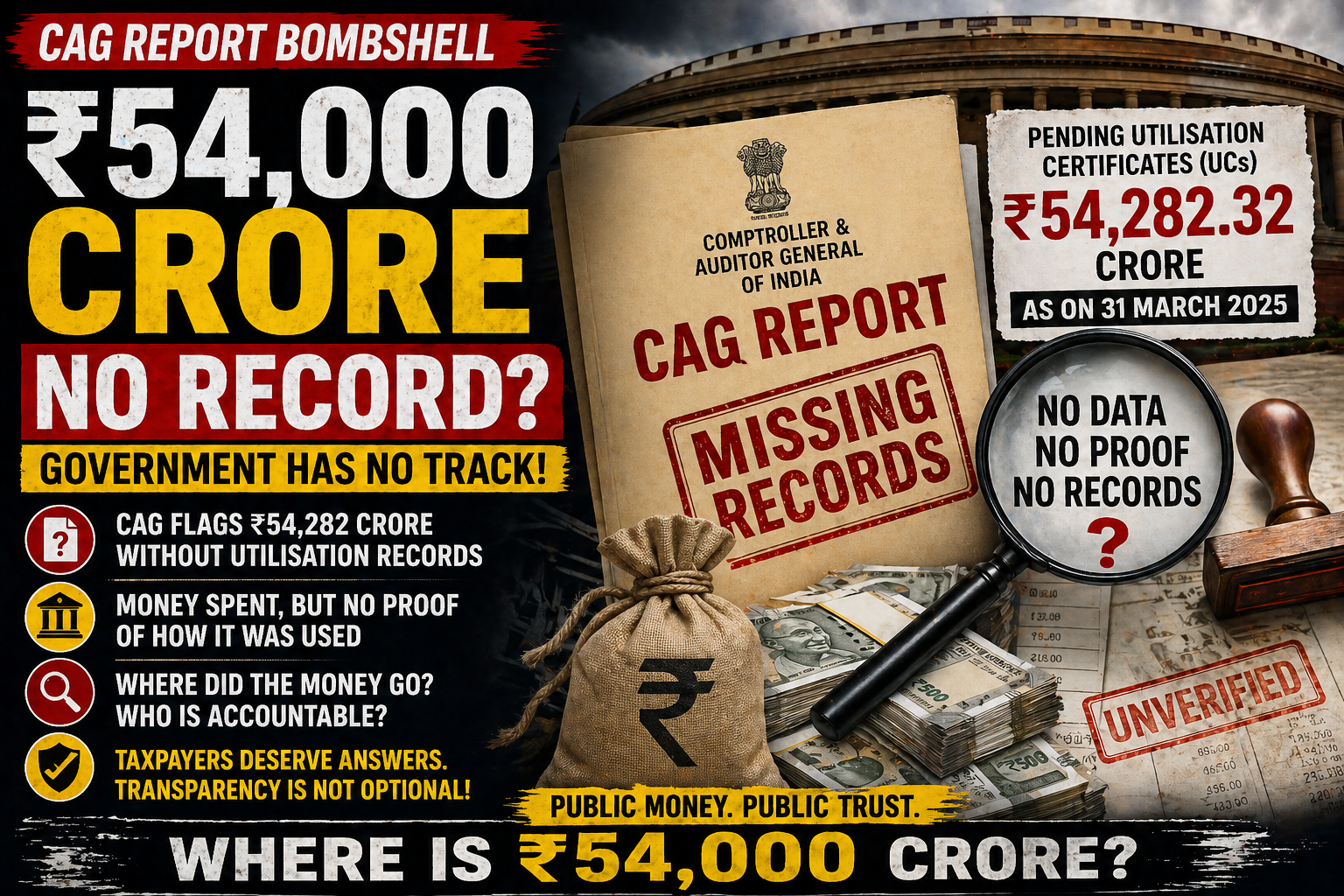
A fresh CAG report tabled in Parliament has triggered serious concerns over public financial transparency after flagging more than ₹54,000 crore for which required spending records were not available.
The exact amount identified is:
₹54,282.32 crore
This has quickly become one of the most discussed governance and finance stories of 2026.
But before jumping to conclusions, it is important to understand what the report actually says.
This is not necessarily “money vanished from treasury” in the literal sense.
Instead, the report points to a major issue in financial documentation and utilisation records.
That distinction matters.
What Did the CAG Actually Find?
According to the CAG’s audit of the Union Government Accounts for FY 2024–25, a total of:
33,973 utilisation certificates (UCs)
worth
₹54,282.32 crore
were still outstanding as of March 31, 2025.
This means ministries and departments that received public funds had not yet submitted proof of how the money was spent.
In simple terms:
The government has disbursed the money, but the required “proof of use” is missing.
What Is a Utilisation Certificate (UC)?
This is the most important concept in this story.
A Utilisation Certificate (UC) is an official document submitted by a department, ministry, institution, or implementing agency to confirm that public money has been used for the purpose for which it was allocated.
Think of it as:
an official receipt + proof of execution
For example, if ₹1,000 crore is allocated for roads, the agency must later certify that the money was actually used for road construction.
Without a UC:
- spending cannot be fully verified
- project completion cannot be confirmed
- legislative oversight weakens
Does This Mean ₹54,000 Crore Is Missing?
The accurate answer is:
Not necessarily
This is where many headlines become misleading.
The CAG report does not say the money has been stolen or disappeared.
Instead, it says:
there is no submitted record proving how it was used
This is still serious.
Because in public finance, lack of documentation itself is a major governance red flag.
Why This Is a Big Concern
Even if the money was genuinely spent, missing records raise several serious questions:
1. Was the money used for the intended purpose?
Without documentation, there is no formal assurance.
2. Was there delay in project execution?
Missing UCs may indicate unfinished projects.
3. Could there be misallocation?
The CAG also flagged ₹12,754 crore as misclassified expenditure.
4. Is there weak financial governance?
This is the broader concern.
Which Departments Were Flagged?
According to the audit findings, major pendency was seen in departments such as:
- Ministry of Housing and Urban Affairs
- Department of Higher Education
These accounted for a significant share of the outstanding amount.
This raises questions because these departments directly impact:
- infrastructure
- urban development
- education funding
- central grants
Why No One Is Talking About It
This is perhaps the biggest public question.
A figure like ₹54,000 crore naturally grabs attention.
Yet the story has not dominated mainstream public discussion.
Possible reasons include:
- complexity of audit terminology
- misunderstanding of UCs
- news cycle dominated by politics and elections
- assumption that “pending record” ≠ “scam”
But transparency issues of this scale deserve attention.
The Bigger Issue: Trust in Public Finance
Public money comes from taxpayers.
When large amounts remain unverified on paper, public trust can weaken.
This is not only about numbers.
It is about:
- governance
- accountability
- institutional efficiency
- public confidence
That is why CAG reports matter.
The CAG acts as the constitutional watchdog for government finances.
What Happens Next?
Usually, after such findings:
- departments are asked to submit pending UCs
- Public Accounts Committee may review the issue
- ministries may be required to explain delays
- internal financial controls may be tightened
This can take months.
Could This Affect the Economy?
Indirectly, yes.
Such reports can impact:
- investor confidence
- policy credibility
- public finance perception
- sovereign governance image
Especially when the amount is this large.
Conclusion
The CAG has not said ₹54,000 crore has vanished.
What it has said is equally important:
the government currently lacks complete records proving how ₹54,282 crore was used
That is a serious transparency issue.
Whether this is a documentation delay, procedural lapse, or deeper governance problem is what future reviews and parliamentary scrutiny will need to establish.
FAQs
Did ₹54,000 crore disappear from treasury?
The CAG report does not say it disappeared. It says required utilisation records are pending.
What is a utilisation certificate?
It is proof that public money was spent for its intended purpose.
Why is this serious?
Because without records, there is no formal verification of spending.