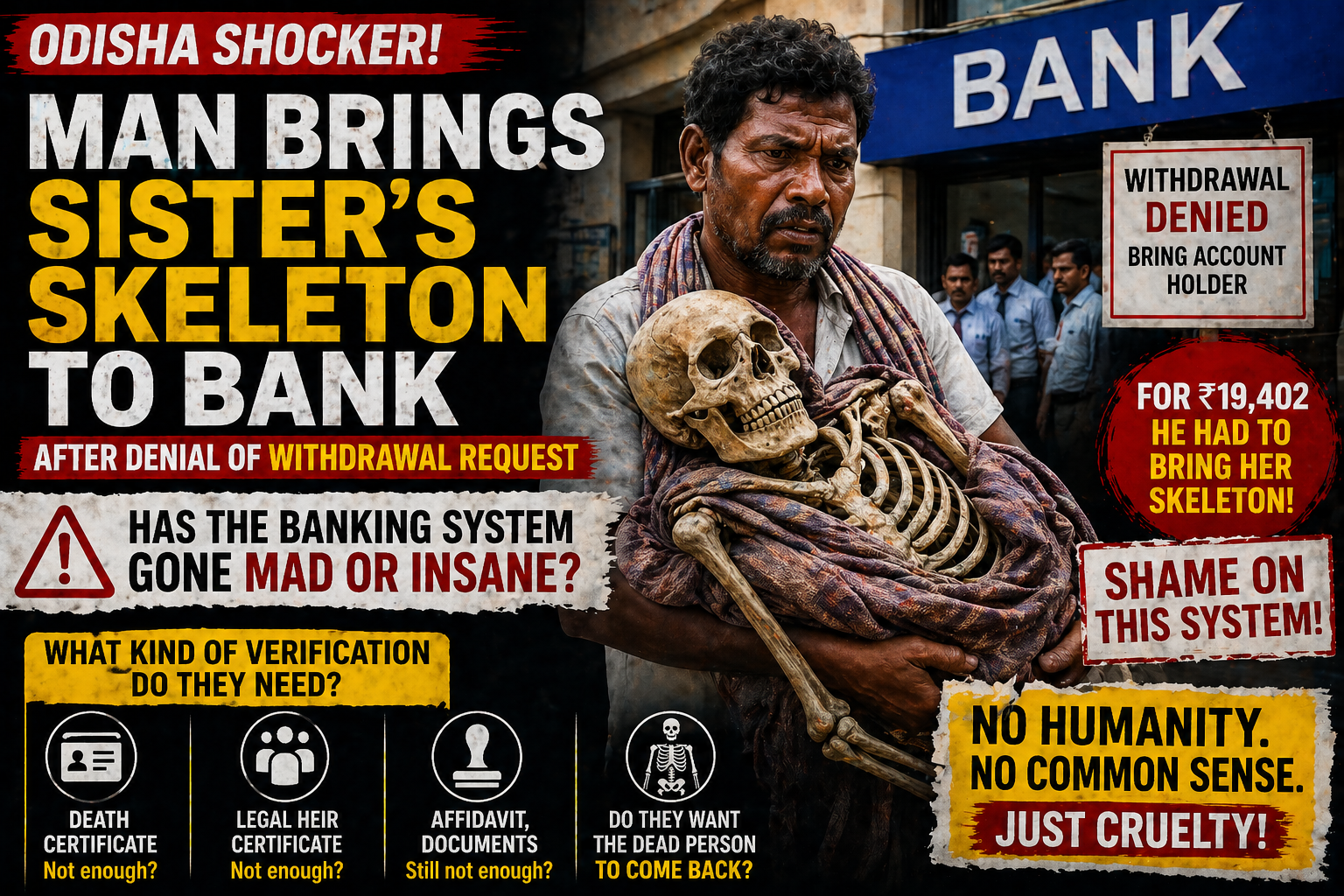
In one of the most shocking and heartbreaking incidents to emerge from India this year, a man from Odisha was allegedly forced to bring the skeletal remains of his deceased sister to a bank after repeated refusal to allow withdrawal from her account.
Yes, you read that right.
A brother had to dig up his sister’s remains and carry the skeleton to the bank just to prove that she was dead.
The incident from Keonjhar district, Odisha, has sparked nationwide outrage and raised serious questions:
- Have bank officials gone insane?
- What kind of verification process is this?
- Why should someone prove death in such a horrifying way?
- Has bureaucracy become inhuman?
The man, identified as Jitu Munda, was later able to receive ₹19,402, including interest, after authorities issued the required documents.
What Actually Happened?
According to multiple reports, Jitu Munda had been visiting the bank repeatedly to withdraw money from his late sister’s account.
His sister had died earlier this year, and the account reportedly had around ₹19,300–₹19,402 in savings.
He alleged that bank staff repeatedly insisted on either:
- the account holder being physically present, or
- valid legal heir documents and death proof
Out of extreme frustration and lack of awareness about legal procedures, he exhumed the skeletal remains and carried them to the branch as proof.
Has the Banking System Lost Its Mind?
This is the question many people across India are asking.
Social media has exploded with reactions such as:
“What kind of verification needs a skeleton?”
“Have people in the bank gone mad?”
“How can someone be asked to bring the dead person?”
These reactions are not surprising.
Even if banking procedures require documents, the situation points to a serious failure of communication and empathy.
The larger issue may not be the rule itself.
The larger issue is:
Did anyone clearly explain the process to him?
Reports suggest Jitu Munda is illiterate and unaware of banking legalities, which makes the incident even more tragic
What Verification Was Actually Required?
This is important.
Banks generally cannot allow withdrawal from a deceased person’s account without proper documentation.
Normally, they require:
- death certificate
- legal heir certificate / succession proof
- nominee details
- ID proof of claimant
These are standard procedures to prevent fraud.
So the issue is not the existence of verification.
The issue is whether the branch staff humanely guided the man through the process.
That is where the public outrage lies.
Why This Incident Has Shocked the Nation
This story has gone viral because it reflects something deeper than just a banking dispute.
It reflects:
- bureaucratic insensitivity
- lack of financial literacy support
- rural documentation gaps
- poor last-mile governance
This is why people are calling it a failure of humanity.
Community reactions online strongly reflect anger at how an illiterate rural claimant was handled.
Bank’s Version of Events
The bank later stated that proper procedures had been explained and that the man was allegedly under the influence of alcohol when he visited the branch.
However, authorities still stepped in to help process the documentation and release the money.
This suggests that the issue may have involved both:
- lack of awareness
- lack of sensitive communication
A Bigger Question for India’s Banking System
This is not just one viral incident.
It raises larger questions:
- Are rural citizens being properly assisted?
- Do banks have enough customer guidance support?
- Are staff trained for humanitarian handling?
- Is documentation support accessible in villages?
These are important questions for public institutions.
The Human Cost of Bureaucracy
The most painful part of this incident is not the money.
It is the fact that for less than ₹20,000, a man felt compelled to carry the remains of his sister to prove the truth.
That image has become a symbol of what many are calling bureaucratic cruelty.
Conclusion
The Odisha skeleton bank incident is more than just a shocking headline.
It is a reflection of the gap between rules and humanity.
Verification is necessary.
Fraud prevention is necessary.
But when a citizen feels forced to bring skeletal remains to prove death, the system must ask itself:
Where did empathy disappear?
The money was eventually released after the authorities issued the proper documents.
But the questions raised by this incident will remain for a long time.
FAQs
Why did the Odisha man bring his sister’s skeleton to the bank?
He alleged repeated denial of withdrawal and brought the remains as proof of death.
How much money was in the account?
The bank later released ₹19,402, including interest.
Was the withdrawal finally allowed?
Yes, after the death certificate and legal heir certificate were issued.