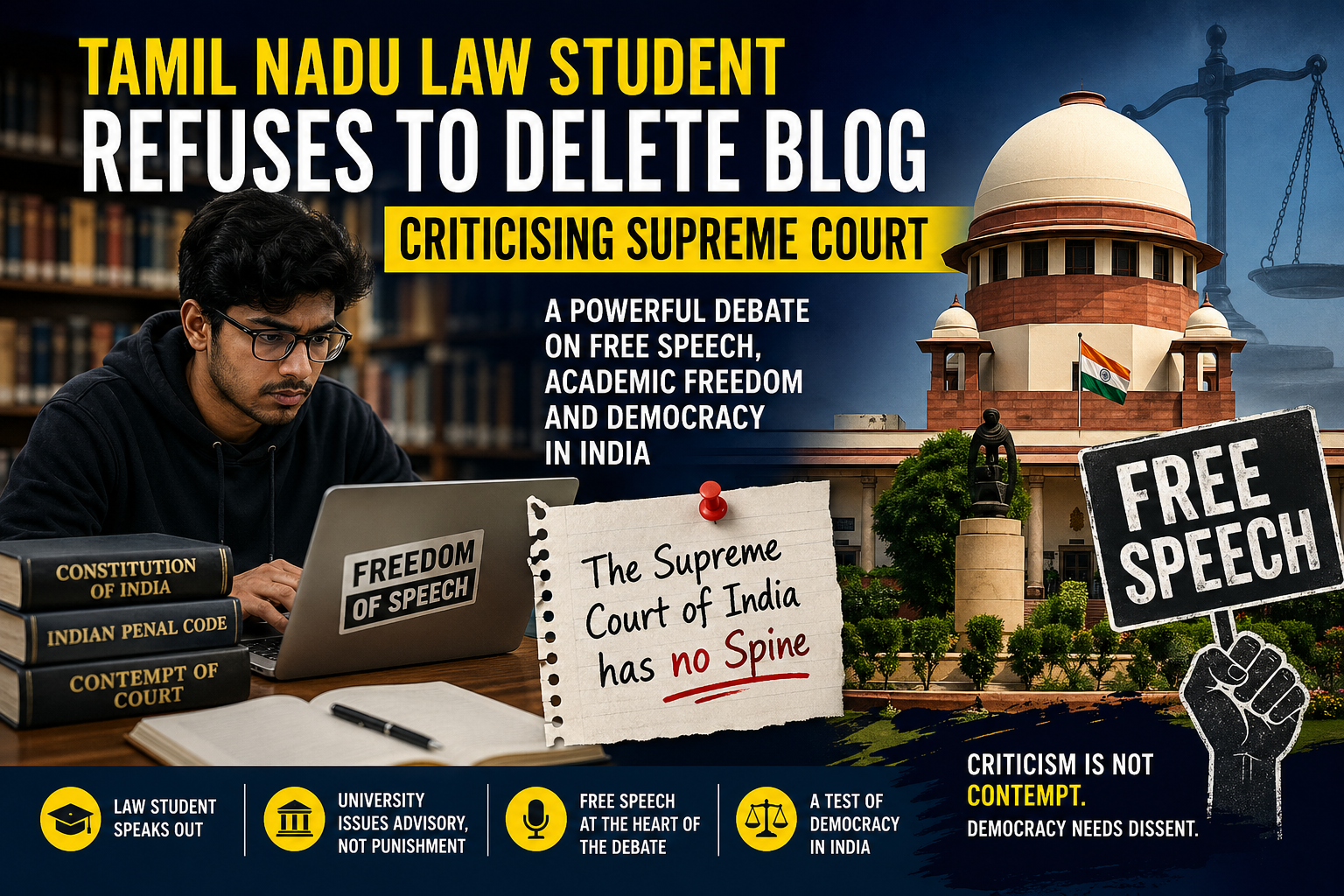
A final-year student at Tamil Nadu National Law University has refused to remove a strongly worded blog post criticising the Supreme Court of India, igniting a wider national conversation around free speech, academic freedom, and the right to critique constitutional institutions.
In a development that has triggered widespread debate across legal, academic, and public circles, a final-year student at Tamil Nadu National Law University (TNNLU) has refused to take down a blog post sharply criticising the Supreme Court of India.
The incident has now become far more than a campus-level issue.
It has evolved into a national conversation on freedom of speech, institutional criticism, academic independence, and the constitutional rights of students in India. Reports indicate that the university ultimately chose not to pursue disciplinary action and publicly clarified that the communication was advisory, while affirming that fair criticism of institutions is legitimate in a democratic framework.
At the center of this discussion is A. Rishi Kumar, a final-year law student who published a strongly worded article on his Substack page, criticizing the Supreme Court’s decision to ban a Class VIII civics textbook and blacklist its authors.
The refusal to delete the post has now sparked important constitutional and legal questions:
- Can students openly criticise constitutional institutions?
- Where does free speech end and contempt begin?
- What role should universities play in protecting student expression?
- Does criticism strengthen democracy?
This blog explores the issue in depth.
What Happened? Understanding the Controversy
The controversy began when Rishi Kumar published a blog post titled:
“The Supreme Court of India Has No Spine”
The title itself quickly drew attention across legal circles and social media.
The article criticized the Supreme Court’s earlier decision relating to a Class VIII NCERT civics textbook, particularly a chapter that referred to concerns around corruption in the judiciary.
According to reports, the court had ordered the removal of the textbook chapter and also blacklisted the authors involved in creating the material.
Kumar questioned the logic behind restricting access to educational content that, according to him, largely praised the judiciary while only briefly acknowledging institutional shortcomings.
This distinction became central to the debate.
His argument was simple yet legally significant:
If institutions in a democracy cannot be critically examined, what happens to constitutional accountability?
Why the Blog Triggered National Attention
The issue did not remain limited to the university campus.
The post spread rapidly across:
- X (formerly Twitter)
- legal communities
- law student forums
- Substack readership
- news platforms
- Reddit discussions
Public reaction was divided.
Some viewed the language as provocative.
Others saw it as a courageous assertion of constitutional values and democratic dissent. Community discussions across legal and public forums strongly framed it as a free speech and academic freedom issue.
This incident touches a highly sensitive intersection of:
- judiciary
- education
- free speech
- constitutional law
- student rights
That is why it gained traction so quickly.
University’s Response: Advisory, Not Punitive
Initially, reports suggested that the university had asked the student to take down the blog post.
However, the institution later clarified that this was not a formal directive.
Instead, it described the communication as an advisory note issued in good faith, prompted by external complaints and pressure from individuals claiming to be lawyers and judges from various states.
Registrar S.M. Balakrishnan later stated that:
- no disciplinary action would be taken
- the student acted in personal capacity
- the university name was not referenced
- criticism of institutions is legitimate in democracy
This clarification is crucial.
It reflects an institutional recognition that academic spaces must allow dissent and debate.
Freedom of Speech Under the Indian Constitution
This case directly invokes Article 19(1)(a) of the Constitution of India.
This article guarantees:
Freedom of speech and expression
This right extends to:
- students
- journalists
- academicians
- citizens
- bloggers
- researchers
However, Article 19 is subject to reasonable restrictions under Article 19(2).
These include restrictions related to:
- public order
- defamation
- contempt of court
- sovereignty and integrity
The critical legal question here is:
Does criticism of the judiciary amount to contempt?
The answer is not always straightforward.
Criticism vs Contempt of Court
One of the most searched legal questions emerging from this controversy is:
Can you criticise the Supreme Court in India?
The answer is:
Yes — fair criticism is constitutionally protected.
Criticism becomes problematic only if it:
- scandalizes the court
- obstructs justice
- undermines public confidence through malicious falsehoods
Indian courts have historically distinguished between:
- fair criticism
- contemptuous attacks
This distinction is legally important.
A democracy must permit institutional criticism.
Otherwise, accountability collapses.
Conclusion: A Defining Moment for Free Speech in India
The Tamil Nadu law student controversy is more than a campus dispute.
It is a reflection of the evolving relationship between:
- law
- education
- institutional power
- democratic dissent
The university’s eventual decision not to pursue disciplinary action and its acknowledgment that fair criticism is legitimate have turned this episode into a defining moment in the conversation around academic freedom.
For students, lawyers, and citizens alike, this incident serves as an important reminder:
Democracy survives not by silence, but by informed criticism.