Scrolling through social media today feels very different from what it did a decade ago.
Many people have started noticing a shift — a subtle but significant change in how public figures, especially celebrities, engage with social issues.
A question naturally arises:
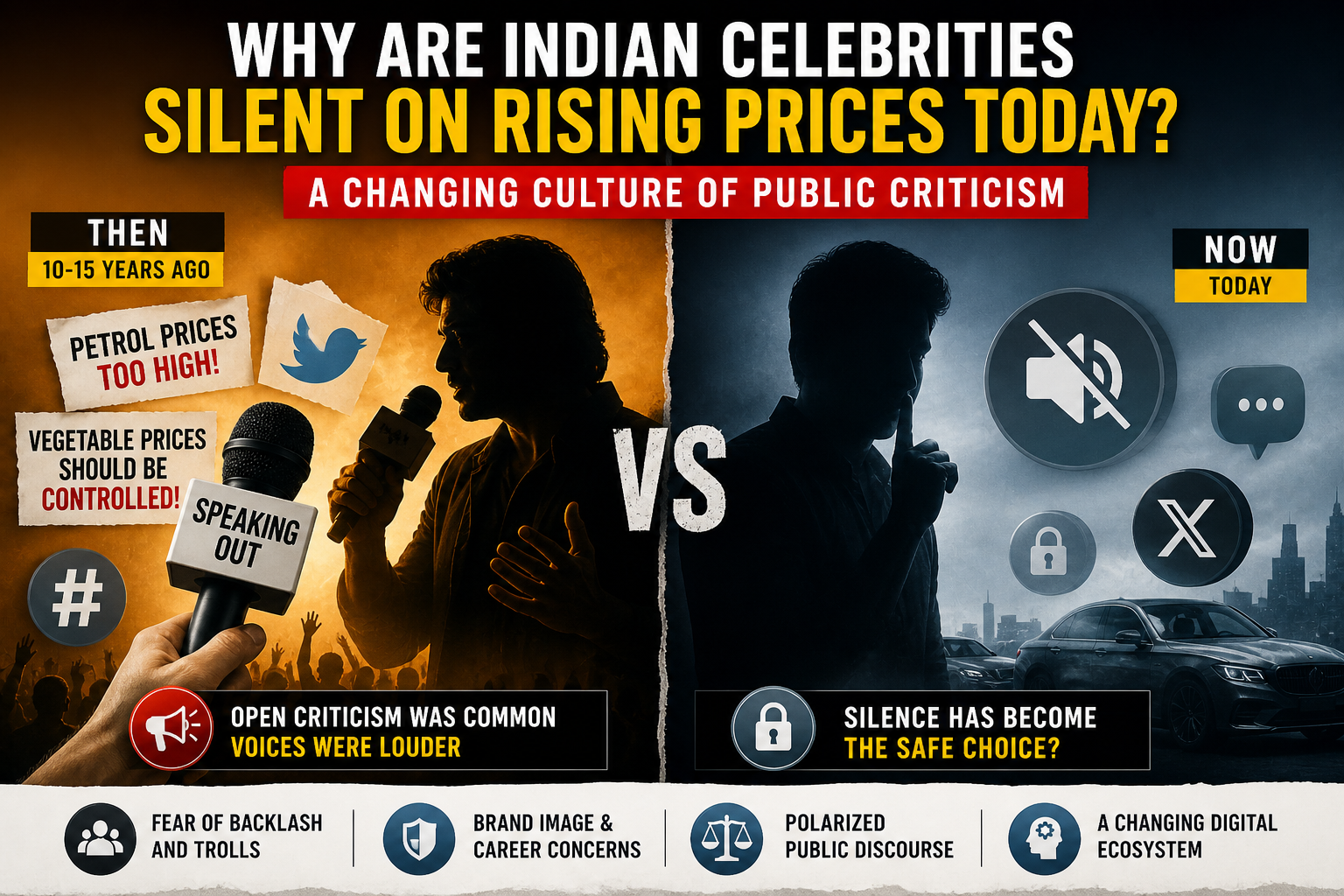
Why do we rarely see celebrities openly criticizing rising prices today, when it was more common 10–15 years ago?
This observation is not about blaming anyone. Instead, it opens up an important conversation about how public discourse in India has evolved over time
Looking Back: When Public Criticism Was More Visible
Around a decade or more ago, it was not uncommon to see:
- public figures commenting on rising petrol prices
- discussions around food inflation
- tweets and posts questioning economic decisions
- open criticism of governance and policies
Social media platforms like Twitter were often used as tools for direct public expression.
Celebrities were seen as voices representing public concerns.
The Present Scenario: A Noticeable Silence
Fast forward to today, and the landscape appears different.
Despite ongoing discussions among the general public about:
- fuel prices
- cost of living
- everyday expenses
There is comparatively less visible commentary from celebrities on such topics.
This change has sparked curiosity and debate.
Possible Reasons Behind This Shift
There is no single answer, but several factors may explain this transformation.
1. Changing Nature of Social Media
Social media today is far more intense and reactive than before.
- Posts can go viral instantly
- Opinions can attract strong backlash
- Misinterpretation spreads quickly
This environment may encourage individuals, especially public figures, to be more cautious about what they share.
2. Fear of Backlash or Reputation Risk
Public criticism today often leads to:
- trolling
- online campaigns
- divided audience reactions
For celebrities whose careers depend on public perception, maintaining neutrality might seem safer.
This doesn’t necessarily mean fear — it can also reflect strategic communication choices.
3. Increased Polarization in Public Discourse
Public conversations have become more polarized.
Even neutral statements can be interpreted as:
- supporting one side
- opposing another
In such an environment, silence can sometimes be seen as a way to avoid being drawn into controversy.
4. Professional and Brand Considerations
Today’s celebrities are not just artists — they are also:
- brand ambassadors
- entrepreneurs
- global public figures
Any public statement can impact:
- endorsements
- partnerships
- audience reach
This makes them more cautious about expressing opinions on sensitive issues.
5. Has the Situation Changed or Perception Changed?
Another important angle to consider is:
Is the silence real, or is our perception changing?
- Information consumption has evolved
- Algorithms control what we see
- Conversations have shifted platforms
It’s possible that discussions still exist — just in different formats or spaces.
A Broader Question: Freedom of Expression vs Public Responsibility
This shift leads to a deeper reflection:
- Should celebrities actively speak on public issues?
- Or should they remain neutral as individuals?
There is no universal answer.
Some believe that public figures have a responsibility to speak up.
Others argue that everyone has the right to choose what they express.
Then vs Now: Was It Easier to Criticize Before?
A common thought that emerges is:
Was criticism easier in earlier times compared to today?
Possible interpretations include:
- earlier discourse may have felt less intense
- reactions may have been less amplified
- social media dynamics were simpler
However, this does not necessarily mean one period was better or worse — just different.
What Can We Conclude?
Instead of drawing a fixed conclusion, it’s more useful to understand the shift as part of a larger transformation:
- social media has evolved
- public scrutiny has increased
- communication strategies have changed
- society has become more digitally reactive
So the silence we observe may not be about:
- fear alone
- or complete absence of issues
But rather about:
a changing ecosystem of expression in a highly connected world
Conclusion
The way public figures engage with societal issues has undeniably changed.
Whether this is due to caution, strategy, evolving platforms, or shifting public expectations — it reflects a broader transformation in how conversations happen today.
Ultimately, the real question may not be:
“Why are they silent?”
But rather:
“How has the space for public expression itself changed?”
FAQs
Why don’t celebrities talk about rising prices anymore?
Possible reasons include social media pressure, reputation concerns, and changing public discourse.
Are celebrities afraid to speak out?
Not necessarily — many may simply be more cautious due to evolving online environments.
Was public criticism more common earlier?
It appeared more visible due to simpler social media dynamics and fewer consequences.
Has freedom of expression changed?
The framework remains, but the way people express opinions has evolved significantly.