E20 Petrol in India: Is the Transition Fair to Consumers?
India’s ethanol blending programme has been presented as a major step toward reducing crude oil imports, supporting farmers, and lowering carbon emissions.
The government has accelerated the rollout of E20 petrol, a fuel containing up to 20% ethanol, with the goal of expanding its nationwide availability.
Supporters call it an important energy reform.
Critics argue that the transition has placed an additional burden on millions of vehicle owners who have little or no choice over the fuel they purchase.
The biggest question is no longer whether India should blend ethanol.
It is whether the transition is being implemented in a way that adequately protects consumers.
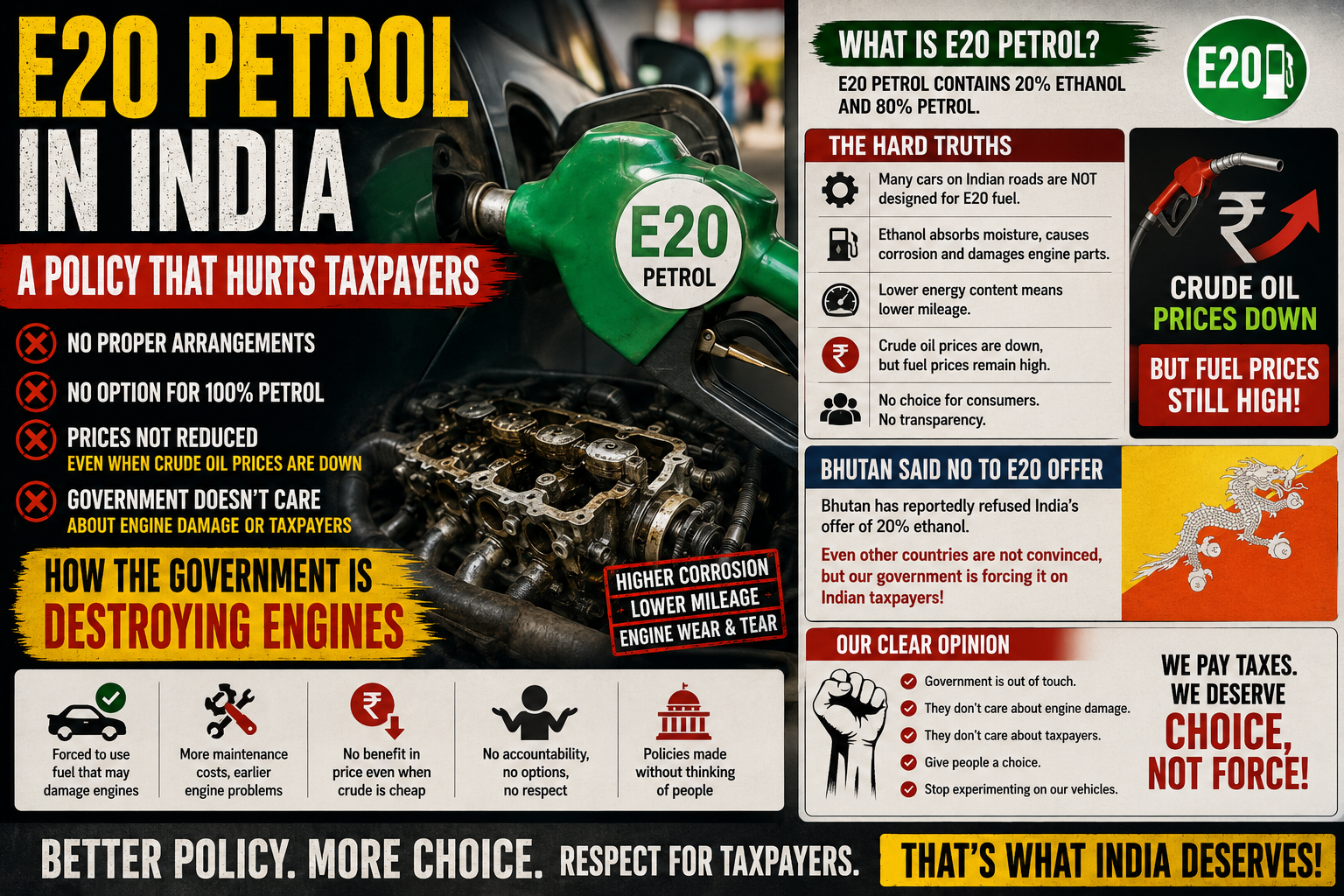
What Is E20 Petrol?
E20 petrol is a blend consisting of:
- 80% petrol
- 20% ethanol
The policy aims to:
- Reduce dependence on imported crude oil.
- Support domestic ethanol production.
- Lower greenhouse gas emissions.
- Improve India’s energy security.
These objectives are widely cited as the rationale behind the programme.
The Consumer Concern: Where Is the Choice?
One of the strongest criticisms raised by some motorists is that, in many places, consumers have limited fuel options.
If E20 becomes the default offering at retail outlets, owners of older vehicles may wonder whether they can still obtain fuel best suited to their engines.
Many consumers argue that a gradual transition should include continued availability of lower-ethanol blends for vehicles that were not originally designed for E20.
Whether such options are available varies by region and fuel station.
Engine Compatibility Matters
Vehicle manufacturers have introduced many newer models that are compatible with E20 fuel.
However, not every vehicle currently on Indian roads was designed for this blend.
Potential concerns discussed by manufacturers and automotive experts include:
Older Vehicles
Some older vehicles may require additional maintenance or component upgrades if operated extensively on higher ethanol blends.
Fuel System Components
Ethanol can interact differently with certain rubber seals, plastics, and fuel system components used in older vehicles.
Fuel Efficiency
Because ethanol contains less energy per litre than petrol, some users report a modest reduction in fuel economy, although the extent varies by vehicle and driving conditions.
Drivers are generally advised to follow the fuel recommendations provided by their vehicle manufacturer.
If Crude Oil Prices Fall, Why Don’t Consumers Always See Lower Petrol Prices?
Another issue frequently raised by the public concerns retail fuel prices.
Many consumers ask:
“If global crude prices have declined, why haven’t petrol prices fallen proportionately?”
Retail fuel prices are influenced by several factors, including:
- International crude prices.
- Exchange rates.
- Refining costs.
- Transportation.
- Central and state taxes.
- Dealer commissions.
As a result, changes in global crude prices do not necessarily translate into immediate or equivalent changes at the pump.
Should Consumers Have More Fuel Options?
This is where the public debate becomes more nuanced.
Many critics of the current rollout are not opposed to ethanol blending itself.
Instead, they argue that consumers should be able to choose among multiple fuel grades where technically appropriate.
Possible approaches include:
- Continued availability of standard petrol where demand exists.
- Clear labelling at fuel stations.
- Better public information on vehicle compatibility.
- Greater consumer awareness before nationwide implementation.
International Experience
Countries around the world have adopted different ethanol blending strategies.
Some have gradually increased blending levels while ensuring compatibility standards and consumer awareness.
Policies vary depending on vehicle fleets, fuel infrastructure, and domestic energy goals.
International examples can offer lessons, but each country’s circumstances differ.
The Need for Better Public Communication
Large policy changes often require public trust.
Consumers benefit from clear answers to questions such as:
- Is my vehicle compatible with E20?
- Will mileage change?
- Will maintenance costs increase?
- What alternatives are available if my vehicle is not recommended for E20?
Transparent communication can help reduce uncertainty during the transition.
Opinion
In my view, India’s goal of reducing oil imports and expanding renewable fuels is understandable.
However, public confidence depends not only on the objective but also on how the policy is implemented.
If consumers are expected to adopt a new fuel standard, they deserve:
- Clear technical guidance.
- Transparent communication.
- Adequate transition planning.
- Practical choices where feasible.
Policies that affect millions of vehicle owners are likely to receive broader acceptance when accompanied by reliable information and consideration for existing vehicles.
Frequently Asked Questions
What is E20 petrol?
E20 petrol contains 20% ethanol and 80% petrol.
Can every vehicle use E20 petrol?
Not necessarily. Compatibility depends on the manufacturer and model year. Owners should consult their vehicle manual or manufacturer.
Does E20 reduce fuel efficiency?
Some vehicles may experience a slight reduction in mileage because ethanol has a lower energy content than petrol.
Why is India promoting ethanol blending?
The policy aims to reduce crude oil imports, support domestic ethanol production, and lower emissions.
Conclusion
The discussion around E20 petrol is ultimately about balancing long-term energy policy with the practical realities faced by consumers.
India’s ethanol programme may contribute to energy security and agricultural demand, but its success will also depend on consumer confidence, transparent communication, and ensuring that vehicle owners have the information they need to make informed decisions.
A successful transition is not only about introducing a new fuel—it is also about bringing the public along with it.