Opinion | Nuclear Power Is Not Just Another Business. It Is a Strategic National Asset.
India stands at an important turning point in its energy journey.
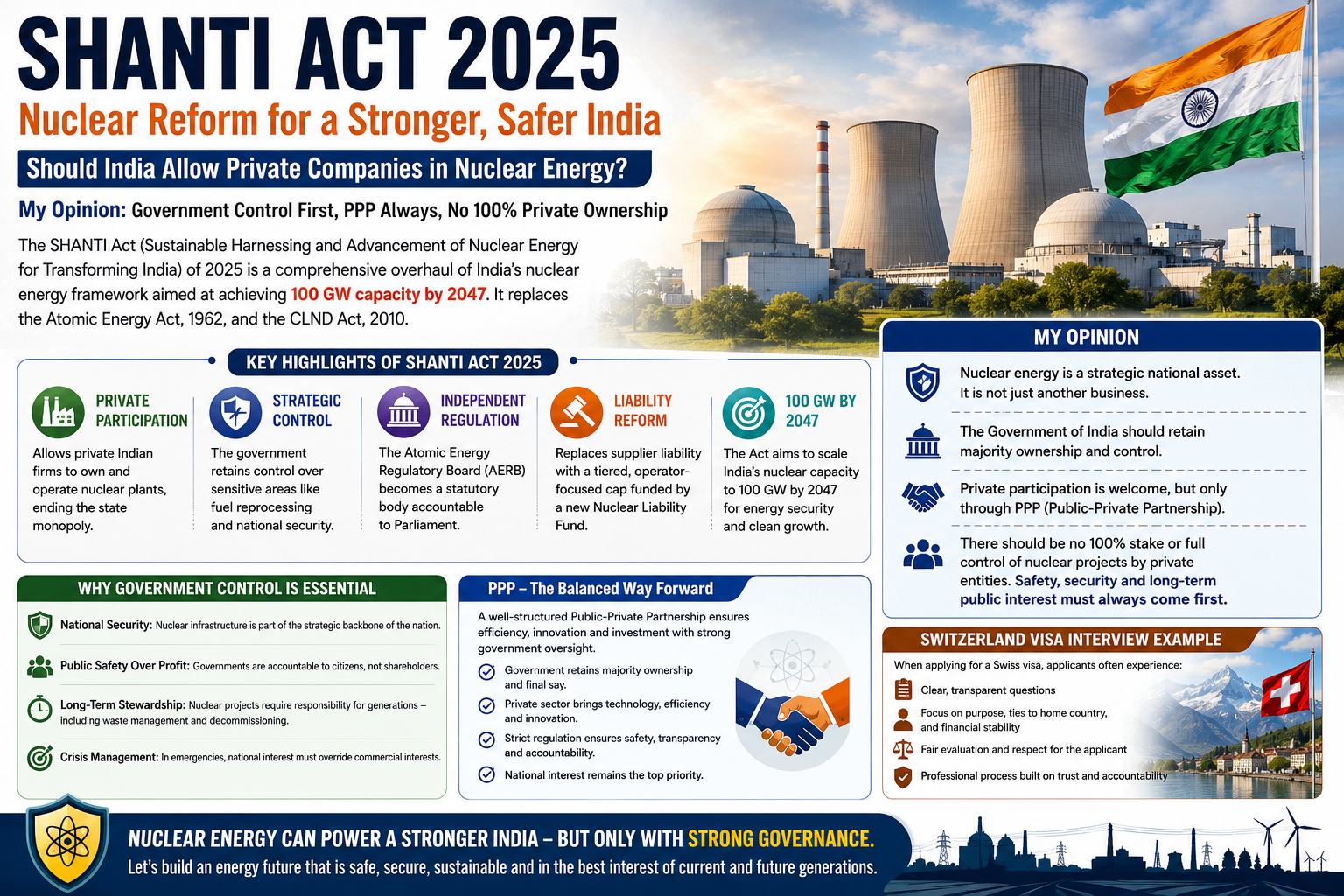
The proposed SHANTI Act (Sustainable Harnessing and Advancement of Nuclear Energy for Transforming India) seeks to modernize India’s nuclear energy framework with an ambitious goal of achieving 100 GW of nuclear power capacity by 2047.
The proposal introduces significant reforms, including replacing the Atomic Energy Act, 1962, and the Civil Liability for Nuclear Damage (CLND) Act, 2010.
Among the most debated provisions is one major change:
Allowing private Indian companies to own and operate nuclear power plants.
While supporters see this as a necessary reform to accelerate investment and energy security, I believe India must proceed with extreme caution.
In my opinion, nuclear energy should remain primarily under government control.
If private participation becomes necessary, it should only happen through carefully regulated Public-Private Partnerships (PPP) where the Government of India retains majority ownership, operational oversight, and strategic control.
Why the SHANTI Act Matters
The proposed reforms aim to:
- Expand India’s nuclear generation capacity.
- Attract private investment.
- Modernize the regulatory framework.
- Create an independent statutory nuclear regulator accountable to Parliament.
- Reform the nuclear liability framework through a dedicated Nuclear Liability Fund.
- Retain government control over highly sensitive areas such as nuclear fuel reprocessing.
These are significant structural changes that could reshape India’s energy sector for decades.
Nuclear Energy Is Different from Other Industries
Private participation has transformed sectors such as:
- Telecommunications.
- Aviation.
- Banking.
- Renewable energy.
- Manufacturing.
But nuclear energy is fundamentally different.
It is not merely about producing electricity.
It involves:
- National security.
- Strategic technology.
- Radioactive materials.
- Long-term waste management.
- International safeguards.
- Emergency preparedness.
A single operational failure can have consequences lasting generations.
That is why many countries maintain strong government oversight over their nuclear sectors.
Why I Believe the Government Should Retain Majority Control
1. National Security Cannot Be Outsourced
Nuclear infrastructure is part of a country’s strategic backbone.
Operational control should ultimately remain with the state to ensure that national security considerations always take precedence over commercial interests.
2. Public Safety Must Come Before Profit
Private companies have a responsibility to shareholders.
Governments have a responsibility to citizens.
In a sector where safety margins are critical, public accountability is essential.
3. Long-Term Stewardship
Nuclear facilities require management over many decades, including decommissioning and radioactive waste handling.
Governments are better positioned to oversee these long-term obligations.
Public-Private Partnership: A Better Path
I am not opposed to private expertise or investment.
Private companies can contribute:
- Engineering expertise.
- Advanced manufacturing.
- Construction capabilities.
- Innovation.
- Project management.
However, my preferred model is a Public-Private Partnership (PPP).
Under such an approach:
- The Government of India would retain majority ownership.
- Strategic decisions would remain under public authority.
- Private firms would participate in construction, technology, operations, and maintenance under strict regulation.
- National security responsibilities would continue to rest with the government.
This model seeks to combine private-sector efficiency with public accountability.
Independent Regulation Is a Positive Step
One notable proposal is strengthening the Atomic Energy Regulatory Board (AERB) by making it a statutory body accountable to Parliament.
An independent regulator can enhance:
- Transparency.
- Safety oversight.
- Public confidence.
- Regulatory consistency.
Strong institutions are vital regardless of who operates nuclear facilities.
Liability Reform Must Preserve Accountability
The proposal to create a Nuclear Liability Fund and revise liability rules aims to provide greater certainty for investment.
At the same time, any liability framework should continue to prioritize:
- Victim compensation.
- Safety incentives.
- Clear operational accountability.
Economic growth should never come at the expense of public safety.
India’s Energy Future
India’s electricity demand will continue to grow as the economy expands.
Meeting climate goals while ensuring energy security will require a diversified mix that includes:
- Solar power.
- Wind energy.
- Hydropower.
- Thermal generation.
- Nuclear energy.
Nuclear power can play an important role in delivering reliable, low-carbon electricity.
The question is not whether India should expand nuclear power.
The question is how that expansion should be governed.
My Opinion
In my view:
- Nuclear energy should remain a strategic national asset.
- The Government of India should retain majority ownership and control.
- If private participation is introduced, it should be through carefully regulated Public-Private Partnerships rather than complete private ownership.
- Safety, transparency, and national security should remain the guiding principles of any reform.
Conclusion
The SHANTI Act represents one of the most significant proposed changes to India’s nuclear energy policy in decades.
If implemented thoughtfully, it could strengthen India’s long-term energy security and support economic development.
At the same time, reforms in such a sensitive sector must balance investment and innovation with national security, public trust, and rigorous oversight.
For strategic infrastructure like nuclear energy, efficiency matters—but accountability matters even more.