When a Peaceful Protest Lasts for Days, What Does It Say About Democratic Engagement?
India has a long history of peaceful protests shaping public policy.
From the freedom movement to environmental campaigns, democratic dissent has often played a significant role in public debate.
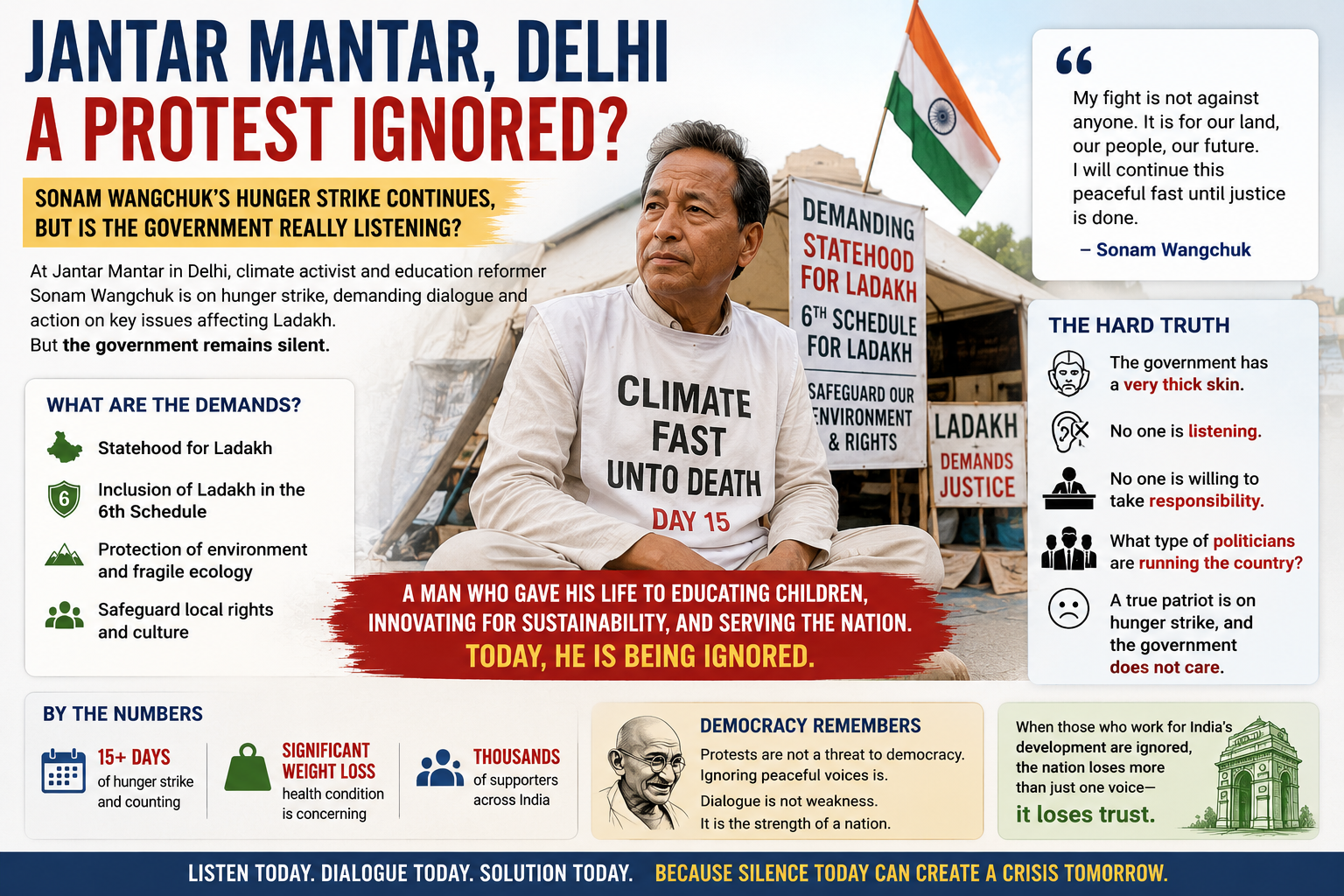
Today, climate activist and education reform advocate Sonam Wangchuk is once again at the center of national attention as his hunger strike at Delhi’s Jantar Mantar continues, raising concerns about his health and renewing debate over how governments respond to prolonged peaceful protests. Reports indicate he has lost significant weight during the fast, while doctors and supporters continue to monitor his condition closely.
Why This Protest Matters
Sonam Wangchuk is widely known for his work in sustainable development, education, and environmental conservation.
His latest hunger strike has become part of a broader protest movement demanding accountability over public issues. As the protest has continued, supporters have repeatedly appealed to the government for dialogue rather than prolonged silence.
Regardless of political affiliation, one fact remains clear:
A prolonged hunger strike by a nationally recognized public figure naturally raises questions about how democratic institutions engage with peaceful protest.
A Democracy Is Judged by How It Responds to Peaceful Dissent
Every elected government faces criticism.
Every democracy witnesses protests.
That alone is not unusual.
The real test comes afterward.
How quickly does the government engage?
Is there meaningful dialogue?
Are grievances acknowledged even when they are not immediately accepted?
These are questions that matter in every constitutional democracy.
Growing Concern Over Wangchuk’s Health
As the fast has continued, multiple reports have described significant weight loss and growing health concerns, even as Wangchuk has stated that he remains committed to continuing the protest peacefully.
For many observers, the issue is now larger than any single demand.
It has become a discussion about the human cost of prolonged democratic protest.
Silence Often Creates More Questions Than Answers
Governments are not obligated to accept every demand placed before them.
However, prolonged silence or delayed engagement often creates greater public scrutiny.
When protests continue for days or weeks without visible political engagement, citizens naturally begin asking:
- Has meaningful dialogue begun?
- Is the government considering the demands?
- What steps, if any, are being taken to resolve the impasse?
These are questions that become more prominent the longer a protest continues.
Peaceful Protest Is Part of Democratic Life
India’s Constitution protects freedom of expression and peaceful assembly, subject to reasonable restrictions.
Throughout Indian history, peaceful protest has often served as a way for citizens to draw attention to issues they believe require urgent action.
Whether people agree or disagree with the specific demands being made, the right to peaceful protest remains an important part of democratic life.
Why Public Dialogue Matters
History shows that many major public disputes are eventually resolved through conversation rather than confrontation.
Constructive dialogue can:
- Reduce public tension.
- Improve trust.
- Clarify misunderstandings.
- Build confidence in democratic institutions.
Even when agreement is not reached immediately, communication itself can strengthen public confidence.
The Bigger Picture
The current protest has become about more than one individual.
It has prompted broader conversations about:
- Democratic accountability.
- Government responsiveness.
- Peaceful civic participation.
- Public trust in institutions.
These discussions are likely to continue regardless of how the immediate protest concludes.
Conclusion
Sonam Wangchuk’s hunger strike has once again brought national attention to the relationship between citizens, protest, and government accountability.
As his health remains under public scrutiny, many Indians are watching not only the protest itself but also how democratic institutions respond.
Ultimately, a democracy is not measured solely by elections.
It is also measured by how it listens to peaceful voices, especially when those voices continue speaking through sacrifice rather than confrontation.