From London’s CJI Event to Modi’s Media Avoidance Debate, Is India Facing a Transparency Problem?
India proudly calls itself the world’s largest democracy.
A democracy is not measured by election rallies, slogans, or government advertisements.
A democracy is measured by something much simpler:
How its leaders respond when faced with uncomfortable questions.
And lately, many citizens are beginning to notice a pattern.
When difficult questions arise—whether about press freedom, dissent, institutional independence, or government accountability—the answers often seem incomplete, defensive, or absent altogether.
The London Incident That Sparked Debate
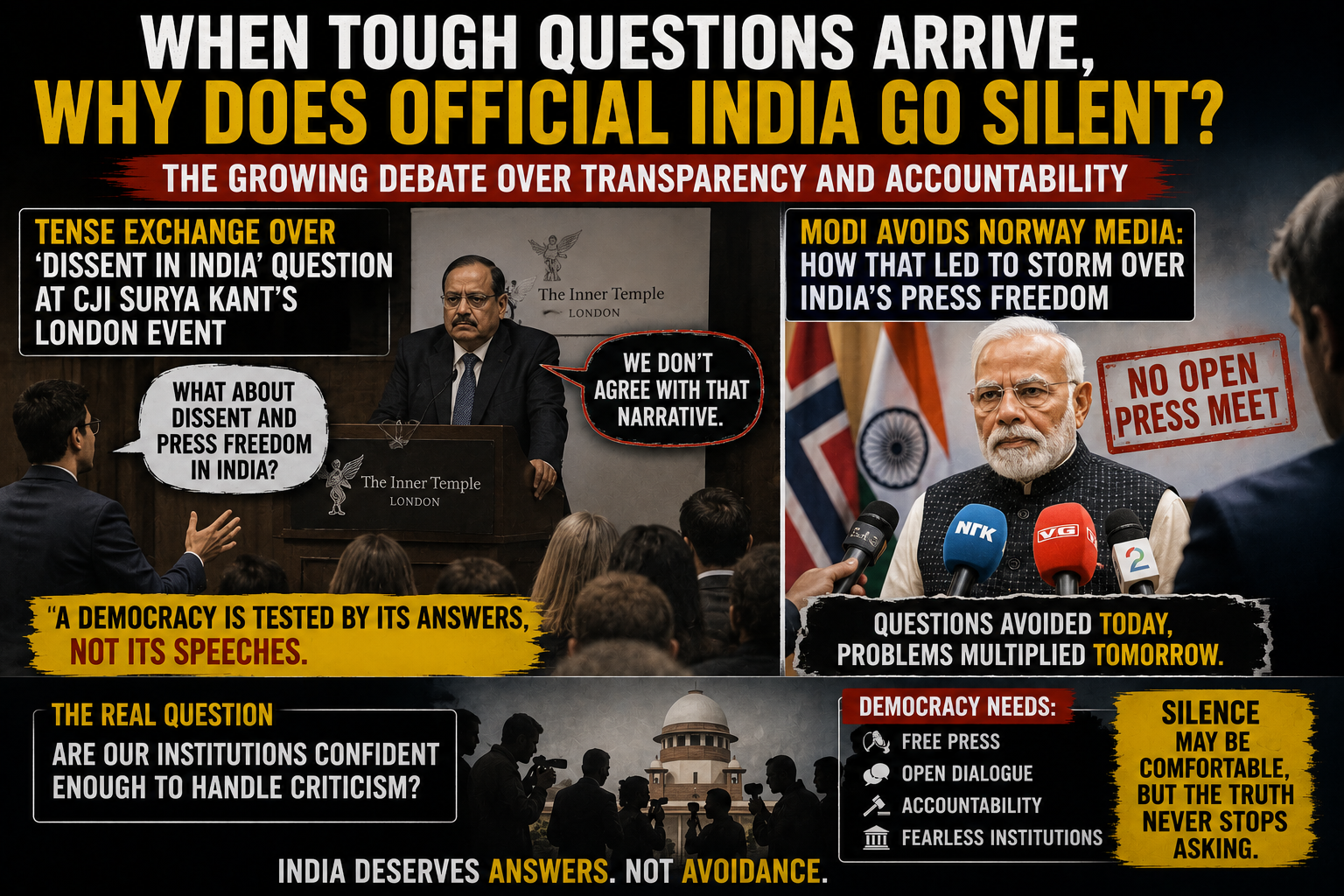
Recent discussions surrounding a lecture event involving Chief Justice Surya Kant in London generated significant attention after audience members reportedly raised questions related to dissent, democracy, and freedom of expression in India.
The controversy was not necessarily about the question itself.
The controversy was about perception.
Many observers felt that the exchange highlighted a growing discomfort among India’s institutions when confronted with critical questions from young people, academics, and international audiences.
Fair or unfair, that perception is spreading.
Why Are Students Asking These Questions?
Students today are not living in the pre-internet era.
They consume information from:
- International media
- Independent journalists
- Government statements
- Social media platforms
- Academic publications
As a result, they ask difficult questions.
And they expect direct answers.
When those answers are not forthcoming, speculation fills the gap.
The Norway Media Episode
Another discussion that attracted attention involved Prime Minister Narendra Modi’s foreign visit and the subsequent debate over media interactions.
Critics argued that opportunities for unscripted questioning from international journalists appeared limited.
Supporters dismissed the criticism as politically motivated.
But once again, the issue was perception.
When leaders regularly communicate through speeches, social media posts, and controlled appearances while avoiding spontaneous questioning, critics naturally begin asking:
What is the government unwilling to discuss?
The Press Freedom Debate Refuses to Disappear
Whether one agrees with international rankings or not, concerns regarding press freedom continue to generate global attention.
The government’s supporters often argue that criticism is exaggerated and politically motivated.
Critics argue that journalists face increasing pressure and that difficult questions are becoming less welcome in public discourse.
Regardless of which side is correct, the issue keeps returning because the underlying concerns have not disappeared.
Democracy Requires More Than Communication
Modern governments are excellent at communication.
There are speeches.
There are social media campaigns.
There are videos.
There are announcements.
But communication is not the same thing as accountability.
Accountability requires something more difficult:
Answering questions you do not want to answer.
A leader’s strength is not tested when speaking to supporters.
It is tested when responding to critics.
Why Silence Creates Bigger Problems
Governments often assume that avoiding controversial topics reduces political damage.
History suggests the opposite.
When institutions avoid difficult conversations:
- Public trust declines.
- Rumors increase.
- Speculation grows.
- Credibility suffers.
People naturally begin filling informational gaps with their own conclusions.
Transparency is often the cheapest solution to a credibility problem.
The Real Issue Is Confidence
Strong institutions do not fear criticism.
Strong institutions welcome scrutiny because they are confident in their decisions.
The moment institutions appear uncomfortable with questions, citizens begin asking even more questions.
That is exactly what appears to be happening today.
Across social media, university campuses, and public discussions, many Indians are not demanding perfection.
They are demanding explanations.
India’s Global Image Depends on More Than Economic Growth
India’s rise as a global power is real.
The country is growing economically.
Its diplomatic influence is expanding.
Its geopolitical importance continues increasing.
But global credibility is built on more than GDP figures.
It is built on:
- Institutional confidence
- Public trust
- Press freedom
- Open debate
- Democratic accountability
These factors matter just as much as economic indicators.
Why Citizens Are Frustrated
Many citizens feel that important questions remain unanswered.
Questions about:
- Press freedom
- Dissent
- Institutional independence
- Economic concerns
- Examination controversies
- Employment opportunities
continue surfacing repeatedly.
The frustration comes not from disagreement.
The frustration comes from the perception that genuine questions are often treated as attacks rather than opportunities for discussion.
The Bigger Question
The issue is not whether India faces criticism.
Every democracy faces criticism.
The real question is:
Can India’s leaders and institutions confidently engage with criticism instead of avoiding it?
Because in a democracy, difficult questions are not a threat.
They are part of the job.
Conclusion
India’s future as a global democratic power will depend not only on economic growth and geopolitical influence but also on its willingness to embrace scrutiny.
Citizens do not expect leaders to have perfect answers.
They expect leaders to answer.
When tough questions are met with silence, deflection, or discomfort, the questions do not disappear.
They become louder.
And in a democracy, that is exactly what should happen.