From Russian Oil to Washington’s Approval: Is New Delhi Still Calling the Shots?
For decades, India proudly projected itself as a nation that could not be dictated to by any global power.
Whether it was the Soviet Union, the United States, China, or Europe, India’s message was simple:
India will decide what is best for India.
But today, many citizens are beginning to wonder whether that principle is slowly fading.
The question is becoming increasingly common:
Why does it sometimes appear that India’s foreign policy decisions are becoming too closely aligned with American interests?
This is not a conspiracy theory.
It is a question being openly debated by analysts, economists, diplomats, and ordinary citizens.
Why Does Every Major Decision Seem to Involve Washington?
India is a sovereign nation of more than 1.4 billion people.
Yet many geopolitical developments increasingly create the perception that New Delhi must constantly calculate how Washington will react before making major decisions.
When discussions emerge about:
- Russian oil imports
- Global sanctions
- Trade agreements
- Defense purchases
- Technology partnerships
the United States often appears somewhere in the background.
The question many Indians ask is simple:
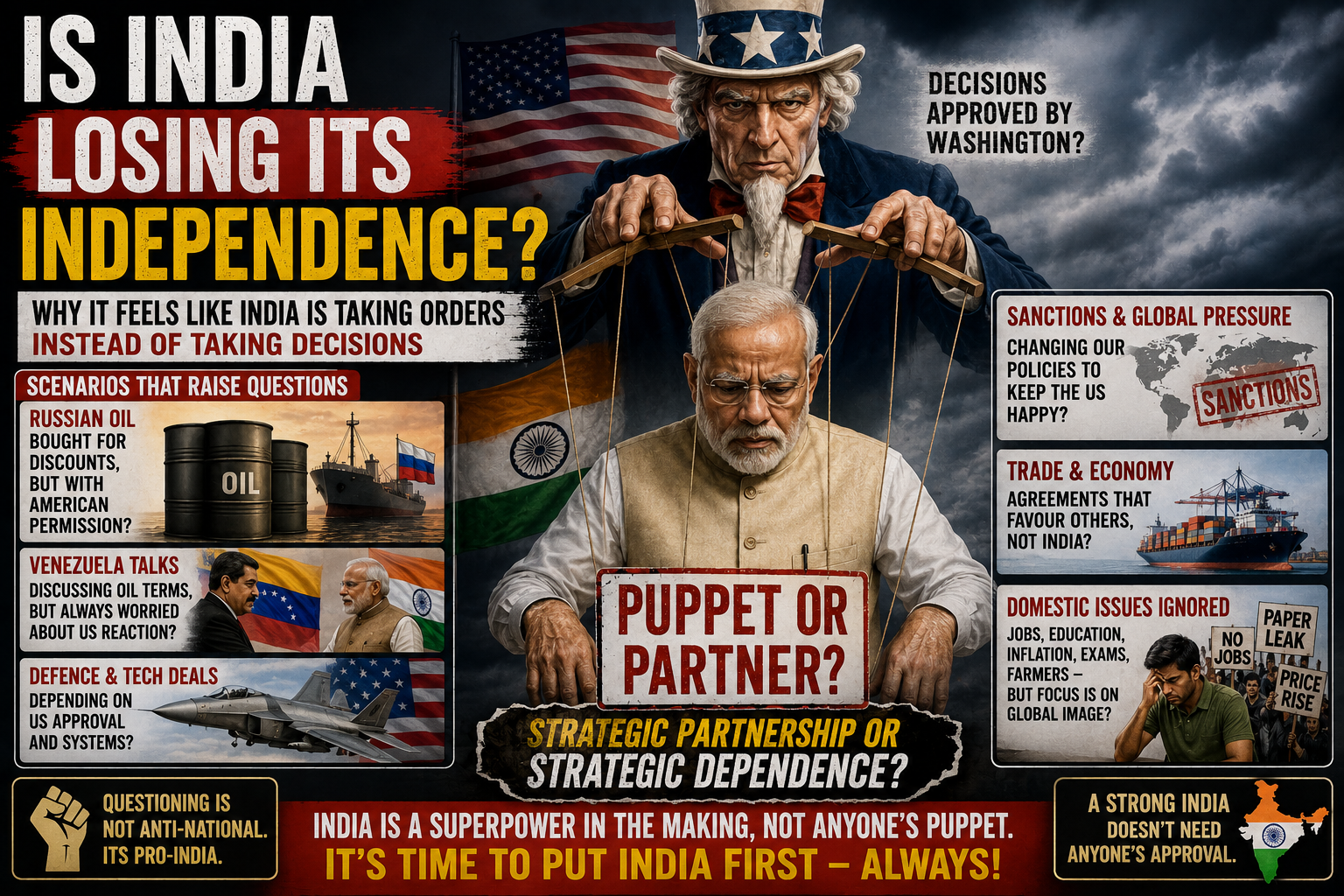
Why should India’s national interest require approval from anyone?
The Russian Oil Example
One of the strongest examples frequently cited is Russian crude oil.
India continued buying Russian oil despite Western pressure because it was economically beneficial.
Many citizens applauded the decision.
But critics argue that the very fact that commentators constantly discuss whether America “allows” or “tolerates” these purchases reveals an uncomfortable reality.
Why should Indians even be discussing permission from another country when making decisions that affect India’s energy security?
The Venezuela Question
Energy diplomacy provides another example.
Whenever India explores relationships with sanctioned or politically sensitive countries, the discussion often shifts toward potential American reactions rather than India’s requirements.
For many observers, this creates a troubling impression:
Instead of asking what India needs, political discussions increasingly focus on what Washington might accept.
That perception alone raises questions about strategic autonomy.
What Happened to Non-Alignment?
India’s historical foreign policy was based on independence.
The goal was not neutrality.
The goal was freedom.
Freedom to trade.
Freedom to negotiate.
Freedom to disagree.
Freedom to act according to Indian interests.
Many critics argue that modern foreign policy sometimes appears more focused on geopolitical alignment than genuine independence.
Meanwhile, What About Domestic Problems?
Foreign policy debates are important.
But many citizens are asking an even tougher question.
Why does the government often appear more comfortable discussing international diplomacy than addressing domestic frustrations?
People are worried about:
- Job creation
- Rising costs of living
- Examination controversies
- Recruitment delays
- Public sector vacancies
- Agricultural challenges
Many citizens feel these issues deserve the same urgency that international partnerships receive.
The Optics Problem
Politics is often about perception.
Even when governments make rational strategic decisions, perceptions matter.
And right now, many citizens perceive that:
- Washington’s approval is increasingly important.
- Domestic concerns receive less attention than grand diplomatic narratives.
- Geopolitical branding sometimes overshadows governance outcomes.
Whether that perception is entirely fair is almost beside the point.
The perception itself has become politically significant.
Strategic Partnership Is Not the Same as Strategic Dependence
There is nothing wrong with maintaining strong relations with the United States.
Every major economy seeks partnerships.
The problem begins when partnerships create the appearance of dependence.
A confident nation should be able to:
- Work with America.
- Buy oil from Russia.
- Trade with Europe.
- Engage with the Middle East.
- Participate in BRICS.
without appearing beholden to any single power center.
The Real Concern
The concern is not America.
The concern is not Russia.
The concern is whether India’s policymakers are still placing Indian interests above everything else.
Citizens are entitled to ask difficult questions when they see:
- Economic challenges at home.
- Youth frustration.
- Growing political polarization.
- Increasing emphasis on image management.
Democracy becomes weaker when questioning government priorities is treated as disloyalty.
Conclusion
India is too large, too important, and too powerful to function as anyone’s junior partner.
The country does not need permission from Washington, Moscow, Beijing, or any other capital to pursue its interests.
The real debate is not whether India has become a puppet.
The real debate is whether India’s leaders are demonstrating the independence, confidence, and accountability that citizens expect from a nation that aspires to be a global power.
And until those questions are convincingly answered, the debate will continue.