From Exam Controversies to Economic Anxiety: What Are the Real Priorities?
In a democracy, governments are expected to listen carefully to the concerns of citizens. Whether the issue is education, jobs, economic growth, inflation, or public accountability, people expect leaders to address the challenges affecting their daily lives.
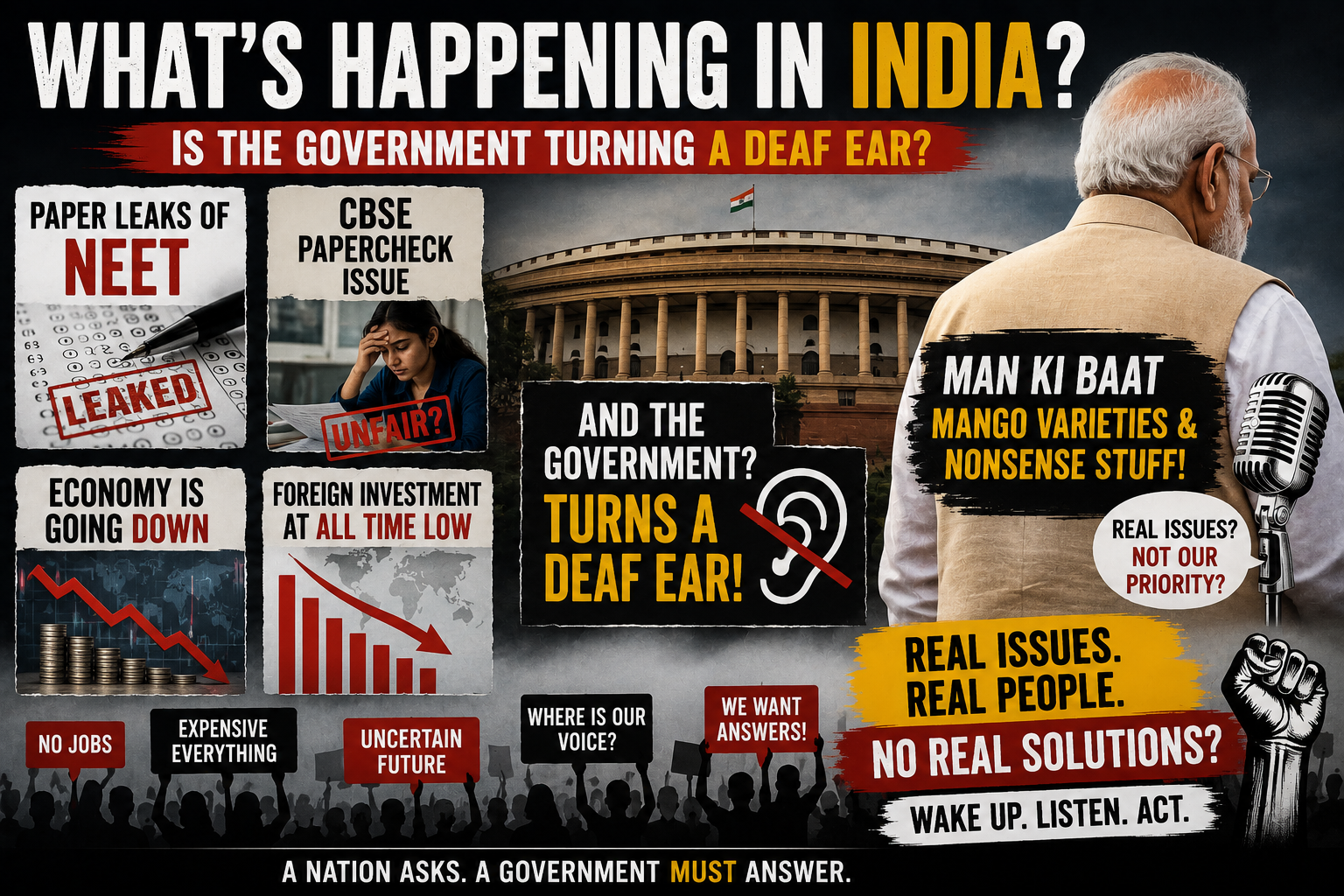
However, a growing section of Indians is asking a difficult question:
Is the government turning a deaf ear to some of the country’s most pressing concerns?
The Exam Crisis That Refuses to Go Away
Over the past few years, competitive examinations have become a major source of frustration for students and parents.
Controversies surrounding examination management, allegations of paper leaks in various recruitment and entrance exams, concerns over evaluation processes, and delays in results have repeatedly dominated public discussions.
For many students, years of preparation, financial investment, and emotional commitment depend on these examinations.
When controversies emerge, students often feel that their future is being treated as a secondary issue rather than a national priority.
The demand from students has remained simple:
- Greater transparency
- Faster investigations
- Stronger accountability
- Better examination security
Yet many continue to feel that their concerns are not receiving the attention they deserve.
The Economy Debate
Economic discussions have also become increasingly polarized.
Supporters of the government point to infrastructure projects, digital transformation, manufacturing initiatives, and growth projections.
Critics, however, argue that everyday economic realities tell a more complicated story.
Questions frequently raised include:
- Are enough quality jobs being created?
- Why are young graduates struggling to find employment?
- Why do many families feel increasing financial pressure?
- Are small businesses receiving sufficient support?
While economists disagree on the severity of these issues, the concerns themselves are very real for millions of households.
Foreign Investment and Business Confidence
Another topic that frequently appears in economic discussions is foreign investment.
Investment flows naturally fluctuate depending on global conditions, interest rates, geopolitical events, and domestic policies.
However, critics argue that India must continuously work to maintain investor confidence through:
- Policy stability
- Regulatory clarity
- Ease of doing business
- Judicial efficiency
- Predictable governance
The debate is not simply about investment numbers. It is about whether India is creating the conditions necessary for long-term economic confidence.
The Growing Disconnect
Perhaps the biggest criticism from some sections of society is not about a single issue.
It is about priorities.
Many citizens believe discussions about:
- Education reforms
- Employment opportunities
- Healthcare challenges
- Agricultural concerns
- Examination integrity
- Economic uncertainty
should receive greater attention in national conversations.
When people struggling with these issues hear discussions that appear disconnected from their daily realities, frustration naturally grows.
Democracy Requires Questions
A healthy democracy does not fear questions.
In fact, questions are essential.
Citizens have the right to ask:
- Why are examination controversies recurring?
- What is being done to improve job creation?
- How will economic concerns be addressed?
- What steps are being taken to improve institutional accountability?
Asking these questions is not anti-government.
It is part of democratic participation.
Governments gain trust not by avoiding criticism but by responding to it openly and transparently.
Leadership and Public Expectations
Every government faces criticism.
Every administration must balance competing priorities.
But public expectations also evolve.
Today’s citizens are more informed, more connected, and more vocal than ever before.
They want:
- Results
- Transparency
- Accountability
- Honest communication
Political messaging alone is rarely enough to satisfy people facing real-world challenges.
The Bigger Question
The real debate is not about one speech, one policy, or one political party.
The real question is whether public concerns are being heard with the seriousness they deserve.
India is a young nation with enormous potential.
Its students, workers, entrepreneurs, farmers, and professionals all want the same thing:
A government that listens as much as it speaks.
Conclusion
India’s future will not be determined by political slogans alone.
It will be determined by how effectively institutions address concerns related to education, employment, economic opportunity, governance, and public trust.
Citizens will continue to ask questions.
And in a democracy, that is exactly how it should be.
The challenge for any government is not to silence those questions—but to answer them.