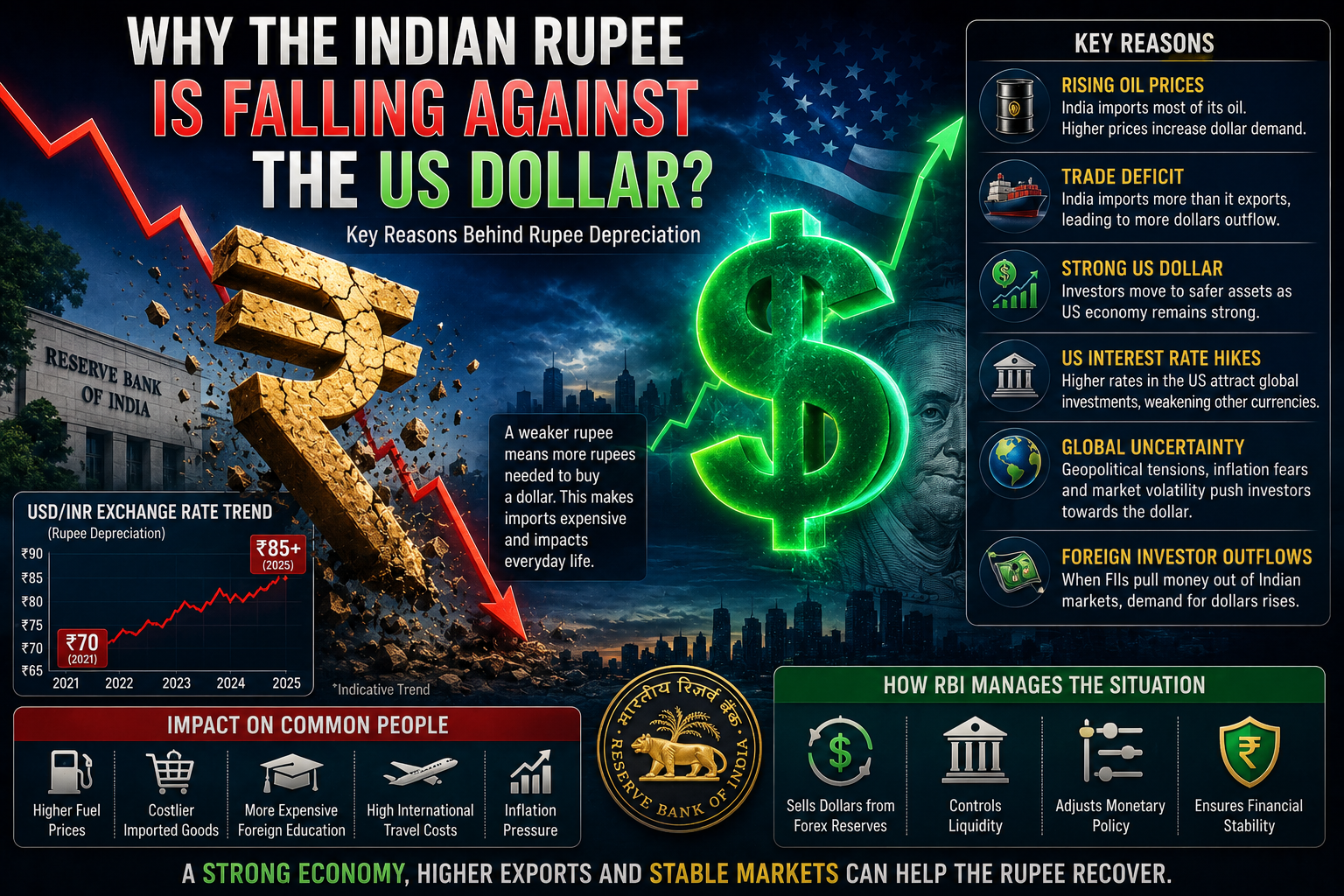
The falling value of the Indian rupee against the U.S. dollar has once again become one of the most searched economic topics in India.
Searches for:
- “Why rupee is falling against dollar”
- “Indian rupee vs US dollar”
- “USD INR today”
- “rupee depreciation reasons”
- “why dollar is getting stronger”
have surged as people notice rising import costs, fuel prices, foreign investment shifts, and global economic uncertainty.
The weakening rupee impacts:
- fuel prices
- imported goods
- foreign education costs
- international travel
- inflation
- stock markets
But why exactly is the rupee falling against the dollar?
The answer involves global economics, trade imbalances, geopolitics, oil prices, and investor confidence.
What Does It Mean When the Rupee Falls?
When people say the rupee is “falling,” it means:
More Indian rupees are needed to buy one US dollar.
For example:
- Earlier: $1 = ₹70
- Later: $1 = ₹85
This means the rupee has weakened or depreciated.
A weaker currency reduces purchasing power internationally and makes imports more expensive.
Why the US Dollar Is Becoming Stronger Globally
One major reason behind rupee weakness is the global strength of the United States dollar.
During periods of global uncertainty, investors worldwide often move money into dollar-based assets because the dollar is considered safer.
This usually happens during:
- wars and geopolitical tensions
- economic slowdowns
- inflation fears
- financial instability
As global demand for dollars increases, many currencies — including the rupee — weaken.
Oil Imports Are a Major Reason
India imports a large amount of crude oil from international markets.
Oil is generally traded globally in:
- US dollars
So when oil prices rise or the dollar strengthens:
- India needs more dollars
- demand for dollars increases
- pressure on the rupee rises
This is one of the biggest structural reasons behind rupee depreciation.
Trade Deficit and Currency Pressure
Another major factor is the trade deficit.
A trade deficit occurs when a country imports more goods than it exports.
If India buys more from foreign countries than it sells internationally:
- more dollars leave the country
- demand for dollars increases
- rupee weakens further
Economists closely monitor trade balance because it directly affects currency strength.
Foreign Investors and Stock Market Impact
Global investors also play a huge role in currency movement.
When foreign institutional investors pull money out of Indian markets:
- they convert rupees into dollars
- dollar demand rises
- rupee falls
This often happens when:
- US interest rates increase
- global markets become unstable
- investors prefer safer assets
The relationship between stock markets and currency markets has become very strong in today’s global economy.
US Interest Rates Affect the Entire World
The Federal Reserve strongly influences global financial markets.
When the Federal Reserve raises interest rates:
- US investments become more attractive
- investors move money into dollar assets
- emerging market currencies weaken
This affects countries worldwide, including India.
Geopolitical Tensions Also Impact the Rupee
Global conflicts and geopolitical instability can weaken emerging-market currencies.
Major global concerns involving:
- Middle East tensions
- trade wars
- sanctions
- energy disruptions
- global conflicts
often increase demand for safe-haven currencies like the US dollar.
As fear rises globally, the rupee may come under additional pressure.
Inflation and Currency Value
Inflation is another critical factor.
If inflation rises faster in one country compared to another:
- purchasing power weakens
- currency value may decline over time
High inflation can reduce international investor confidence and contribute to currency depreciation.
Is Rupee Weakness Always Bad?
Not necessarily.
A weaker rupee can also help certain sectors.
Exports Become More Competitive
Indian goods become cheaper internationally.
This may benefit:
- IT services
- pharmaceuticals
- textile exports
- manufacturing exports
However, excessive depreciation can create inflation and economic instability.
How the RBI Tries to Control Rupee Volatility
The Reserve Bank of India actively monitors currency fluctuations.
The RBI may intervene by:
- selling dollars from forex reserves
- controlling liquidity
- adjusting monetary policy
The goal is usually not to completely stop rupee movement, but to prevent extreme volatility.
Why Ordinary People Feel the Impact
A weaker rupee affects daily life in many ways.
Higher Fuel Prices
Oil imports become more expensive.
Costlier Electronics
Imported goods like phones and laptops may cost more.
Foreign Education Expenses Rise
Students studying abroad pay more in rupee terms.
International Travel Becomes Expensive
Flights, hotels, and foreign spending increase in cost.
Can the Rupee Recover?
Currency movements depend on several factors:
- global economic stability
- oil prices
- investor confidence
- export growth
- central bank policy
If economic conditions improve and capital inflows increase, the rupee could stabilize or strengthen over time.
Global Currency Competition Is Increasing
The world economy is also changing rapidly due to:
- BRICS discussions
- de-dollarization debates
- digital currencies
- central bank policy shifts
Many countries are exploring alternatives to reduce dependence on the dollar, though the dollar remains the dominant global reserve currency today.
Conclusion
The falling value of the Indian rupee against the United States dollar is not caused by a single issue.
It is the result of multiple global and domestic factors including:
- oil imports
- trade deficits
- global uncertainty
- investor behavior
- US interest rates
- geopolitical tensions
While currency fluctuations are a normal part of global economics, the impact is deeply connected to everyday life — from fuel prices to travel costs and inflation.
One thing is certain:
The future of the rupee will depend not only on India’s economy, but also on the rapidly changing global financial system
FAQs
Why is the rupee falling against the dollar?
Because of factors like rising dollar strength, oil imports, trade deficits, and global economic uncertainty.
Does a weak rupee affect common people?
Yes. It can increase fuel prices, imported goods costs, and foreign travel expenses.
Can the RBI stop rupee depreciation?
The RBI can manage volatility through interventions, but currency values are also influenced by global markets.
Is a weaker rupee always negative?
Not entirely. It can help exports become more competitive globally.