Democracy Cannot Function if Citizens Lose Trust in What Is Said in Parliament
Parliament is supposed to be the temple of Indian democracy.
For millions of Indians, statements made in Parliament carry enormous weight. Citizens assume that when ministers stand before the nation and speak in the House, they are presenting facts that have been verified by the government.
But what happens when citizens believe there are contradictions between statements made in Parliament and information released later through official channels?
That is a question India cannot afford to ignore.
The Operation Sindoor Debate Raises Difficult Questions
Recent public discussions surrounding Operation Sindoor have reignited an old but important debate:
Can citizens always trust what governments tell them?
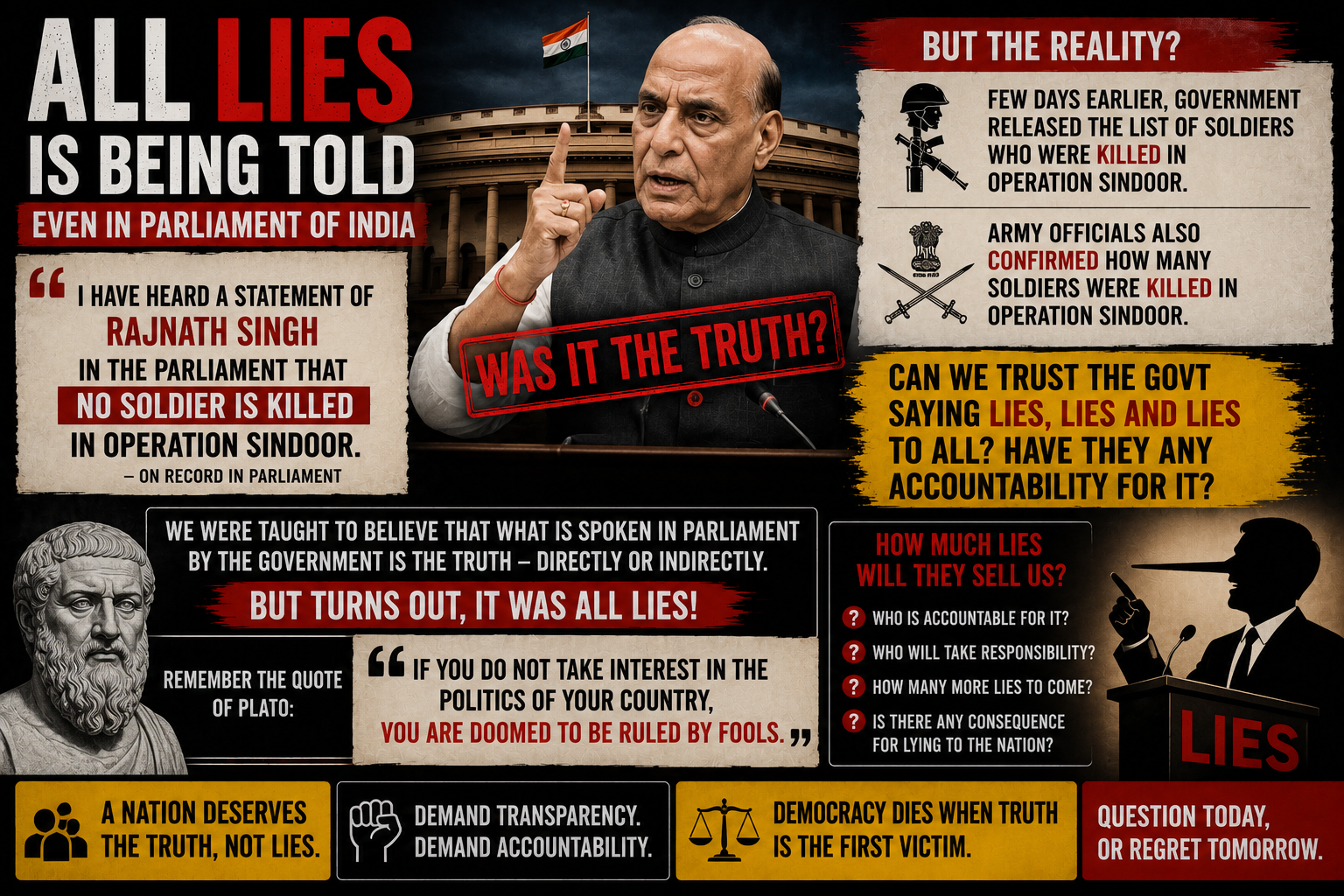
Some citizens and commentators have pointed to apparent differences between statements made by senior leaders in Parliament and subsequent information released by official sources regarding casualties.
If such discrepancies exist, they deserve clarification.
Because in a democracy, transparency is not optional.
It is essential.
Parliament Is Not a Political Rally
Political rallies are designed to persuade.
Parliament is different.
Parliament exists to inform, legislate, and hold the executive accountable.
When ministers speak in Parliament, those words become part of the official record of the Republic of India.
That is precisely why accuracy matters.
If there are contradictions between parliamentary statements and later official disclosures, the government should explain them clearly and publicly.
Silence only deepens public distrust.
Trust Once Lost Is Difficult to Recover
Governments of every political party depend on public trust.
When citizens begin asking whether they can believe official statements, democracy itself suffers.
People start asking:
- Are all facts being disclosed?
- Are difficult truths being withheld?
- Who verifies information before it is presented in Parliament?
- Who is accountable if official statements turn out to be inaccurate?
These are not anti-government questions.
These are pro-democracy questions.
Accountability Is the Foundation of Democracy
No government is perfect.
Mistakes happen.
Information evolves during military operations and national security events.
However, if errors occur in official statements, democratic accountability demands:
- Clarification.
- Correction.
- Transparency.
- Responsibility.
Strong democracies do not fear corrections.
Strong democracies welcome them.
Plato’s Warning Still Resonates
The famous quote often attributed to the Greek philosopher Plato remains relevant even today:
“One of the penalties for refusing to participate in politics is that you end up being governed by your inferiors.”
Regardless of the exact wording or historical attribution, the message is clear:
Citizens must remain engaged, informed, and willing to ask difficult questions.
Democracy is not a spectator sport.
Patriotism Does Not Mean Blind Acceptance
Questioning governments is not anti-national.
Demanding accountability is not disloyalty.
In fact, holding governments accountable is one of the highest forms of democratic participation.
Every government—past, present, and future—must be subject to scrutiny.
Because governments serve the people.
The people do not serve governments.
The Bigger Question
The real issue is larger than one statement, one minister, or one operation.
The bigger question is this:
Can Indian citizens continue to trust that information presented in Parliament is accurate, complete, and truthful?
That trust is the foundation upon which democratic legitimacy rests.
Once citizens begin doubting official institutions, rebuilding confidence becomes extraordinarily difficult.
Conclusion
India is the world’s largest democracy.
Its institutions are strongest when they are transparent, accountable, and open to scrutiny.
If citizens perceive inconsistencies between parliamentary statements and official records, the government owes the nation a clear explanation.
Because democracies do not weaken when questions are asked.
They weaken when questions go unanswered.
And in a democracy, accountability is not a favor granted by governments.
It is a duty owed to the people.