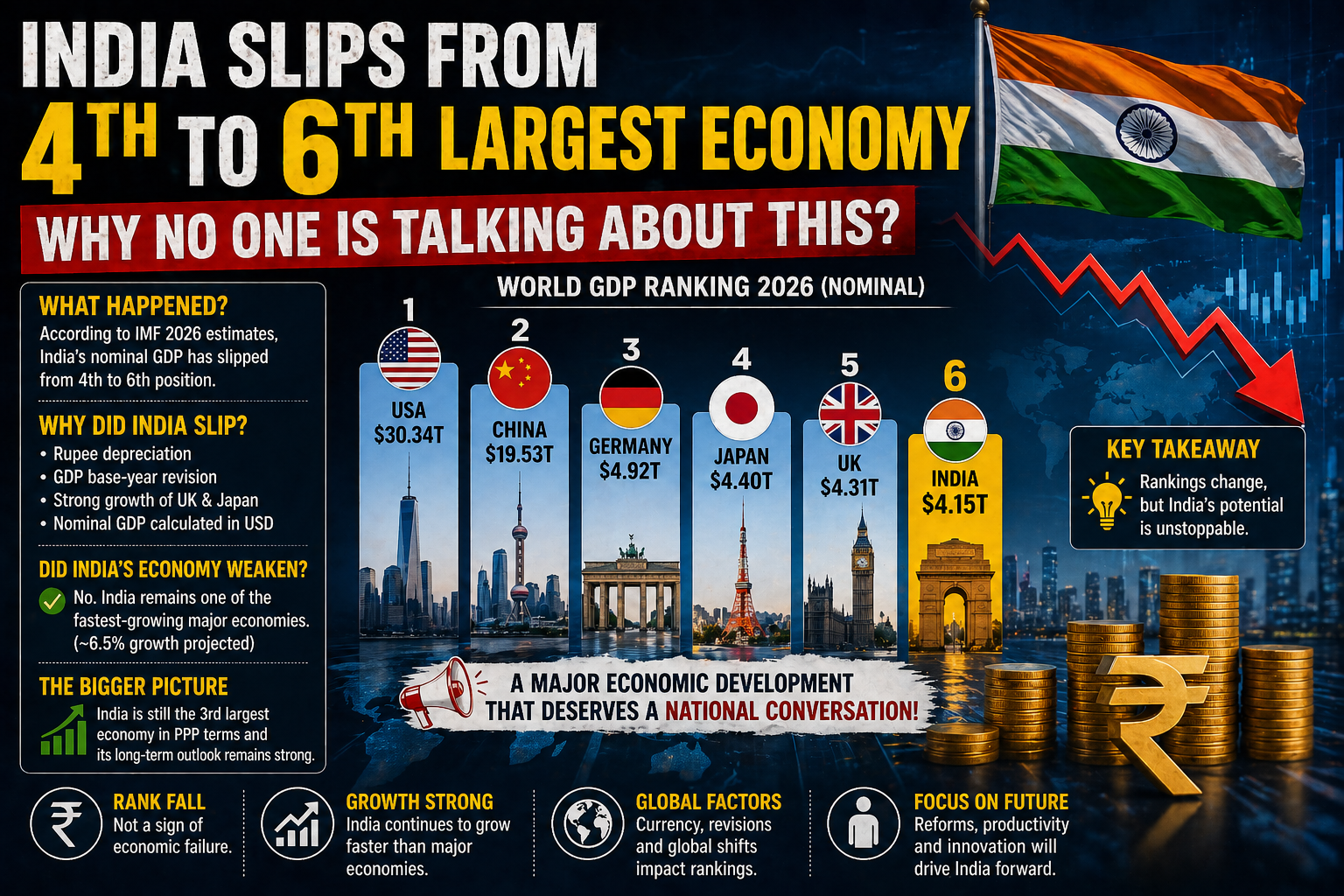
In one of the most significant economic developments of 2026, India has officially slipped from the 4th largest economy to the 6th largest economy in the world in terms of nominal GDP, according to the latest IMF World Economic Outlook estimates.
Surprisingly, despite the scale of this development, the issue has not received the level of public debate it deserves.
This is not a small ranking change.
Moving two positions down in the global GDP ranking is a major economic headline.
So the obvious question is:
Why is no one talking about India moving from 4th to 6th position?
Let’s understand what actually happened.
India’s GDP Ranking in 2026
According to the IMF’s latest estimates, India now stands at approximately:
$4.15 trillion nominal GDP
This places India behind:
- United States
- China
- Germany
- Japan
- United Kingdom
- India
This means India has moved below both Japan and the United Kingdom.
Did India’s Economy Actually Shrink?
The short answer is:
No
This is the most important part of the story.
India’s economy has not shrunk in real terms.
In fact, India continues to remain one of the fastest-growing major economies in the world, with projected growth around 6.5%.
So why did the rank fall?
The answer lies in nominal dollar calculations.
The Real Reason: Rupee Depreciation
Global GDP rankings are measured in US dollars.
This means that even if India grows strongly in rupee terms, a weaker rupee can make the economy look smaller in dollar terms.
For example:
If India’s GDP grows in INR but the rupee weakens against USD, then the converted dollar value decreases.
This is exactly what happened.
A weaker rupee significantly impacted India’s ranking.
So this is more of a currency effect than a collapse in domestic growth.
Why No One Is Talking About It
This is where the discussion becomes interesting.
A large part of public discourse often focuses on:
- GDP growth percentage
- fastest-growing economy narrative
- domestic reforms
- stock market sentiment
Because India still remains the fastest-growing major economy, the narrative around growth remains positive.
As a result, the ranking shift has not become a mainstream public conversation.
Growth vs Ranking: Two Different Stories
A lot of people confuse growth rate with global rank.
These are two different metrics.
Growth Rate
How fast the economy is expanding
GDP Rank
How large the economy is compared to other countries in USD
So India can grow fast and still lose rank if:
- currency weakens
- others grow faster in dollar terms
- statistical revisions happen
This is exactly what happened.
Why This Matters
Some may say rankings are only symbolic.
That is only partly true.
GDP rank affects:
- investor perception
- global economic influence
- capital flows
- policy narrative
- international standing
This is why such shifts matter.
Even community discussions on finance forums are actively debating this ranking drop.
The Positive Side Nobody Should Ignore
Despite the drop, India’s long-term outlook remains strong.
IMF projections suggest India could regain higher positions in coming years.
India also remains:
3rd largest economy in PPP terms
This is a major positive indicator.
Why the Public Debate Is Important
The issue is not about panic.
The issue is transparency.
People should understand that:
rank fell does not mean economy failed
But it also should not be ignored.
A healthy economy discussion requires understanding:
- nominal GDP
- real GDP
- currency effects
- comparative ranking
Conclusion
India’s move from 4th to 6th position in global GDP rankings is a major economic development that deserves more public discussion.
However, the fall is not due to economic collapse.
It is largely driven by:
- rupee depreciation
- GDP base-year revision
- nominal USD conversion effects
At the same time, India continues to be one of the fastest-growing major economies globally.
So the real story is not decline.
The real story is:
how global rankings can change even when growth remains strong
FAQs (SEO Rich Snippet Ready)
Did India’s GDP fall in 2026?
Not in real terms. The ranking shift is mainly due to nominal USD calculations and currency effects.
Why did India move from 4th to 6th?
Main reasons include rupee depreciation and GDP base-year revision.
Is India still growing?
Yes, India remains one of the fastest-growing major economies.