The phrase “Thucydides Trap” has once again become a globally searched geopolitical term after Xi Jinping reportedly referenced it during discussions involving Donald Trump.
Searches for:
- “What is the Thucydides Trap?”
- “Xi Jinping Donald Trump meeting”
- “US China conflict theory”
- “Thucydides Trap explained”
have surged online as people try to understand why this ancient political theory remains central to modern U.S.-China relations.
The concept has become increasingly important in discussions surrounding:
- global power competition
- China–US tensions
- military rivalry
- trade conflicts
- international diplomacy
What Is the Thucydides Trap?
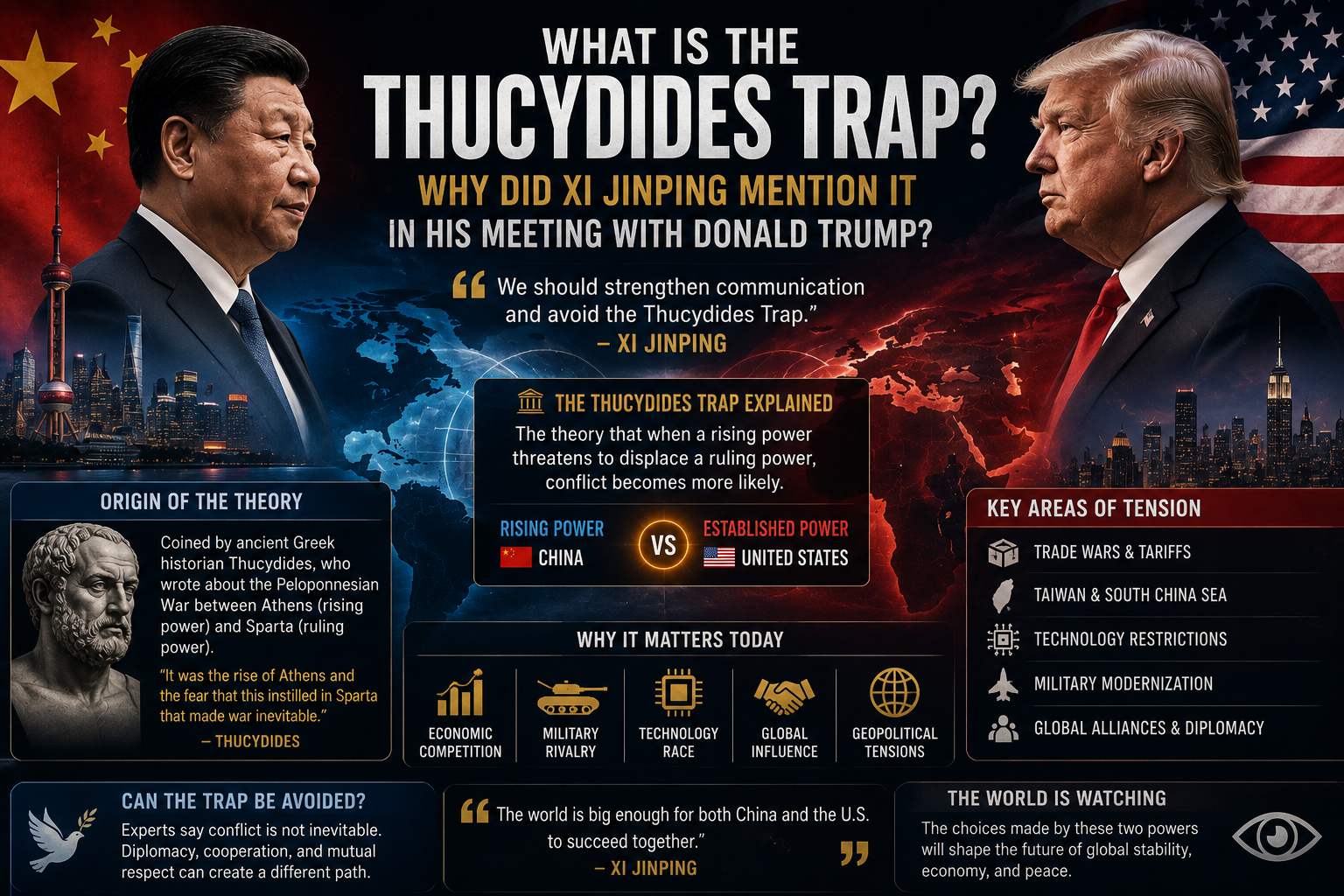
The Thucydides Trap is a political theory that suggests:
When a rising power threatens to replace an existing dominant power, conflict often becomes likely.
The idea is named after ancient Greek historian Thucydides, who wrote about the war between:
- Peloponnesian War powers
- Athens (a rising power)
- Sparta (the dominant power at the time)
According to Thucydides, fear created by Athens’ rise made war almost inevitable.
Today, many geopolitical experts compare:
- China → rising global power
- United States → existing superpower
This comparison is why the theory remains highly discussed in international politics.
Why Xi Jinping Mentioned the Thucydides Trap
Xi Jinping has previously argued that conflict between China and the United States is not inevitable, even under conditions described by the Thucydides Trap theory.
During interactions and diplomatic discussions involving Donald Trump, the phrase became symbolically important because it reflected growing concerns over:
- trade wars
- military competition
- Taiwan tensions
- technology restrictions
- global influence battles
By referencing the theory, Xi appeared to signal that:
China and the U.S. should avoid repeating historical patterns that lead to great-power conflict.
Why the United States and China Are Compared to Athens and Sparta
Many political analysts compare modern geopolitics to the ancient rivalry described by Thucydides.
China as the Rising Power
China’s rapid growth includes:
- economic expansion
- military modernization
- technological advancement
- global trade influence
United States as the Established Power
The U.S. remains:
- the world’s largest military power
- dominant in global finance
- highly influential diplomatically and technologically
This changing balance of power is why the Thucydides Trap is frequently discussed in relation to China and America.
Trade Wars and Economic Competition
The theory gained even more attention during tensions between:
- Donald Trump
- Xi Jinping
particularly during the U.S.-China trade war.
Major issues included:
- tariffs
- semiconductor restrictions
- manufacturing competition
- supply chain dependence
The economic rivalry intensified fears that geopolitical competition could escalate further.
Military Tensions and Strategic Rivalry
Another reason the Thucydides Trap is widely discussed is because of military concerns involving:
- the South China Sea
- Taiwan
- Indo-Pacific strategy
- naval expansion
Analysts warn that when major powers compete simultaneously in:
- economics
- military influence
- technology
- diplomacy
the risk of confrontation can increase dramatically.
Can the Thucydides Trap Be Avoided?
One of the most debated questions in international relations is:
Can rising and dominant powers avoid war?
Many experts argue the answer is yes — if diplomacy, cooperation, and economic interdependence remain strong.
Supporters of peaceful coexistence point to:
- trade partnerships
- global institutions
- nuclear deterrence
- diplomatic negotiations
as reasons modern nations may avoid repeating ancient historical patterns.
Why This Theory Became Popular Worldwide
The Thucydides Trap became globally famous after scholars and geopolitical strategists began using it to explain tensions between:
- China
- United States
The phrase is now frequently used in:
- political debates
- international news analysis
- military strategy discussions
- economic forecasting
Searches for terms like:
- “Thucydides Trap explained”
- “Xi Jinping Trump meeting”
- “China vs US rivalry”
continue trending worldwide.
Criticism of the Thucydides Trap Theory
Not all experts agree with the theory.
Critics argue that:
- history is more complex than simple power transitions
- modern globalization changes international behavior
- nuclear weapons discourage direct conflict
Others warn that constantly repeating the theory could itself increase fear and mistrust between nations.
How Technology and AI Have Changed Global Competition
Unlike ancient Athens and Sparta, modern rivalry between:
- China
- United States
also involves advanced technology competition.
Major areas include:
- artificial intelligence
- semiconductor manufacturing
- cybersecurity
- space technology
- quantum computing
This technological rivalry has become a major part of modern geopolitical strategy.
The Global Importance of US-China Relations
The relationship between China and United States impacts nearly every aspect of the global economy.
Their cooperation or conflict can affect:
- stock markets
- energy prices
- military alliances
- international trade
- global stability
That’s why even symbolic phrases like “Thucydides Trap” receive worldwide attention.
Conclusion
The mention of the Thucydides Trap by Xi Jinping during discussions connected to Donald Trump reflects one of the biggest geopolitical questions of the 21st century:
Can a rising global power and an existing superpower avoid conflict?
As tensions continue involving trade, technology, military influence, and diplomacy, the theory remains central to understanding the future of international politics.
Whether history repeats itself or not, one thing is certain:
The relationship between China and the United States will shape the future of the world for decades to come
FAQs
What is the Thucydides Trap?
A theory suggesting conflict may occur when a rising power challenges a dominant power.
Who created the Thucydides Trap theory?
The concept is based on writings by ancient Greek historian Thucydides.
Why did Xi Jinping mention it?
To emphasize that conflict between China and the United States is not inevitable.
Why is the theory important today?
Because it is often used to explain tensions between China and the United States.