As discussions around a common BRICS currency intensify globally, India has taken a clear and calculated stance—stepping back from the idea of a unified monetary system.
This decision has sparked a critical question:
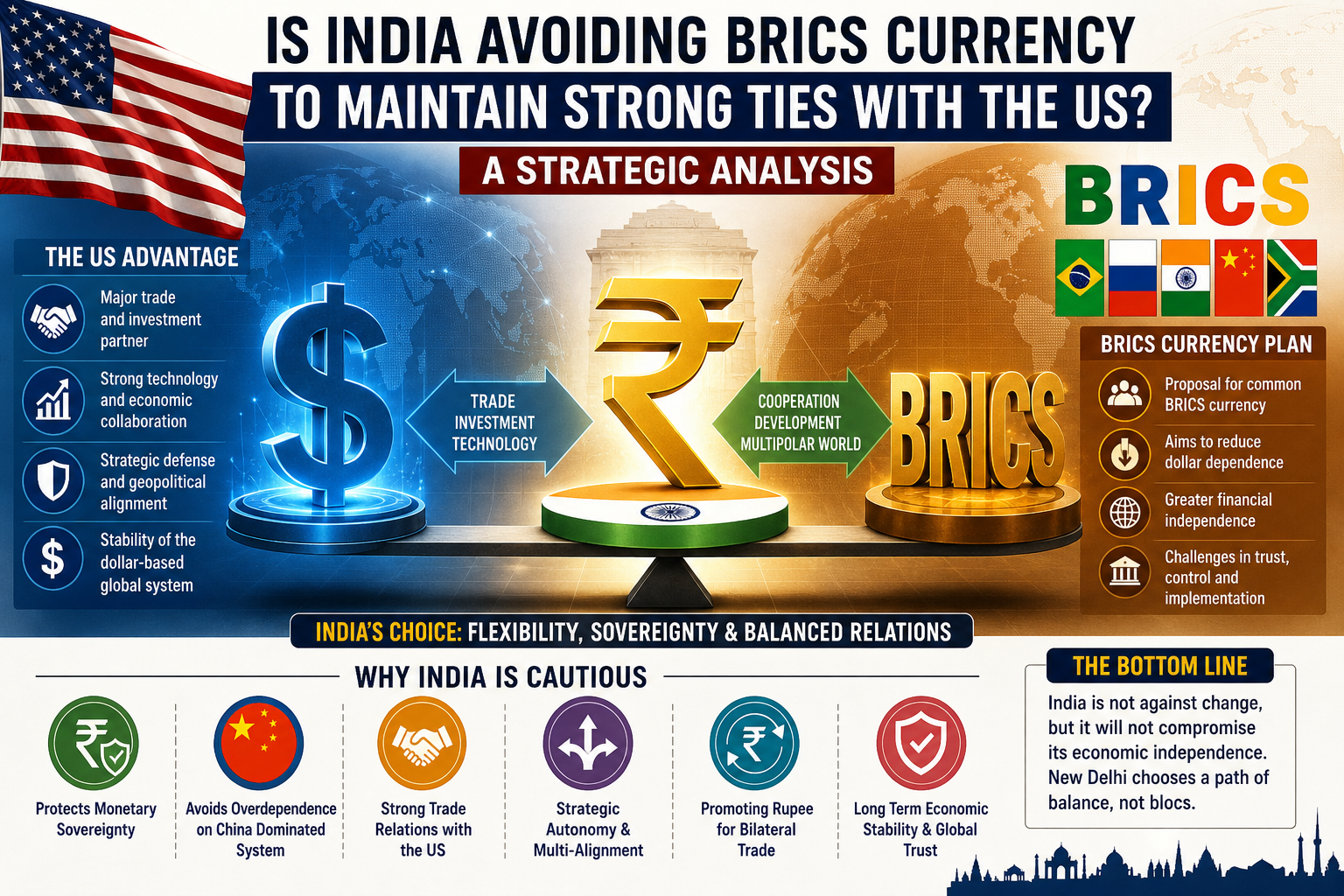
Is India avoiding a BRICS currency to maintain strong ties with the United States?
While the answer is not straightforward, the issue sits at the intersection of geopolitics, trade strategy, and economic sovereignty.
India’s Position on BRICS Currency
India has consistently indicated that it:
- does not support a common BRICS currency
- does not favor complete de-dollarization
- supports bilateral trade in local currencies (like the rupee)
This position reflects a balanced economic strategy, rather than alignment with any single bloc.
The US Factor: A Strategic Consideration?
India’s economic relationship with the United States is one of the strongest in the world.
Key points include:
- The US is one of India’s largest trading partners
- Significant foreign investment flows come from US companies
- Strong collaboration in technology, defense, and finance
Because of this, some analysts believe that:
India’s reluctance to move away from the dollar-based system may help preserve stability in its US economic ties.
This does not necessarily mean “pleasing” the US—but it does reflect pragmatic economic decision-making.
A Wider Debate: Strategic Alignment vs Independence
There are two major schools of thought.
View 1: India is Maintaining Western Alignment
Some observers argue that:
- Avoiding BRICS currency helps India stay integrated with global dollar markets
- It reduces financial friction with Western economies
- It signals economic stability to global investors
This interpretation suggests India is choosing global integration over bloc isolation.
View 2: India is Protecting Its Own Interests
Others strongly disagree with the above view.
They argue that India’s decision is driven by:
- monetary sovereignty
- control over interest rates and inflation
- flexibility in global trade
- avoiding dependency on a China-influenced system
From this perspective, India is not aligning with the US—but rather avoiding dependence on any single power center.
Why India Is Cautious About a BRICS Currency
Several practical concerns influence India’s position.
1. Monetary Control
A shared currency would require:
- centralized monetary authority
- coordinated fiscal policies
- reduced national control
India prefers to retain full control over the Indian rupee.
2. China’s Dominance in BRICS
China’s economic size raises concerns that:
- a BRICS currency could be heavily influenced by Beijing
- smaller economies may have limited control
India has historically been cautious about such frameworks.
3. Stability of the Dollar System
Despite criticism, the US dollar remains:
- the world’s primary reserve currency
- widely used in global trade
- backed by deep financial markets
Completely moving away from it carries risks.
India’s Alternative Strategy: Rupee-Based Trade
Instead of supporting a shared BRICS currency, India is promoting:
- bilateral trade in rupees
- direct currency settlements
- reduced dependency on intermediaries
This approach allows India to:
- expand its economic influence
- reduce transaction costs
- maintain independence
Is India Balancing Between Global Powers?
India’s decision reflects a broader strategy often described as:
“multi-alignment”
This means:
- engaging with the US for trade and technology
- participating in BRICS for global cooperation
- avoiding full dependence on either
This balancing act is becoming a defining feature of India’s foreign policy.
Global Implications of India’s Decision
India’s stance has significant consequences:
- slows down BRICS currency ambitions
- reinforces the role of the US dollar globally
- signals cautious reform instead of radical change
- shapes future global financial systems
Without India’s full participation, a BRICS currency faces serious limitations.
Conclusion
India’s decision to avoid a common BRICS currency is not a simple yes-or-no geopolitical move.
It reflects a deeper strategy:
- protecting monetary sovereignty
- maintaining global trade balance
- avoiding dependence on any single bloc
- keeping strong economic ties with major powers, including the United States
So the real answer is:
India is not choosing the US over BRICS — it is choosing flexibility over rigidity.
FAQs
Did India reject the BRICS currency?
India has not supported the idea of a common BRICS currency and prefers bilateral trade systems.
Is India trying to align with the US?
India is maintaining strong economic ties with the US, but also balancing relationships globally.
Does India support de-dollarization?
India supports selective currency diversification but not complete abandonment of the dollar.
What is India’s alternative strategy?
Promoting rupee-based bilateral trade instead of a shared currency system.