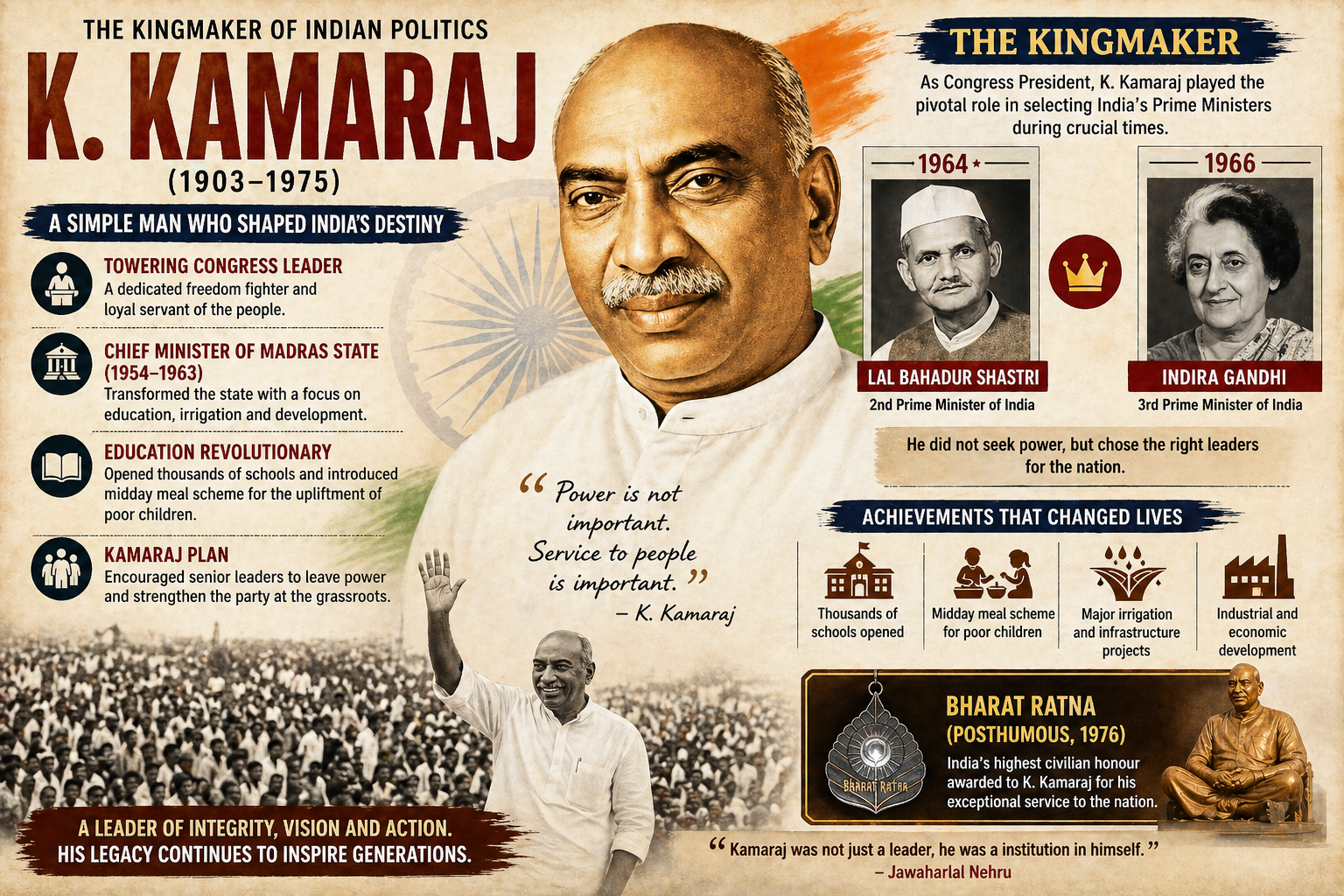
Few leaders in Indian political history command the respect and legacy that Kumaraswami Kamaraj, popularly known as K. Kamaraj, continues to hold.
Born in 1903 and remembered until his passing in 1975, Kamaraj was one of the tallest leaders of the Indian National Congress and one of the most influential political strategists India has ever seen.
He is widely remembered as:
“The Kingmaker of Indian Politics”
This title was not symbolic.
It was earned through his extraordinary role in shaping India’s national leadership during one of its most crucial political transitions.
As Congress President, Kamaraj played the decisive role in the appointment of:
- Lal Bahadur Shastri as Prime Minister in 1964
- Indira Gandhi in 1966
His contribution to Indian politics, governance, and public welfare remains historic.
Early Life of K. Kamaraj
K. Kamaraj was born on 15 July 1903 in Virudhunagar, in present-day Tamil Nadu.
Coming from a humble background, Kamaraj did not have access to formal higher education.
However, his sharp political mind, administrative ability, and dedication to public service made him one of the most respected leaders in independent India.
He joined the Indian freedom movement at a young age and became deeply involved in the struggle against British rule.
Chief Minister of Madras State (1954–1963)
Kamaraj served as the Chief Minister of Madras State from 1954 to 1963.
This period is widely considered one of the most transformative phases in South Indian governance.
Under his leadership, Madras State witnessed major progress in:
- education
- irrigation
- infrastructure
- rural development
- industrialization
Today, much of the developmental foundation of modern Tamil Nadu is traced back to his tenure.
Kamaraj’s Greatest Achievement: The Education Revolution
One of Kamaraj’s most remembered achievements was the expansion of school education.
He strongly believed that:
education should reach every child, especially the poor
During his tenure, thousands of new schools were opened across rural areas.
His government is often credited with introducing and expanding the midday meal concept in schools, which helped increase enrollment among underprivileged children.
This single reform changed the educational landscape of the state.
The Rise of the “Kingmaker”
Kamaraj’s national political influence grew significantly when he became the President of the Indian National Congress in 1964.
This was the moment when his political wisdom shaped the destiny of India.
Role in Choosing Lal Bahadur Shastri as Prime Minister
After the death of Jawaharlal Nehru in 1964, India faced a leadership vacuum.
The country needed a stable, widely acceptable leader.
At this critical moment, Kamaraj played the central role in building consensus within the Congress party.
His support was instrumental in installing:
Lal Bahadur Shastri
as India’s next Prime Minister.
This was one of the most important leadership decisions in India’s post-independence history.
Role in Choosing Indira Gandhi
After the sudden death of Lal Bahadur Shastri in 1966, India once again entered a period of uncertainty.
Once again, Kamaraj emerged as the central figure.
He played a decisive role in the selection of:
Indira Gandhi
as the next Prime Minister of India.
This earned him the legendary title:
Kingmaker
because he helped shape India’s top leadership not once, but twice.
Why Kamaraj Was Called the Kingmaker
Kamaraj was not known for personal ambition.
Unlike many leaders, he did not seek the Prime Minister’s post for himself.
Instead, he focused on party stability and national interest.
His ability to unite factions, build consensus, and identify leadership made him the most powerful political strategist of his time.
This is why historians and political analysts continue to refer to him as the Kingmaker of Indian politics.
The Kamaraj Plan
One of his major political strategies was the famous Kamaraj Plan.
Under this plan, senior Congress leaders holding government positions were encouraged to resign and work to strengthen the party organization.
The idea was to reconnect the leadership with grassroots politics.
This became one of the most discussed political reforms in Congress history.
Legacy and Contribution to India
Kamaraj’s legacy goes far beyond titles.
He is remembered for:
- integrity
- simplicity
- public welfare
- educational reforms
- political vision
Even today, he remains one of the most respected leaders in Indian history.
He was posthumously awarded the Bharat Ratna in 1976 for his immense contribution to the nation.
Why Kamaraj Still Matters Today
Kamaraj’s leadership style offers important lessons for modern politics:
- governance with simplicity
- people-first development
- education as nation-building
- leadership without personal ambition
These principles remain highly relevant.
Conclusion
K. Kamaraj was not just a Congress leader.
He was one of the most influential architects of India’s political leadership.
From transforming Madras State to helping install two Prime Ministers, his role in Indian democracy remains historic.
That is why he is remembered not only as a leader, but as the Kingmaker who shaped India’s destiny.
FAQs
Why was K. Kamaraj called the Kingmaker?
Because he played the decisive role in choosing Lal Bahadur Shastri and Indira Gandhi as Prime Ministers.
What was Kamaraj famous for?
He was famous for educational reforms, simple leadership, and political strategy.
Which state was ruled by Kamaraj?
He served as Chief Minister of Madras State from 1954 to 1963.