India’s growing defence partnership with the United States has become one of the most discussed geopolitical topics in recent years.
With landmark agreements such as LEMOA, COMCASA, BECA, and GSOMIA, the India–US strategic relationship has moved beyond diplomacy into deep military and intelligence cooperation.
However, these agreements have also raised important questions among citizens, defence analysts, and policy observers:
- Is India sharing too much military information?
- Could such data be misused?
- Does the US gain a strategic advantage?
- Is India compromising its military sovereignty?
These are valid concerns, but they must be discussed with facts.
This blog explains what these agreements really mean.
What Are the India–US Defence Agreements?
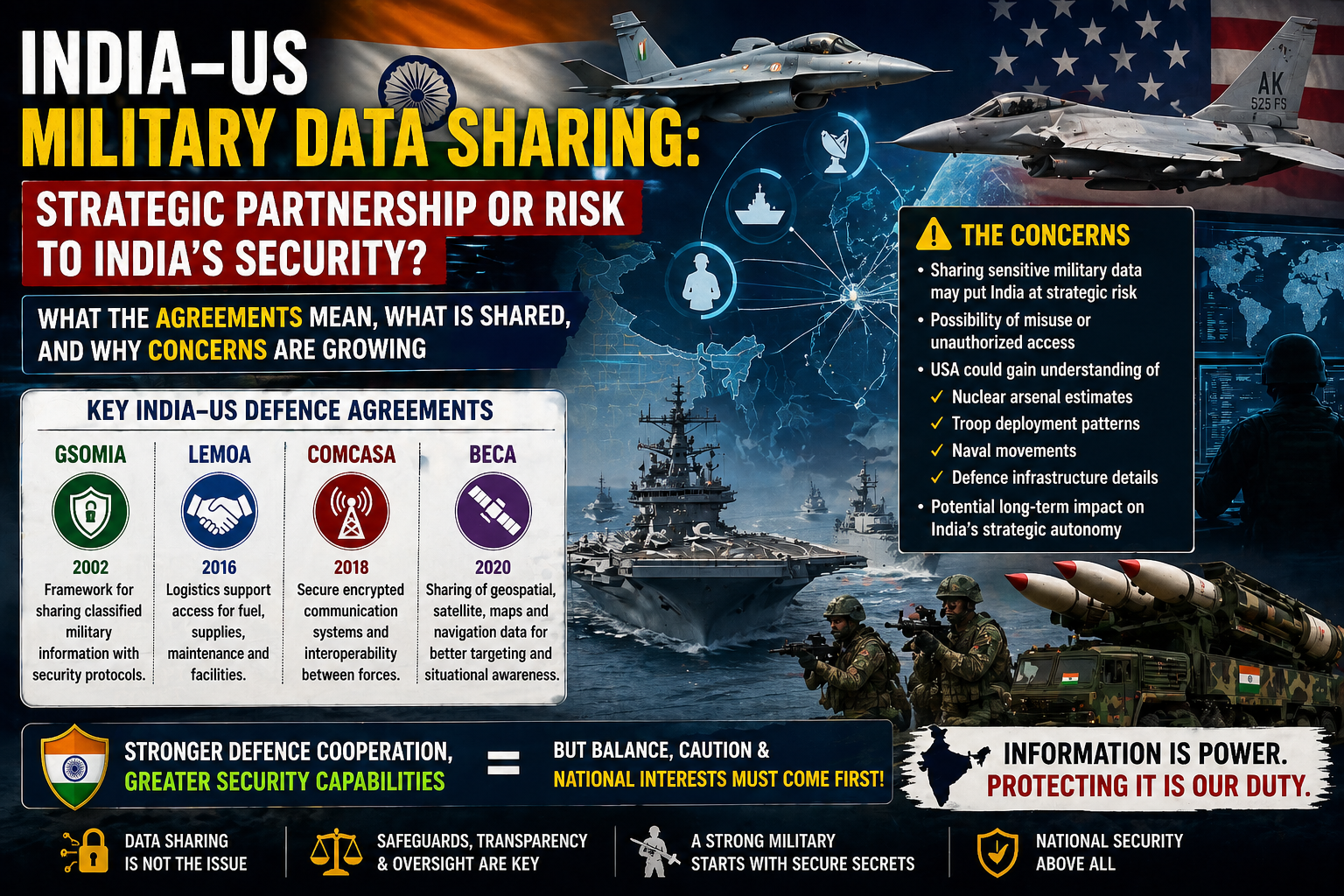
India and the United States have signed four major foundational defence agreements.
1. GSOMIA (2002)
General Security of Military Information Agreement
This agreement provides a framework for sharing classified military information while ensuring security safeguards.
It does not mean unrestricted access to all defence secrets.
It creates protocols for protected information exchange.
2. LEMOA (2016)
Logistics Exchange Memorandum of Agreement
This allows reciprocal access to military facilities for:
- refuelling
- maintenance
- supplies
- logistics support
For example, Indian naval ships can access US bases for fuel, and vice versa.
This is not a basing agreement.
The US does not automatically get control over Indian bases.
3. COMCASA (2018)
Communications Compatibility and Security Agreement
This enables India to use secure encrypted communication equipment and systems on US-origin defence platforms.
It improves interoperability.
For example:
- secure aircraft communications
- naval data links
- encrypted battlefield systems
Again, this does not automatically mean sharing all troop movements or nuclear data.
4. BECA (2020)
Basic Exchange and Cooperation Agreement
This is the most discussed agreement.
BECA enables sharing of:
- satellite imagery
- geospatial intelligence
- navigation data
- topographic and aeronautical maps
This improves missile targeting and operational precision.
This helps India significantly, especially in border and maritime surveillance.
Does the US Know India’s Nuclear Weapons Count?
This is an important point.
There is no public evidence or agreement text suggesting that India has shared the exact number of its nuclear weapons with the US.
Such claims should not be stated as fact.
India’s nuclear arsenal estimates are typically discussed by independent global research bodies, not through public India–US treaties.
So the statement:
“USA knows how many nuclear weapons India has”
is not something that can be factually claimed from these agreements.
Does the US Know Where Indian Troops or Ships Are Deployed?
Again, this depends on context.
Certain operational data may be shared during:
- joint exercises
- maritime coordination
- anti-submarine operations
- Indo-Pacific cooperation
But there is no evidence that these agreements grant permanent unrestricted visibility into all Indian troop deployments.
That would be a serious overstatement.
Why Critics Still Raise Concerns
Even though these agreements are limited, critics raise strategic concerns.
Some of the main concerns include:
1. Dependence on US Military Systems
As India increasingly uses US-origin systems, interoperability may create technological dependence.
2. Strategic Autonomy
India has historically valued strategic independence.
Critics worry that deeper defence integration may reduce autonomy.
3. Risk of Data Exposure
Any intelligence-sharing framework inherently raises cybersecurity and trust questions.
This is a valid debate.
Community discussions often reflect these sovereignty concerns.
Does This Give the US a Strategic Advantage?
Potentially in a limited sense — yes.
Strategic partnerships are always two-way.
When nations share intelligence frameworks, both sides gain visibility and interoperability advantages.
However, India also gains substantial benefits:
- better satellite intelligence
- maritime awareness
- targeting precision
- China border surveillance
- Indo-Pacific coordination
So the relationship is not one-sided.
Why India Signed These Agreements
The main geopolitical context is China.
Much of the defence cooperation accelerated due to concerns around:
- Indo-Pacific security
- Indian Ocean surveillance
- border tensions
- maritime strategy
The Real Debate: Security vs Sovereignty
The real issue is not whether “America knows all secrets.”
That is too simplistic.
The actual debate is:
How much defence cooperation is healthy without compromising sovereignty?
This is where policy experts differ.
Conclusion
India’s defence agreements with the US do involve military information sharing, but it is incorrect to claim that the US automatically has access to all Indian military secrets, troop counts, nuclear weapons numbers, or ship deployments.
The reality is more nuanced.
These agreements are strategic frameworks designed to improve:
- logistics
- secure communications
- geospatial intelligence
- defence interoperability
At the same time, concerns about long-term strategic autonomy are legitimate and worth discussing.
That is the real national security debate.
FAQs
Does BECA allow the US to access India’s military secrets?
BECA focuses on geospatial and satellite data sharing, not unrestricted access to all military secrets.
Does the US know India’s nuclear weapons count?
There is no public evidence supporting this claim.
What is COMCASA?
It enables secure encrypted communication interoperability between Indian and US military systems.