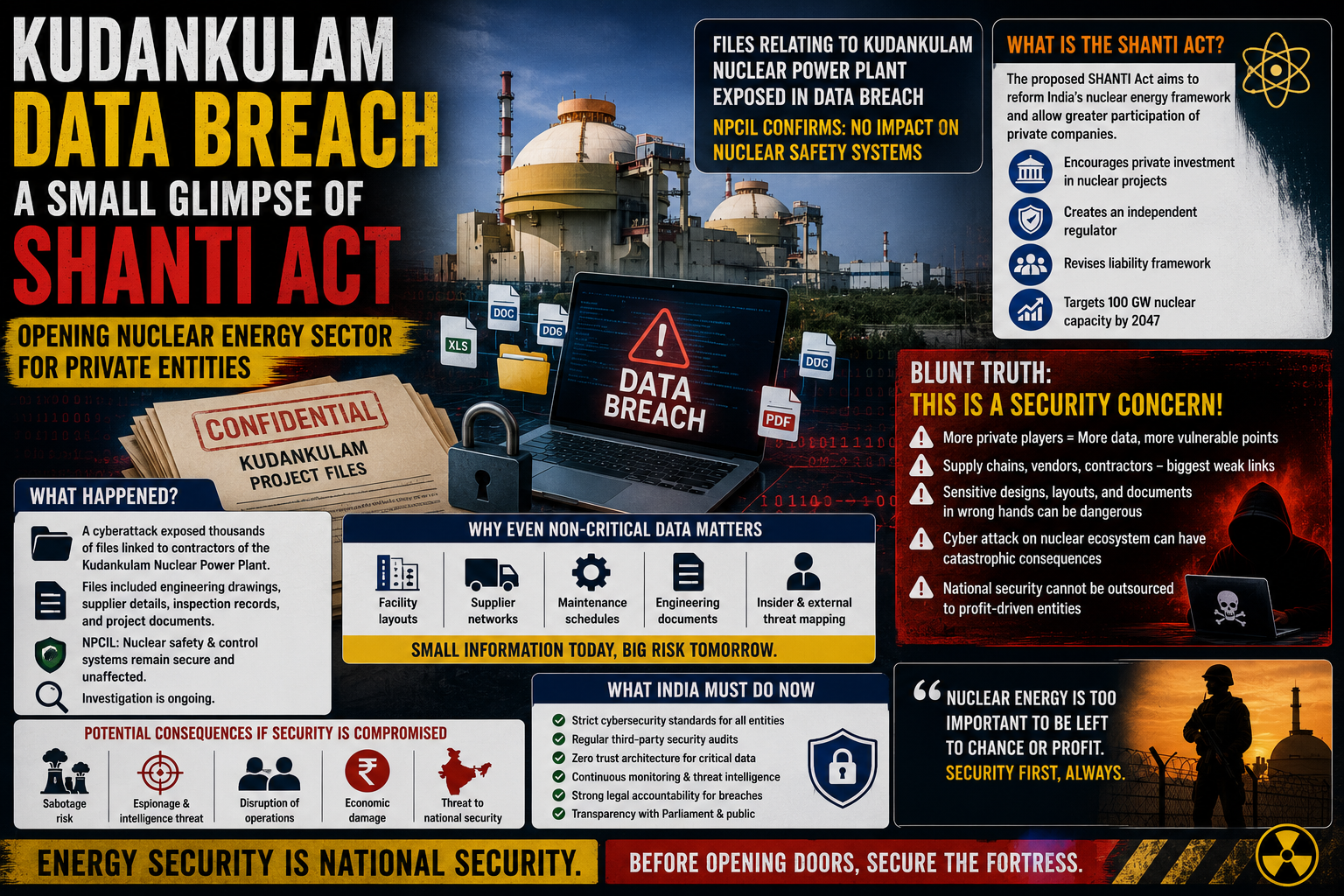
Kudankulam Data Breach: A Wake-Up Call for India’s Nuclear Sector?
India’s nuclear energy ambitions are expanding rapidly.
The proposed SHANTI Act (Sustainable Harnessing and Advancement of Nuclear Energy for Transforming India) seeks to modernize the country’s nuclear energy framework, encourage greater investment, and help India reach ambitious nuclear power generation targets.
At the same time, reports of a cybersecurity incident involving files related to the Kudankulam Nuclear Power Plant have reignited an important debate:
Can India safely expand nuclear infrastructure without making cybersecurity an even higher national priority?
While authorities have stated that the reported breach did not affect nuclear safety systems or reactor operations, the incident has highlighted the growing importance of protecting every part of the nuclear ecosystem—not only reactors themselves but also contractors, suppliers, engineering records, and supporting digital infrastructure.
What Happened at Kudankulam?
According to reports, a ransomware group claimed responsibility for publishing thousands of files allegedly linked to contractors associated with the Kudankulam Nuclear Power Plant.
The reported documents included items such as engineering drawings, supplier information, inspection records, and project-related documents.
However, the Nuclear Power Corporation of India Limited (NPCIL) stated that the reported breach was limited to conventional project-related systems and did not compromise nuclear safety or security systems. Investigations by the relevant authorities are ongoing.
Why Even Non-Critical Data Matters
Modern critical infrastructure relies on extensive digital ecosystems.
Even when operational reactor systems remain isolated, information such as:
- Facility layouts
- Supplier networks
- Maintenance schedules
- Engineering documentation
- Procurement records
may have value to hostile actors if exposed.
Cybersecurity experts often note that attackers can combine seemingly harmless information from multiple sources to build a more complete picture of critical infrastructure.
The SHANTI Act and Private Participation
The proposed SHANTI Act includes reforms intended to expand India’s nuclear power sector, including allowing greater participation by private Indian companies while retaining government control over sensitive activities such as fuel reprocessing.
Supporters argue that these reforms could:
- Accelerate investment.
- Increase generating capacity.
- Modernize the sector.
- Help India meet long-term energy demand.
The proposal also envisages an independent statutory regulator and updated liability arrangements.
Cybersecurity Must Grow Alongside Expansion
Whether nuclear projects are developed by public-sector enterprises, private companies, or partnerships between the two, cybersecurity becomes increasingly important as the ecosystem expands.
A larger network of contractors, vendors, digital platforms, and engineering firms can also increase the number of potential points that require protection.
This does not mean private participation is inherently less secure, but it does underscore the need for consistent standards across every organization involved.
Lessons From Previous Cyber Incidents
This is not the first time Kudankulam has been associated with cybersecurity concerns.
A 2019 malware incident affected an administrative network, with officials stating at the time that operational reactor systems remained isolated and unaffected. That episode prompted broader discussions about protecting critical infrastructure against evolving cyber threats.
The latest reports reinforce the importance of continuously strengthening cyber resilience.
Questions Worth Asking
As India expands its nuclear programme, several questions deserve public discussion:
Should cybersecurity standards be mandatory across every contractor?
Should vendors handling sensitive project information undergo stricter security audits?
How frequently should cybersecurity assessments be conducted?
Should Parliament receive regular reports on cyber preparedness for critical infrastructure?
These questions are relevant regardless of whether projects are publicly or privately managed.
Opinion
In my view, the Kudankulam incident should serve as a reminder that cybersecurity is now a core part of national security.
If India moves toward greater private participation in nuclear energy, the country will need:
- Uniform cybersecurity requirements.
- Independent audits.
- Strong oversight.
- Transparent incident reporting.
- Robust protection for contractors and supply chains.
The issue is not simply who owns or operates a facility.
The larger challenge is ensuring that every organization connected to critical infrastructure meets the highest security standards.
Frequently Asked Questions
Was the Kudankulam nuclear reactor hacked?
Authorities have stated that the reported incident did not compromise reactor safety or nuclear control systems, though investigations into the reported data exposure are continuing.
What is the SHANTI Act?
The proposed SHANTI Act is a reform package intended to modernize India’s nuclear energy framework, including provisions for greater private-sector participation under government oversight.
Why is cybersecurity important for nuclear projects?
Critical infrastructure depends on secure digital systems. Protecting engineering records, suppliers, contractors, and operational technology helps reduce risks to national security.
Conclusion
India’s nuclear programme will play an increasingly important role in meeting future electricity demand.
The recent Kudankulam data breach reports should not be viewed only as an isolated cyber incident but as an opportunity to strengthen cybersecurity across the entire nuclear ecosystem.
Whether infrastructure is developed through public institutions, private companies, or partnerships, one principle remains constant:
In nuclear energy, cybersecurity is not an optional feature—it is a national security requirement.