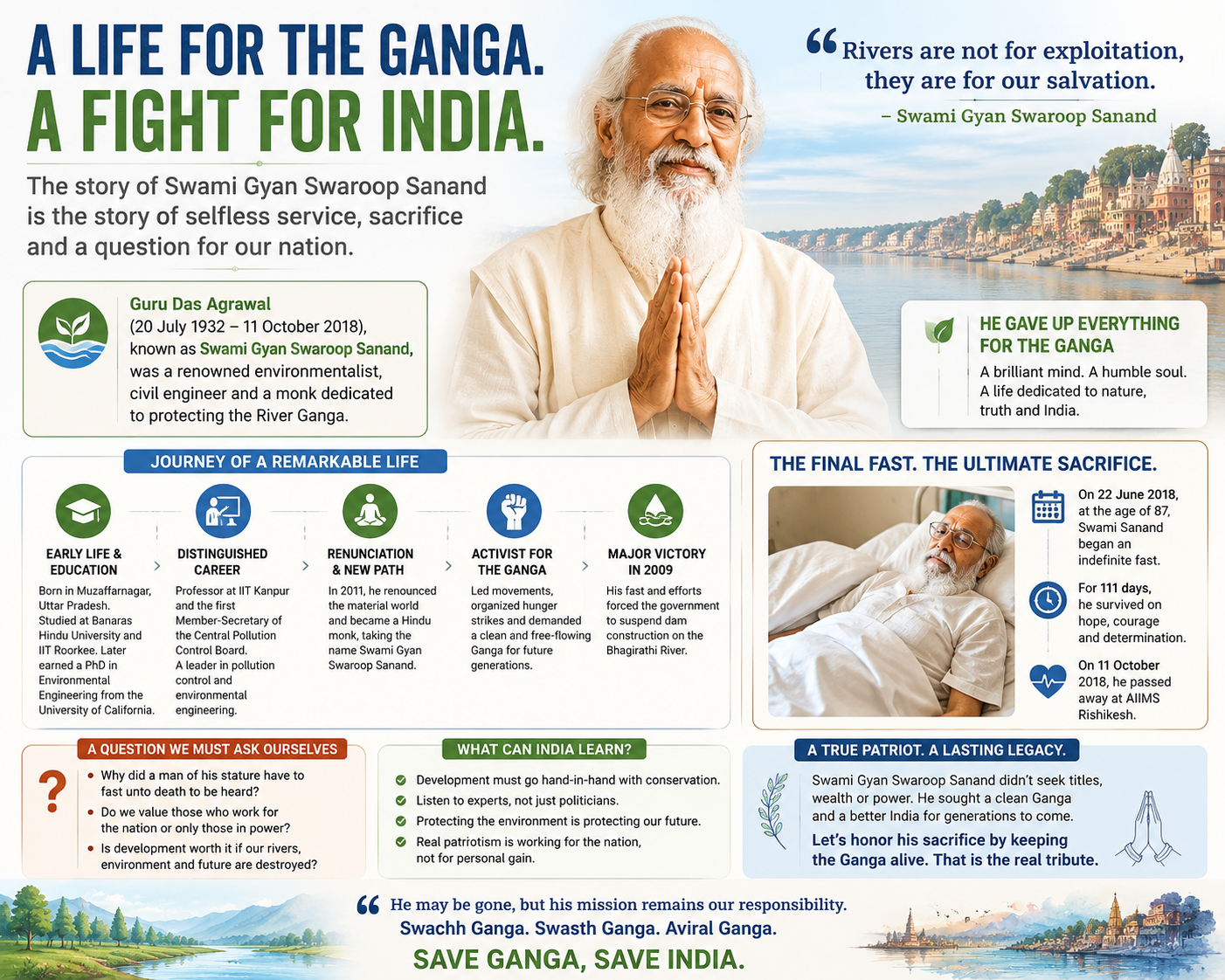
An IIT Professor, Scientist, Environmentalist, and Monk Sacrificed Everything. His Death Raises Questions India Still Hasn’t Answered.
Every Independence Day, politicians speak about serving the nation.
Every election, leaders promise development.
Every government talks about protecting India’s heritage and natural resources.
But one question refuses to go away:
What happens when an ordinary citizen—or in this case, one of India’s finest scientists—dedicates his entire life to protecting the country instead of seeking power or wealth?
The story of Guru Das Agrawal, later known as Swami Gyan Swaroop Sanand, is not just the story of one man.
It is a story about modern India.
And it forces us to ask whether our country truly values those who sacrifice everything for the public good.
A Man Who Had Nothing Left to Prove
Guru Das Agrawal was not an unknown activist.
He was one of India’s most respected environmental engineers.
His achievements included:
- Professor at IIT Kanpur.
- Former Member-Secretary of the Central Pollution Control Board.
- Environmental engineering expert.
- PhD from the University of California.
- Advisor on pollution control and river management.
Few people possessed his academic credentials or technical expertise.
He could have spent retirement comfortably.
Instead, he chose a very different path.
From Professor to Monk
In 2011, Guru Das Agrawal renounced worldly life and became Swami Gyan Swaroop Sanand.
He gave up status, comfort, and personal ambition.
His mission became singular:
Protect the River Ganga.
For him, the Ganga was not merely a river.
It was India’s civilizational lifeline.
He believed that uncontrolled pollution, unchecked development, and poorly planned projects threatened one of the country’s most important natural treasures.
A Life Dedicated to the Ganga
Unlike many who simply issued statements, Sanand chose peaceful democratic protest.
He repeatedly undertook hunger strikes to demand stronger action to protect the river.
His activism contributed to the suspension of certain hydroelectric projects on the Bhagirathi River in 2009.
Whether one agreed with all his proposals or not, few questioned his sincerity.
He asked for no political office.
He sought no personal gain.
His only demand was stronger protection for the Ganga.
The Fast That Ended His Life
On 22 June 2018, at the age of 87, Swami Sanand began another indefinite fast.
He wanted the government to implement stronger measures for conserving the Ganga and to act on earlier commitments.
For 111 days, he continued his protest.
On 11 October 2018, he died at AIIMS Rishikesh.
His death shocked many environmentalists, scientists, and civil society groups.
The Question That Still Echoes
The issue is not merely whether one agreed with every demand he made.
The larger question is this:
Why did one of India’s most respected environmental experts feel that fasting unto death was the only way left to make his voice heard?
That question deserves reflection.
Development vs. Conservation
India undoubtedly needs:
- Roads.
- Electricity.
- Industry.
- Infrastructure.
- Economic growth.
But development should not become an excuse to ignore environmental sustainability.
Modern nations must balance economic progress with protection of natural resources.
That balance remains one of India’s greatest challenges.
Do We Value Those Who Serve Without Seeking Power?
Swami Sanand did not enter politics.
He did not build a political party.
He did not seek fame.
He simply spent his final years advocating for a cause he believed would benefit future generations.
His life raises an uncomfortable question:
Do we celebrate people like him only after they are gone?
Patriotism Is More Than Slogans
Patriotism is often associated with speeches, flags, and public ceremonies.
But people like Swami Sanand remind us that patriotism can also mean:
- Protecting rivers.
- Preserving forests.
- Defending public resources.
- Speaking for future generations.
Love for one’s country is not measured only by words.
It is measured by actions.
What Can India Learn?
Whether one agreed with every aspect of Swami Sanand’s movement or not, his life offers important lessons:
- Scientific expertise should inform public policy.
- Environmental concerns deserve serious engagement.
- Peaceful democratic protest should not be ignored.
- Sustainable development requires listening to diverse voices.
Final Thoughts
Swami Gyan Swaroop Sanand lived as a scientist.
He chose to die as a peaceful environmental activist.
His story is not only about the Ganga.
It is about how democracies respond to citizens who dedicate their lives to public causes.
History often remembers those who asked difficult questions long after governments and political debates have changed.
The lasting tribute to Swami Sanand will not be speeches.
It will be whether India succeeds in protecting the rivers, ecosystems, and natural heritage he spent his life trying to preserve.