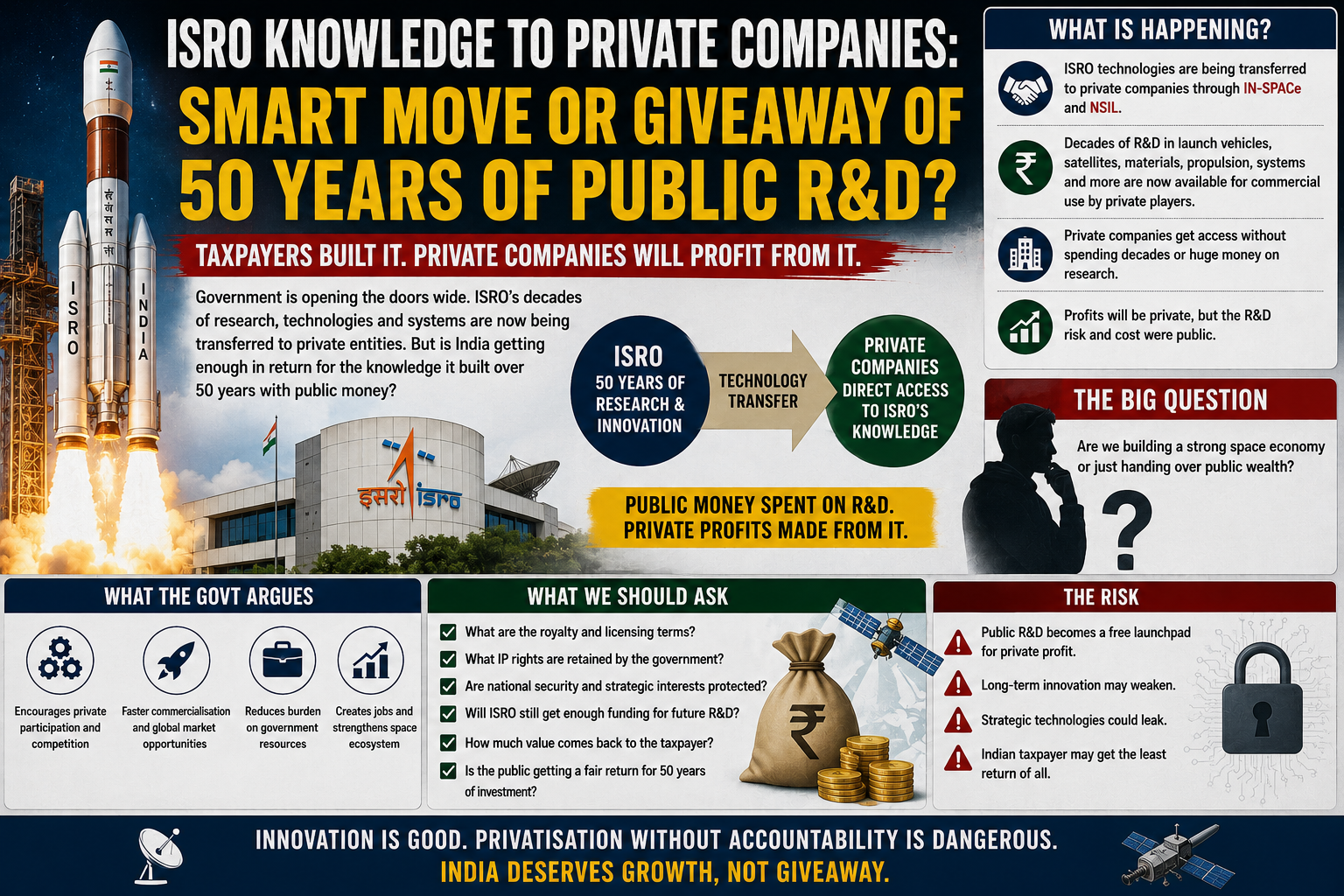
Meta Description: India is opening the space sector to private companies and transferring ISRO-developed technologies. Is this smart commercialisation or a risky privatisation of public R&D?
ISRO Technology Transfer to Private Companies: Is India Commercialising Public R&D Too Aggressively?
India spent decades building Indian Space Research Organisation from the ground up.
Scientists, engineers, technicians and researchers worked for generations to develop India’s launch vehicles, satellites, propulsion systems, navigation technologies, tracking infrastructure and space applications.
Much of that development was ultimately funded by the Indian taxpayer.
Now the government is deliberately opening the space sector to private companies.
That is not a secret.
The government’s space-sector reforms explicitly seek greater private participation across the space economy, while ISRO and its commercial arm, NewSpace India Limited, are facilitating technology transfers and access to government-developed capabilities.
And this is where the uncomfortable question begins:
Are we building a competitive private space industry—or are we allowing private companies to commercialise decades of publicly funded research without demanding enough in return?
That question deserves a serious answer.
India Spent Decades Building This Knowledge
ISRO itself says that the Indian space programme developed indigenous end-to-end capabilities over the last five decades. It also notes that more than 500 MSMEs, PSUs and large private industries have contributed to the programme.
This is important.
India’s space technology did not appear overnight.
The country invested public money in laboratories, testing facilities, launch infrastructure, research programmes and human expertise.
That investment created intellectual property, engineering expertise and technological know-how that now have enormous commercial value.
So when that technology moves into the private sector, the public has a legitimate question:
What exactly is the taxpayer receiving in return?
Is the Government Giving ISRO’s Entire Knowledge to Private Companies?
No—and this distinction matters.
It would be inaccurate to say that the government is simply handing over all of ISRO’s knowledge from the last 50 years to private companies.
ISRO operates formal technology-transfer mechanisms.
Its own documentation says technologies developed by the Department of Space can be transferred to industry, with technology transfer enabled through NSIL.
ISRO also says its technology-transfer programme is intended to generate industrial and economic benefits from technologies developed through long-term public investment.
So the real criticism is not that “everything is being given away.”
The real question is:
Are the terms of this commercialisation sufficiently beneficial to the public that financed the original research?
That is a much harder question—and one worth asking.
The SSLV Example Shows How Serious the Reform Is
This is not merely theoretical.
In September 2025, ISRO, NSIL, IN-SPACe and Hindustan Aeronautics Limited signed a technology-transfer agreement for the Small Satellite Launch Vehicle, or SSLV. ISRO described the agreement as a major milestone in commercialising the technology.
The government’s FY2025–26 achievements document goes even further, describing SSLV as the first complete launch-vehicle technology transfer to an Indian company, allowing HAL to independently build, own and commercialise SSLV launches.
That is a major change.
India is moving from:
Government develops → government operates
towards:
Government develops → industry commercialises
That can be economically powerful.
But it also creates an entirely new accountability question.
The Government’s Argument Is Simple: Commercialise What ISRO Has Already Proven
There is a legitimate argument on the other side.
ISRO is a government space agency, not a commercial manufacturing company.
Once a technology has matured, the government may reasonably conclude that private industry can manufacture it more efficiently, scale production, attract investment and compete internationally.
ISRO itself says it has historically worked with industry and transferred mature technologies to create industrial growth and technological self-reliance.
That argument makes sense.
Why should a government laboratory continue manufacturing every mature component if Indian companies can do it?
The problem begins when commercialisation becomes a substitute for new public research rather than a complement to it.
The Bigger Fear: Who Pays for the Next Generation of Innovation?
This is where the debate becomes uncomfortable.
Suppose the government spends thousands of crores developing a technology.
A private company receives access to the technology.
The company commercialises it.
The company earns revenue.
Fine.
But who finances the next generation of technology?
If public institutions increasingly concentrate on foundational R&D while private companies primarily commercialise mature technologies, there must be a mechanism ensuring that the public research ecosystem continues receiving strong investment.
Otherwise, India risks creating an uneven model:
Public money → research → technology → private commercialisation → private revenue
while the public institution remains dependent on government funding for the next breakthrough.
That is not automatically wrong.
But it needs to be designed carefully.
Public R&D Should Not Become a Free Launchpad for Private Profit
Private participation itself is not the problem.
In fact, India needs private investment in space.
The private sector can bring:
- Capital
- Manufacturing capacity
- Faster decision-making
- Commercial discipline
- Global marketing
- New business models
- Entrepreneurial risk-taking
The question is whether the government is negotiating hard enough on behalf of taxpayers.
If a publicly developed technology has enormous commercial value, the technology-transfer agreement should protect national interests.
That means asking:
How much does the company pay?
What intellectual-property rights are transferred?
What royalties or licensing fees apply?
Does the government retain strategic rights?
What happens if the company fails?
Can the technology be sold or transferred to another entity?
What safeguards prevent sensitive knowledge from reaching foreign-controlled entities?
These are not anti-business questions.
They are basic questions of responsible public asset management.
ISRO Facilities Are Also Being Made Available to Private Players
Technology transfer is only one part of the reform.
ISRO says private players are being supported through access to its facilities for testing and system requirements. Its FY2025 achievements reported dozens of such activities completed, ongoing or under discussion.
The space-sector framework also provides mechanisms for private entities to access government-owned infrastructure and facilities.
Again, there is a strong argument for doing this.
Space infrastructure is extraordinarily expensive.
Why should India build duplicate testing facilities when existing national infrastructure can potentially be shared?
But if public infrastructure is being used to help private businesses, the terms need to be transparent.
The Government Should Not Confuse Privatisation With Innovation
This is perhaps the central point.
Private ownership does not automatically mean innovation.
Innovation requires:
- Research funding
- Scientists
- Universities
- Patents
- Experimental infrastructure
- Failure tolerance
- Long-term investment
- Skilled engineers
A company taking an existing ISRO technology and manufacturing it commercially is valuable.
But that is not necessarily the same thing as developing the next breakthrough.
India must ensure that private-sector growth does not come at the expense of fundamental research.
ISRO Should Remain India’s Research Engine
There is a role for both sides.
ISRO should focus on:
- Fundamental space research
- Advanced propulsion
- Deep-space missions
- Human spaceflight
- Planetary science
- New launch technologies
- Advanced materials
- Navigation
- Strategic space capabilities
Private industry can focus on:
- Manufacturing
- Commercial launch services
- Satellite production
- Earth observation
- Communications
- Space applications
- Components
- Commercialisation of mature technologies
That division could actually make India stronger.
ISRO discovers.
Industry scales.
Universities innovate.
Startups experiment.
Government regulates.
That is a much healthier ecosystem than simply handing everything to either the public sector or the private sector.
The 100 Technology-Transfer Agreements Question
The scale of the transition is already significant.
According to ISRO’s FY2025–26 achievements, IN-SPACe, NSIL and ISRO had reached 100 Technology Transfer Agreements with non-government entities following the space-sector reforms, with about 24 agreements signed during that financial year.
That number should make policymakers—and taxpayers—pay attention.
One or two technology transfers are easy to explain.
One hundred is an ecosystem-level transformation.
And ecosystem-level transformations require ecosystem-level accountability.
What Should the Government Do?
My position is straightforward:
Open the space sector—but don’t open the public treasury without conditions.
India should encourage private companies to compete.
But technology developed through decades of taxpayer-funded R&D should not be treated as an ordinary commercial commodity.
The government should ensure:
- Transparent technology-transfer pricing.
- Appropriate royalties for commercially valuable technologies.
- Strong intellectual-property protections.
- National-security screening.
- Strict cybersecurity requirements.
- Mandatory technology-transfer agreements.
- Periodic audits.
- Public reporting of major transfers.
- Continued funding for fundamental ISRO research.
- Stronger university–ISRO research collaboration.
Private companies should make money.
There is nothing wrong with that.
But the country that financed the original research should also benefit substantially from the commercialisation.
This Is Not About Being Anti-Private Sector
Let’s be clear.
India needs private companies in space.
The country cannot expect ISRO alone to build a globally competitive space economy.
The private sector can take Indian space technology to markets that government agencies cannot reach efficiently.
That is good.
The concern is different:
Private participation should expand India’s technological capability—not simply monetise India’s existing public technological inheritance.
There is a huge difference.
The Real Test Will Be What ISRO Develops Next
The success of India’s space reforms should not be measured only by how many ISRO technologies are transferred to private companies.
It should be measured by what India develops after those transfers.
If ISRO continues pushing into technologies that nobody else in India has mastered yet, while industry commercialises mature capabilities, the model could be extremely successful.
But if public R&D becomes weaker while private companies increasingly depend on technology created through historical public investment, then the country needs to ask whether the balance has gone too far.
Frequently Asked Questions
Is ISRO transferring its technology to private companies?
Yes. ISRO, NSIL and IN-SPACe have formal mechanisms for transferring selected technologies to Indian industry.
Is all ISRO knowledge being given to private companies?
No. The claim that the government is handing over all knowledge accumulated by ISRO over five decades would be inaccurate. Technology transfers occur through specific programmes and agreements.
Why is India transferring ISRO technologies?
The stated objective is to increase industrial participation, commercialise mature technologies, strengthen self-reliance and expand India’s space economy.
What is the SSLV technology transfer?
ISRO, NSIL, IN-SPACe and HAL signed an agreement in September 2025 for transfer of SSLV technology to HAL.
Conclusion: Open the Door to Private Industry, But Don’t Forget Who Built the House
India should not be afraid of private companies.
India should be afraid of bad policy design.
ISRO’s achievements belong to the nation. The scientists who built India’s space programme did so within a publicly funded ecosystem that took decades to develop.
Commercialising mature technologies can multiply the value of that investment.
But commercialisation should not become an excuse to underfund public research or transfer valuable national technology without adequate safeguards and returns.
The government should therefore answer a simple question:
When a private company makes money from technology developed through decades of public investment, how much value comes back to the public that paid for it—and how much is retained by the private company?
That is the question taxpayers deserve to have answered.
India can have a world-class private space industry.
India can have an even stronger ISRO.
The two goals are not contradictory.
But the government must make sure that privatisation becomes a tool for expanding India’s technological power—not a shortcut for avoiding the difficult, expensive work of funding the next fifty years of Indian R&D.