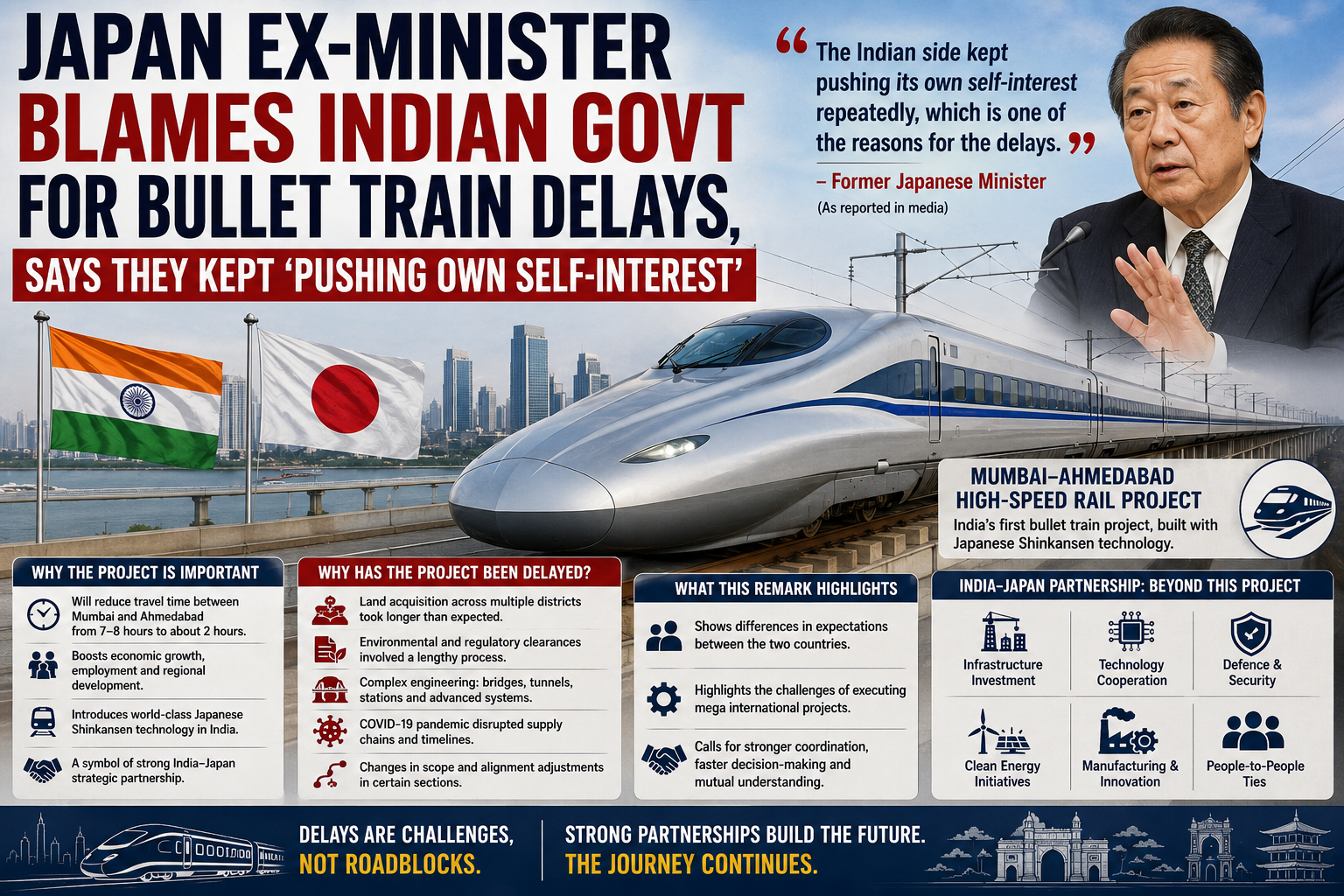
Japan’s Former Minister Raises Questions About India’s Bullet Train Delays
India’s ambitious Mumbai-Ahmedabad High-Speed Rail Project, often referred to as the bullet train project, is one of the country’s largest infrastructure initiatives and a flagship symbol of India-Japan strategic cooperation.
Recently, comments by a former Japanese minister have drawn international attention after he reportedly suggested that delays were partly caused by decisions driven by India’s own priorities.
The remarks have reopened discussion about why one of India’s most important transport projects has taken longer than originally expected.
What Did the Former Japanese Minister Say?
According to media reports, the former Japanese minister said that the Indian government repeatedly prioritized its own interests during negotiations and implementation, contributing to delays in the project.
These comments reflect his personal assessment and have attracted significant public and media attention.
What Is the Mumbai-Ahmedabad Bullet Train Project?
The project aims to introduce Japan’s renowned Shinkansen high-speed rail technology to India.
Key objectives include:
- Reducing travel time between Mumbai and Ahmedabad.
- Introducing advanced rail technology.
- Enhancing transportation infrastructure.
- Strengthening India-Japan strategic cooperation.
- Supporting long-term economic growth.
Japan has been a major financial and technical partner in the project.
Why Has the Project Been Delayed?
Multiple publicly reported factors have contributed to delays, including:
Land Acquisition
Acquiring land across multiple districts proved more time-consuming than initially anticipated.
Environmental and Regulatory Approvals
Large infrastructure projects require numerous approvals before construction can proceed.
Engineering Challenges
Building high-speed rail involves bridges, tunnels, stations, and specialized infrastructure that require extensive planning.
Pandemic Disruptions
COVID-19 affected supply chains, workforce availability, and project timelines.
These factors have been cited by officials and project authorities over the years.
Why Are the Remarks Significant?
Comments from senior former officials involved in major international partnerships often receive attention because they provide insight into how complex infrastructure negotiations are perceived.
At the same time, such remarks represent one perspective and should be understood alongside the broader context of the project’s technical, legal, and administrative challenges.
India-Japan Relations Extend Beyond One Project
The bullet train initiative is one component of a much broader partnership between India and Japan that includes:
- Infrastructure investment.
- Manufacturing.
- Technology cooperation.
- Supply chain resilience.
- Defence and maritime cooperation.
- Clean energy initiatives.
Both countries continue to describe their relationship as a strategic partnership.
Lessons for Future Mega Projects
Large infrastructure programmes often involve multiple stakeholders, long implementation timelines, and changing economic conditions.
Experts frequently highlight several areas that can improve future projects:
- Faster land acquisition processes.
- Greater coordination between agencies.
- Clear project governance.
- Timely decision-making.
- Transparent communication with stakeholders.
Frequently Asked Questions
What is India’s bullet train project?
It is the Mumbai-Ahmedabad High-Speed Rail Project, developed with Japanese technology and financial assistance.
Why has the project been delayed?
Publicly reported reasons include land acquisition, regulatory approvals, engineering complexity, and pandemic-related disruptions.
Is Japan still supporting the project?
Yes. Japan continues to support the project through financing and technical cooperation.
Conclusion
The comments by the former Japanese minister have renewed attention on the challenges of delivering one of India’s largest infrastructure projects.
While differing opinions exist regarding the reasons for delays, the project remains a significant symbol of India-Japan cooperation. Its eventual completion will be closely watched, not only for its transportation benefits but also as a test of international collaboration on large-scale infrastructure.