SHANTI Act: A Defining Moment for India’s Nuclear Energy Policy
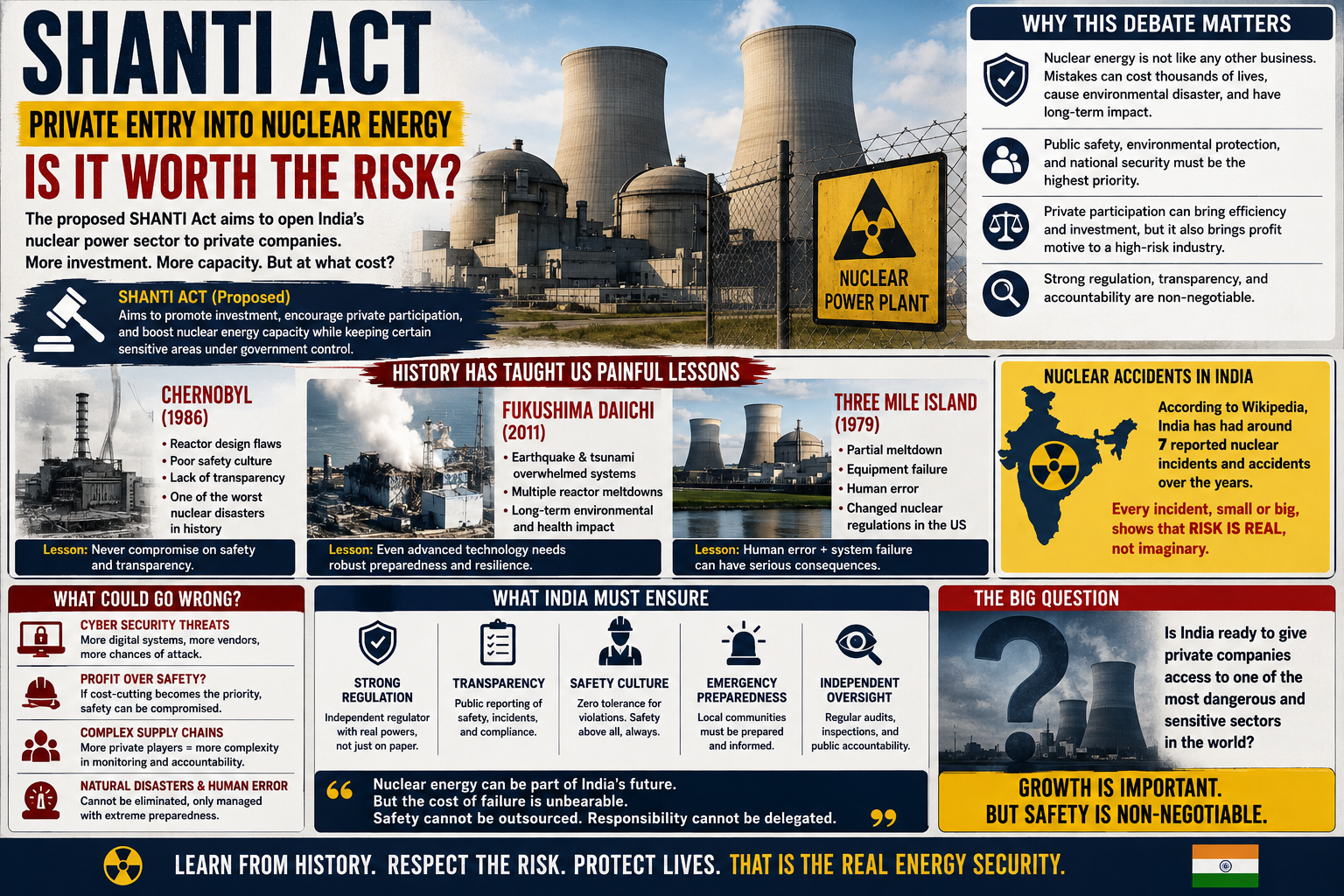
India is planning one of the biggest reforms to its nuclear energy sector in decades through the proposed SHANTI Act. Among its most discussed features is opening parts of the nuclear power sector to greater participation by private Indian companies while retaining government control over sensitive activities such as fuel reprocessing.
Supporters argue that these reforms could accelerate investment, improve electricity generation, and help India achieve its long-term clean energy goals.
Critics ask a different question:
Should one of the country’s most strategic and safety-critical sectors involve private ownership or operation?
This debate is about far more than economics. It touches on public safety, national security, regulation, and long-term accountability.
Why Nuclear Energy Is Different
Unlike many other industries, nuclear power involves handling radioactive materials, maintaining complex engineering systems, and planning for risks that can extend decades into the future.
Even though nuclear energy has produced reliable electricity in many countries, every facility must operate under extremely strict safety standards.
That is why discussions about governance and oversight receive significant public attention.
Lessons From Major Nuclear Accidents
Several major accidents have shaped public thinking about nuclear safety.
Chernobyl (1986)
The Chernobyl disaster in the former Soviet Union became one of history’s worst nuclear accidents. Investigations identified multiple contributing factors, including reactor design flaws and operational decisions.
The accident demonstrated the consequences of inadequate safety culture and poor emergency response.
Three Mile Island (1979)
The Three Mile Island accident in the United States resulted in a partial reactor meltdown. Although the public health impact was limited compared with Chernobyl, it transformed nuclear regulation and operator training.
Fukushima Daiichi (2011)
Following a massive earthquake and tsunami, multiple reactors at Fukushima experienced severe accidents.
The disaster highlighted how natural hazards, infrastructure resilience, and emergency preparedness all influence nuclear safety.
What Do These Events Teach?
Although each accident occurred under different circumstances, they reinforced several common lessons:
- Safety systems must be continuously upgraded.
- Independent regulation is essential.
- Transparency builds public trust.
- Emergency preparedness cannot be compromised.
- Strong oversight matters regardless of who owns or operates a facility.
India’s Nuclear Safety Record
India has operated nuclear facilities for decades.
Publicly available records list several nuclear-related incidents over the years. These incidents vary significantly in severity, ranging from operational issues to safety-related events. They should not all be interpreted as disasters, but they illustrate why continuous monitoring, maintenance, and regulatory oversight remain important.
Every reported incident provides an opportunity to improve procedures and strengthen safety systems.
The SHANTI Act Debate
The proposed SHANTI Act seeks to modernize India’s nuclear framework by:
- Encouraging greater investment.
- Strengthening the regulatory framework.
- Reforming aspects of nuclear liability.
- Expanding generating capacity.
- Retaining government control over certain sensitive nuclear activities.
Supporters believe these changes could help India meet growing electricity demand while reducing dependence on fossil fuels.
Critics argue that expanding participation should be accompanied by robust safeguards, transparent oversight, and clear accountability.
Questions the Public Is Asking
As India considers reforms, several questions naturally arise:
How will cybersecurity standards be enforced?
How will contractors and suppliers be audited?
What independent oversight mechanisms will exist?
How will emergency preparedness be strengthened?
How will the public be informed about safety and compliance?
These are important policy questions regardless of the ownership model.
Balancing Growth and Safety
India’s growing economy requires reliable, low-carbon sources of electricity, and nuclear power is one option that can contribute to that goal.
At the same time, expanding the sector requires public confidence. That confidence depends on transparent regulation, strong institutions, rigorous inspections, and continuous investment in safety and cybersecurity.
Frequently Asked Questions
What is the SHANTI Act?
The SHANTI Act is a proposed reform of India’s nuclear energy framework that includes provisions for greater private-sector participation alongside continued government oversight of sensitive nuclear activities.
Does private participation automatically make nuclear plants less safe?
No. Safety depends on the effectiveness of regulation, engineering standards, operational culture, and independent oversight rather than ownership alone.
Why are Chernobyl, Three Mile Island, and Fukushima often discussed?
These events are studied worldwide because they influenced modern nuclear safety standards, emergency planning, and regulatory practices.
Conclusion
The debate surrounding the SHANTI Act reflects a broader question about how India should balance energy security, economic growth, and public safety.
Whatever policy path is ultimately chosen, long-term success will depend on maintaining rigorous safety standards, independent regulation, transparent governance, and continuous public accountability.
For a sector as strategically important as nuclear energy, public confidence is built not only through ambitious goals but also through demonstrable commitment to safety and oversight.