When Even Long-Time Supporters Raise Economic Questions, India Should Pay Attention
For years, the Narendra Modi government has built its political narrative around two major claims:
- Strong leadership
- Strong economic performance
Election after election, the Bharatiya Janata Party (BJP) has continued to demonstrate remarkable electoral strength across large parts of India.
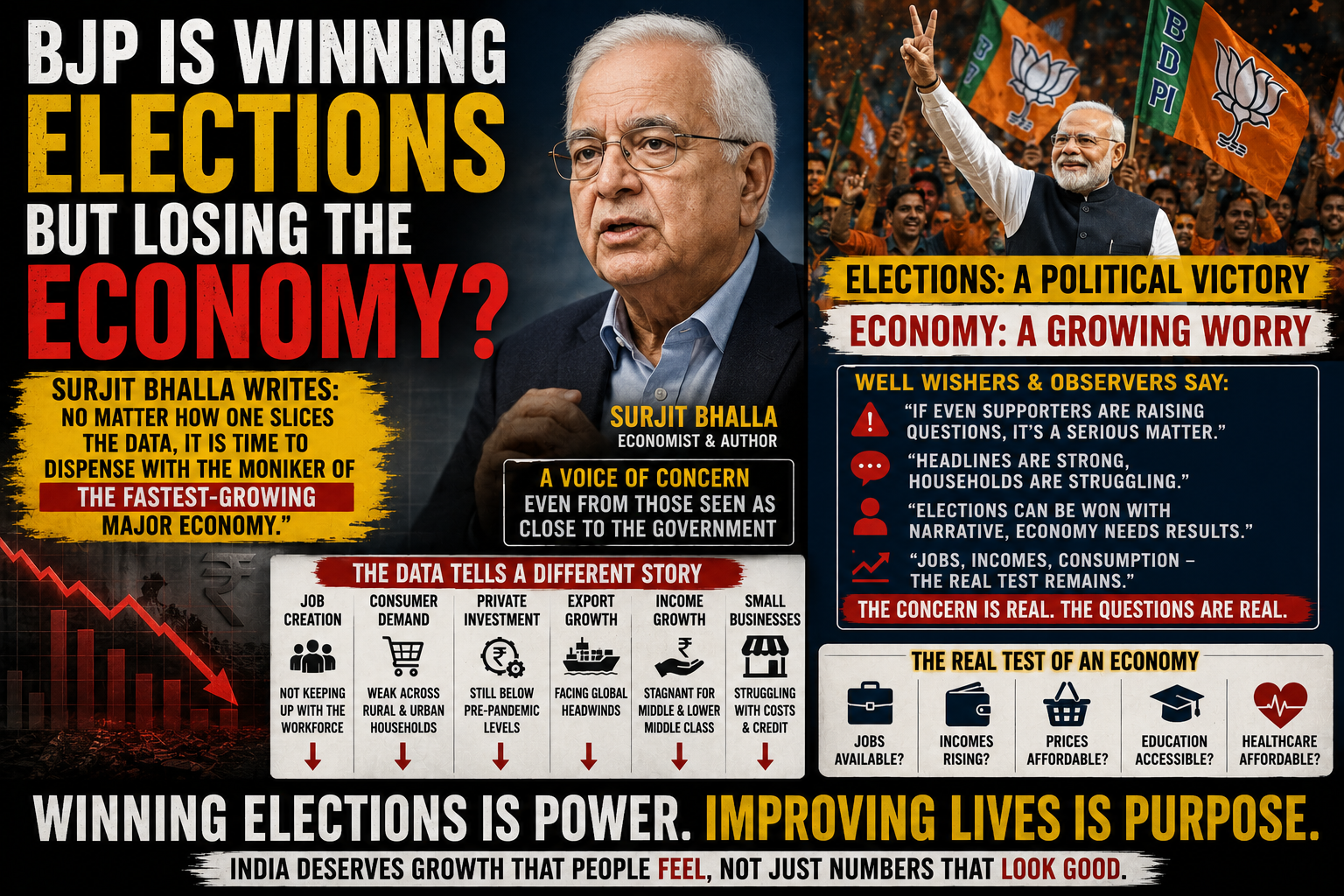
But a recent argument made by economist Surjit Bhalla has sparked an uncomfortable debate.
His message was blunt:
The BJP may be winning elections, but it could be losing the economy.
Coming from a critic, such a statement would hardly surprise anyone.
Coming from Surjit Bhalla—a figure often viewed by many observers as sympathetic to the government’s economic direction in the past—it carries much greater weight.
Why Surjit Bhalla’s Comments Matter
Economic criticism from opposition politicians is routine.
Economic criticism from economists perceived to be broadly supportive of government policies is different.
That is why Bhalla’s observations have attracted attention.
Many political observers have long viewed Surjit Bhalla as someone whose economic views often aligned with key government narratives.
When someone from that camp begins questioning economic performance, it naturally raises concerns.
The question many Indians are now asking is:
If even supporters are worried, how serious is the situation?
The Fastest-Growing Major Economy Claim
One of the most repeated claims in recent years has been that India is the world’s fastest-growing major economy.
Technically, certain GDP growth numbers have supported that narrative.
However, Bhalla’s argument challenges whether headline GDP growth alone tells the full story.
Because ordinary citizens do not live inside GDP charts.
They live inside the real economy.
What Citizens Actually Feel
Across many parts of the country, people are asking questions about:
- Job opportunities
- Wage growth
- Household savings
- Consumer spending
- Inflation pressures
- Small business conditions
While macroeconomic indicators may appear strong, many citizens argue that the benefits are not reaching them equally.
The result is a growing gap between economic headlines and economic reality.
Elections and the Economy Are Not the Same Thing
One of the biggest misconceptions in politics is that election victories automatically prove economic success.
They do not.
Governments can win elections for many reasons:
- Leadership image
- Welfare schemes
- Political organization
- National security issues
- Opposition weakness
Economic performance is only one factor among many.
History across the world shows governments can win elections even during periods of economic stress.
That is why Bhalla’s warning deserves attention.
The Employment Question Refuses to Disappear
Perhaps the most persistent economic concern remains employment.
India produces millions of graduates and job seekers every year.
Yet discussions about:
- Unemployment
- Underemployment
- Contract jobs
- Informal sector work
continue dominating public discourse.
Young Indians are increasingly asking a simple question:
Where are the high-quality jobs?
Economic growth without widespread employment creation eventually becomes politically and socially challenging.
Consumption Tells a Different Story
Economists often look beyond GDP numbers.
One important indicator is consumer spending.
When households feel confident, they spend more.
When families become uncertain about the future, spending slows.
Several economists have argued that weak consumption among lower and middle-income groups remains an area of concern.
If consumers are struggling, economic growth can become less sustainable over time.
Is Growth Becoming Uneven?
Another criticism frequently raised is that economic gains are becoming concentrated.
India has created:
- Billion-dollar companies
- Global technology firms
- Record stock market valuations
At the same time, many households continue struggling with:
- Rising living costs
- Housing affordability
- Healthcare expenses
- Educational costs
This creates a perception that growth is occurring, but not necessarily benefiting everyone equally.
Why This Warning Is Politically Significant
The political importance of Bhalla’s comments lies not in the criticism itself.
It lies in the source.
When criticism comes from traditional opponents, governments can dismiss it as politics.
When concerns emerge from economists who have previously been viewed as broadly supportive, ignoring those concerns becomes more difficult.
That is why many observers see this as a serious moment for economic reflection.
India’s Economy Still Has Enormous Strengths
To be fair, India’s economy also has major advantages:
- Strong demographic profile
- Expanding digital economy
- Growing infrastructure investment
- Rising manufacturing ambitions
- Global strategic importance
The issue is not whether India has strengths.
The issue is whether those strengths are translating into broad-based prosperity.
The Real Test of Economic Success
The ultimate measure of economic success is not:
- Election victories
- Political slogans
- GDP headlines
The ultimate test is whether ordinary citizens feel their lives improving.
Can they find jobs?
Can they save money?
Can they afford education?
Can they build a better future?
Those questions matter more than any quarterly growth figure.
Conclusion
The BJP’s electoral success is undeniable.
But Surjit Bhalla’s warning raises an uncomfortable possibility:
Winning elections and winning the economy are not necessarily the same thing.
If economic concerns are now being voiced by figures who many perceive as broadly aligned with the government’s economic thinking, policymakers would be wise to pay attention.
Because eventually, every economy faces the same test.
Not how it looks on paper.
But how it feels to the people living in it.
And that is a test no government can afford to ignore.