Who Is Responsible for the Disappearance of Coal Worth Hundreds of Crores?
When a common citizen loses a mobile phone, the police can track it.
When a taxpayer misses a filing deadline, notices arrive quickly.
When a small business makes an accounting error, regulators demand explanations.
But when reports emerge that 40 lakh tonnes of coal have allegedly disappeared from SCCL, suddenly the country is asked to wait for inquiries, committees, reports, and explanations.
The question many citizens are now asking is simple:
Is this a case of coal going missing, or is “missing” just another word being used to avoid saying “scam”?
The Controversy That Has Sparked National Attention
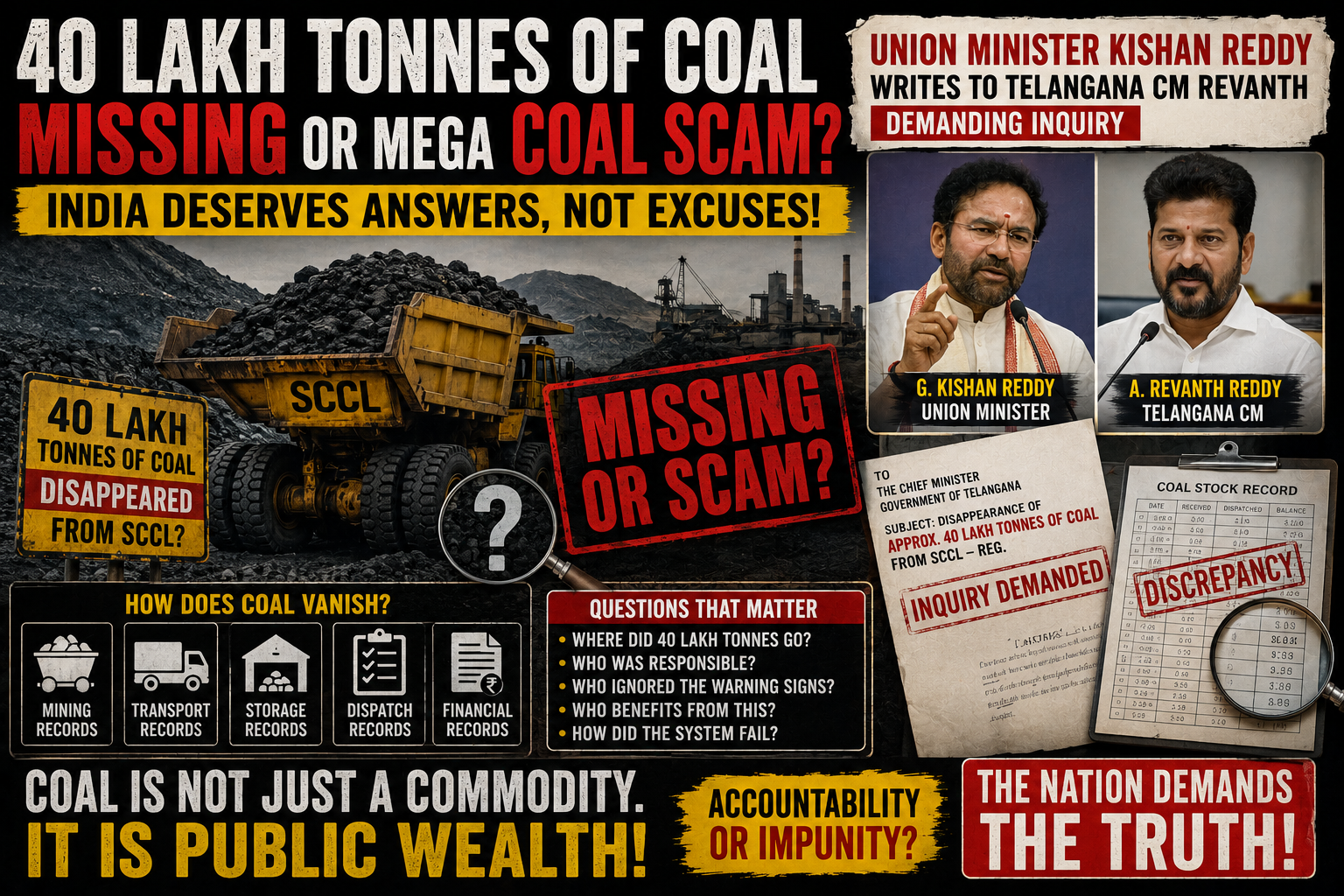
Union Minister G. Kishan Reddy recently wrote to Telangana Chief Minister A. Revanth Reddy, demanding an investigation into reports concerning the disappearance of approximately 40 lakh tonnes of coal from Singareni Collieries Company Limited (SCCL).
If the figures being discussed are accurate, this is not a minor accounting discrepancy.
This is not a misplaced file.
This is not an administrative typo.
This involves a massive quantity of a critical national resource.
And naturally, citizens want answers.
How Does 40 Lakh Tonnes of Coal Simply Vanish?
That is the question at the center of the controversy.
Coal mining operations involve:
- Extraction records
- Transportation records
- Weighbridge data
- Storage records
- Dispatch records
- Financial accounting systems
In theory, every tonne should leave a paper trail.
So if millions of tonnes are allegedly unaccounted for, people are asking:
Where did it go?
Who signed off on the records?
Who was responsible for monitoring inventory?
Why was the discrepancy not detected earlier?
Who benefits if coal disappears?
These are not political questions.
These are accountability questions.
Missing Coal or Missing Accountability?
The larger concern extends beyond the coal itself.
Citizens have seen a familiar pattern before:
- Allegation emerges.
- Political blame game begins.
- Investigation is announced.
- Public attention moves elsewhere.
- Few people are held accountable.
The fear among many observers is that this case could follow the same script.
If millions of tonnes of coal can allegedly disappear without immediate answers, what does that say about oversight mechanisms?
Coal Is Not Just Another Commodity
Coal remains one of India’s most important energy resources.
It powers industries.
It supports electricity generation.
It affects economic growth.
It impacts public finances.
Every tonne represents public wealth.
That is why allegations involving such enormous quantities naturally trigger public outrage.
When national resources appear unaccounted for, citizens have every right to demand transparency.
The Public Wants Names, Not Excuses
One reason stories like this generate anger is because people are tired of vague explanations.
The public does not want:
- Technical jargon
- Political speeches
- Press conference theatrics
The public wants facts.
If coal is missing:
- Who was responsible?
- Who failed in their duty?
- Who approved the records?
- Who ignored warning signs?
Accountability should not stop at junior employees if systemic failures occurred.
The Political Battle Is Already Underway
As expected, political parties are already using the issue to attack one another.
Opposition leaders blame the government.
Government supporters blame previous administrations.
But ordinary citizens are increasingly asking a different question:
Why does accountability always seem to disappear faster than the resources themselves?
The focus should not be on political point-scoring.
The focus should be on finding the truth.
What a Transparent Investigation Must Include
If public trust is to be maintained, any inquiry should examine:
Inventory Records
A complete audit of extraction, transportation, storage, and dispatch records.
Financial Transactions
Whether any unusual financial patterns accompanied the discrepancy.
Administrative Oversight
Who was responsible for monitoring coal inventories.
Internal Reporting
Whether concerns were raised internally and ignored.
Independent Review
An investigation that is seen as credible across political lines.
Without transparency, suspicion will only grow.
Why This Story Matters Beyond Telangana
This is not merely a state-level controversy.
The issue raises broader concerns about:
- Public sector accountability
- Resource management
- Corporate governance
- Government oversight
- Public trust
If citizens lose confidence in how national resources are managed, the damage extends far beyond one company.
The Bigger Question India Must Ask
Perhaps the most important question is not whether coal is missing.
The bigger question is:
How could such a large discrepancy allegedly occur without immediate detection?
Modern industries operate with digital systems, audits, logistics tracking, and financial controls.
If millions of tonnes can become unaccounted for, citizens deserve a detailed explanation.
Conclusion
Forty lakh tonnes is not a rounding error.
It is not a paperwork issue.
It is not a minor discrepancy.
If the allegations are substantiated, this would represent one of the most serious accountability questions facing a major public-sector enterprise.
The country deserves more than political arguments.
The country deserves facts.
And until those facts emerge, one question will continue to dominate public discussion: